 ddp26
ddp26A forecast of the fair market value of SpaceX's businesses

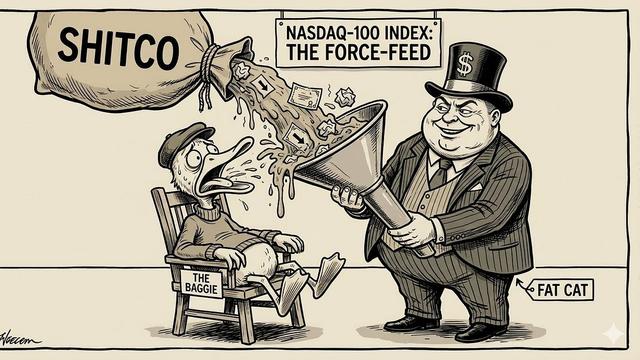
An passive investors are going to get hosed by this thanks to NASDAQ cooking the rules to favor Elon and his band of misfits.
No longer will there be a year of price discovery for index funds, 15 days. Meaning index funds have to buy it at the peak of the hype cycle. Will be a huge wealth transfer from mom and pop retirement accounts to the ultra wealthy.
Legally, any fund that tracks the NASDAQ 100 must follow the rules set by NASDAQ, so you'd want something that is neither a total market index, nor tracks the NASDAQ. Something like an S&P500 index would work
What law prevents someone from choosing to buy stocks from the NASDAQ 100 however they want for a fund?
You can make a mutual fund or ETF with any stocks you want, you just can't call it a NASDAQ 100 fund if you're not tracking the NASDAQ 100 index.
Is that really true? It doesn’t sound likely to me. Then again I’m often surprised by this stuff.
In order to call it a NASDAQ 100 Tracking Fund you need to pay the NASDAQ a licensing fee (same with S&P500, Wilshire 5000, etc.). The contract you have with NASDAQ will determine exactly how much freedom you have to change rules and still call it a NASDAQ 100 fund. I've never seen a licensing agreement, don't know anything about how they would typically read.
There is also the concept of "Index Tracking Error". No fund can perfectly mimic the index, and that is expected and understood, but the goal is generally to have the tracking error <0.1%- 1% would be a bad track. And so an index fund could take the risk that they will have a tracking error and delay picking up SpaceX even after it joins the official index, but then if it goes up they will look worse relative to their real competitors, the other NASDAQ 100 tracking index funds. If SpaceX goes down, of course, they will have positive tracking error, but I'm not sure how much potential investors would value that. SpaceX would be something like 4% of the NASDAQ 100 at it's announced expected market cap, so a 10% movement by SpaceX would be enough on its own to get you into the notable tracking error range if you didn't have any exposure to it.
It's an interesting question whether you could legally track the NASDAQ 100 without calling it that, or something very similar, e.g. "NASDAQ 100, but with a one year delay for new listings".
But assuming it is: How would you even call it, and how would you describe your methodology in the prospectus? "Tech 100 (compare with e.g. NASDAQ)"?
Actively managed funds like that charge around 0.5% to 1% a year. E.g. [0] The most prominent Nasdaq ETF, QQQ, charges 0.2% [1]
Spacex will be around 4.5% of the index [2].
If you believe the thesis of the article that Spacex is about 30% overvalued, and if the only advantage your fund manager has over the rest of the market is that they will avoid Spacex, they will save you 1% of your money over the lifetime of your investment. Assuming you're saving for retirement in 30 years time, the fees will cost you 15% or more.
Maybe your fund manager finds a Spacex-level mispricing every two years. In that case, they're worth the fees. Some people will tell you nobody can beat the market. My employer among others believes very strongly in the idea that some people do make better investment decisions than average. What is certainly true is that not everyone does.
[0] https://helpcenter.ark-funds.com/what-is-the-fee-structure-e...
[1] https://www.invesco.com/qqq-etf/en/home.html
[2] https://www.fool.com/investing/2026/04/01/how-the-spacex-cou...
> the idea that some people do make better investment decisions than average.
Of course some do. After all, that's what makes an "average".
Some people are taller than average, too!
They mean consistently make better decisions than a baseline index investor in a way that isn't luck.
Someone can win at roulette and make more money than the average player over some measurement period, but nobody can be good at roulette (when properly implemented and stuff). Stocks are somewhat possible to be good at but results are mostly random and the fee you'd pay is usually way too much.
>that isn't float adjusted?
AFAIK the problem is that they're lobbying the nasdaq 100 index provider to add a 5x multiplier for free float for spacex. Otherwise it would be far less controversial.
> Legally, any fund that tracks the NASDAQ 100 must follow the rules set by NASDAQ
No? Contractually, maybe. But legally you can do whatever you want with index constructions.