What practical use cases for #WebAssembly can you imagine?

Tell about it in this thread.

I use WASM to integrate software solutions across different stacks. For example, I compile a Twofish cipher implementation from C to WASM and use it in the browser. It’s cheap and prevents reinventing the wheel.

However, WASM has limitations: no threads, no hardware acceleration, etc.

What other real-world use cases can you imagine?
#wasm #webassembly #askfedi #opensource #programming

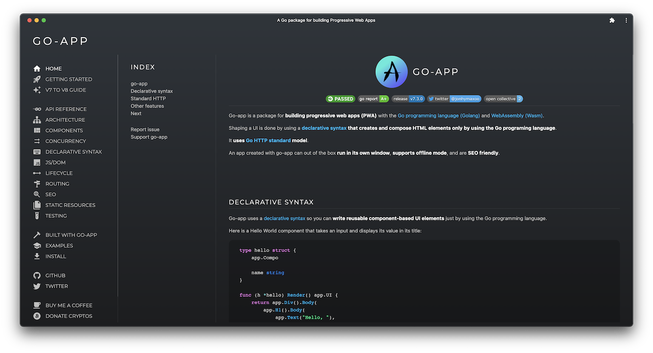
@vitonsky The main use case is avoiding JS. Mixing languages is more complicated than not mixing them. I do web UIs fully in #golang using a react-like framework https://go-app.dev
A Go package for building Progressive Web Apps

A package for building progressive web apps (PWA) with the Go programming language (Golang) and WebAssembly (Wasm). It uses a declarative syntax that allows creating and dealing with HTML elements only by using Go, and without writing any HTML markup.

@pancsta i've just clicked your link.

I waited a seconds for a loading spinner. Then i closed that page.

That is unacceptable bad UX, because the Time to Useful Content is too high. The proper way is to pre-render web pages.

That is common problem of any projects who trying to use WASM instead of JS. The UI works bad and does not competitive to any site built via HTML & JS.

There are blog post about this problem

https://hacks.mozilla.org/2026/02/making-webassembly-a-first-class-language-on-the-web/

Why is WebAssembly a second-class language on the web? – Mozilla Hacks - the Web developer blog

This post is an expanded version of a presentation I gave at the recent WebAssembly CG meeting in Munich. WebAssembly has come a long way since its first release in 2017. The 1.0 version of WebAssembly was already a great fit for low-level languages like C and C++, and immediately enabled many new kinds of applications to efficiently target the web.

Mozilla Hacks – the Web developer blog

@vitonsky not a blocker for actual apps - in iOS, you also wait for installation. Websites, on the other hand, dont need JS (client side code) - see datastar and htmx. #Go is obese, but other platforms produce smaller #WASM binaries.

The point stands - avoid #JS, be happy. The BE/FE contract should move from APIs to markup structure.

btw, go-app supports SSR for SEO, and almost compiles with #TinyGo

@pancsta this design simply uncompetitive in the web.

I mean you can build everything you want as you wish, it just won't be demand.

Nobody needed in a web site that does not work as expected.

I interesting in practical use cases, not a potential scenarious in far future. Maybe 20 years later we actually will use WebAssembly as first class citizen to build sites. It would be nice future.

Interesting to know what problems & needs the WASM can solve right now or in near future.