
#Python makes such great use of that horizontal real estate. /s
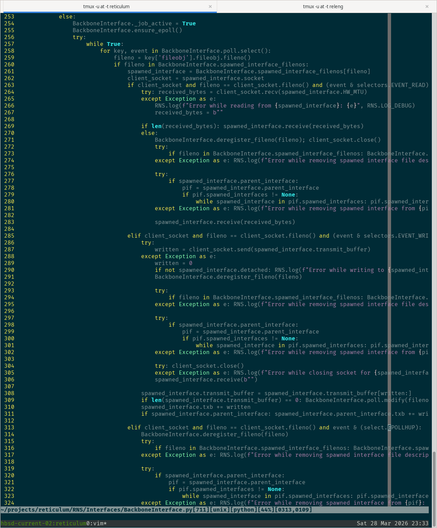
@lattera Those are exceptionally long lines and high levels of indentation, compared to most #Python code I see. (Or honestly, compared to most mainstream languages... Java is the only one that comes to mind where the code tends to look a bit more like that.)
@diazona @lattera yeah part of the aesthetic design of the Python programming language, with mandatory significant whitespace, is for you to look at code like that and immediately think "oh no what have I done". ideally before it gets to this point

@glyph @lattera Indeed. And in fact, now that I take a closer look at that code, there are some *really* inadvisable formatting choices in there. Including cases where the author was actively fighting against the way #Python normally encourages one to write code.

Not that I think this is what actually happened, but if someone specifically decided to create an example of how you can write code that's "properly indented" but still badly formatted and organized, I could see them coming up with something that looks like this.

@diazona @lattera

Agreed. That level of indentation is an almost sure indicator of code that needs to be refactored, due to bad design.

And as you say, it's true regardless of the language. People were writing badly structured code with excessive levels of indentation before we were born, and will be long after we're gone.
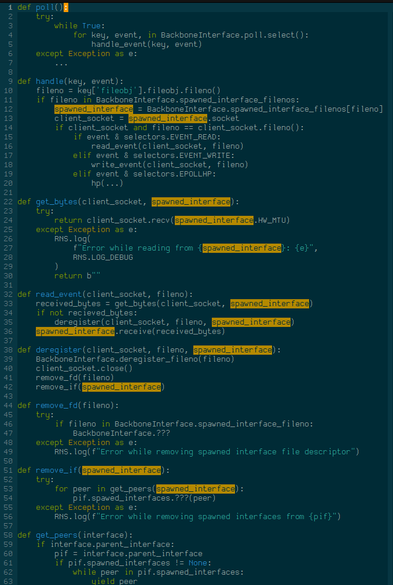

hahahahahaha, that would annoy me to no end.
@lattera #hottake Speaking as a person from the late 1900s and pioneer of early computing I do not understand the obsession with having 80CPL. You have a 4k screen for goodness sakes! Unless you are the copyparty guy I do not get why you would not want to use it. Even when we had 80 or 132 I would always choose longer on my VT whatev. Maybe optimal scan has changed in the smartphone era. 80 was a hangover of the old punchcards. I feel that code is intentionally bad including the weird inlining.
@nf3xn There is a reason newspapers have columns. It /is/ easier to read. @lattera
@hakona @lattera I guess you are welcome to your wrong opinion. Newspapers are hard to read. They have tiny print in narrow columns because of how they were set by hand. No true coder would want 50CPL. The optimal scan line length for programmers who have to read quickly is at or above 80CPL numerous typography studies suggest. I can scan a 132CPL line fine but I suppose if you have only ever read the 80CPL fascism that would be difficult. And don't get me started on 'variable name or prose'
@lattera I don't know about that. This is the code trying to tell you something, right? If you don't like huge indents, then don't use such huge cyclomatic complexity. Even with the most hurried and superficial refactor it fits just fine in 80 character lines, and in reality I'd make better use of Pythonic idioms and features to simplify and improve readability way more than this...
@lattera Like, some of these functions feel like they might benefit from being methods on classes, which eliminates many of the passed around variables. A lot of the cleanup actions should probably be happening in context managers. The exceptions could probably be changed from a "catch, log and carry on" style into a "raise and forget" style. All of which, and more, would render the core, inner part of the code more succinct and readable.