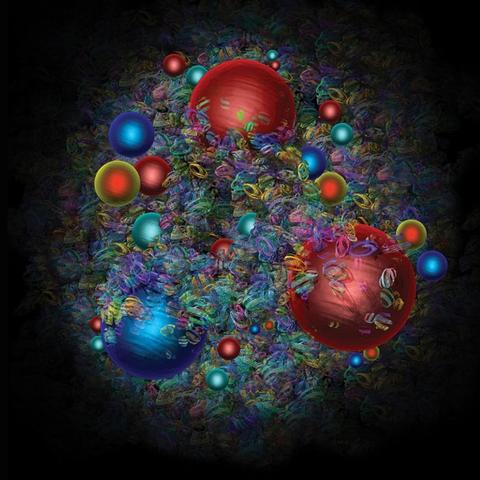
The Higgs boson gives elementary particles their mass, but 98% of the visible mass in the Universe (not dark matter) comes from a less famous mechanism: chiral symmetry breaking. This is why protons and neutrons are so much heavier than their quarks!

Briefly, protons and neutrons act like bags full of a soup of virtual quark-antiquark pairs, which give them most of their mass. This soup, called a 'quark condensate', breaks a certain symmetry that exists outside the bag: 'chiral symmetry', where you change the phase of the clockwise and counterclockwise rotating quarks separately. In the quark condensate, the clockwise spinning virtual quarks are entangled with counterclockwise spinning virtual antiquarks.

https://en.wikipedia.org/wiki/Chiral_symmetry_breaking

Chiral symmetry breaking - Wikipedia

@johncarlosbaez I know this is google-able, but I want to ask someone who knows more than me- what about bonding energy? I thought bonding energy accounted for a large amount of mass.

@cpkimber - if something has binding energy, it has *less* energy and thus *less* mass than it would otherwise have, because binding energy is the energy it would take to pull it apart. For example, when a hydrogen bomb goes off, the hydrogen nuclei fuse into something that has less energy and thus less mass, releasing a lot energy in the process.

https://en.wikipedia.org/wiki/Binding_energy

Binding energy - Wikipedia

@johncarlosbaez I knew that some time ago, but now feel like a kid for asking.
@cpkimber - no prob! I love questions about physics, and that was a good question.
@johncarlosbaez @cpkimber It has less energy than when it is separated. But does it have less energy compared to if you turned off the force? Then to zeroth order I'd think it depends on the exponent?
@Quantensalat @cpkimber - it's a subtle counterfactual question, but I'd say a bound system has less energy than if you turned off the force that binds it.

@johncarlosbaez @cpkimber

If it's e.g. an r^2 potential then the virial theorem would suggest that all contributions are positive. In that case wouldn't I have an attractive potential that lifts the energy of the system above the free case?

(Adiabatically switching off might yield different results, i.d.k. if the virial theorem then keeps holding in each instant cooling off the system. I should find out....)

@cpkimber I find it helpful to think of the binding energy you're referring to (i.e. the strong force) as an enhancement of the fundamental masses that were already present due to the Higgs interaction @johncarlosbaez is describing. I.e. you need to "prime the pump" with some starter mass before you can work your way up to e.g. the proton mass in this way.

I was not a particle guy in my past life, so I don't really know if you can support that intuition with formalism (or how), but since the QCD couplings that include a massive particle *do* depend on that mass, I can squint and tell myself it's "good enough".

@SnoopJ @cpkimber - the Higgs boson gives the quarks masses, and the fact that quarks have different nonzero masses breaks chiral symmetry, so yes there's a real sense in which the Higgs "primes the pump" for the generation of the proton's mass!

However, I want to again emphasize that the proton's mass is not "binding energy": binding energy always contributes *negatively* to mass. All the stuff I said about how chiral symmetry breaking gives mass was not just a ridiculously complicated euphemism for "binding energy". Something else is going on here:

"Briefly, protons and neutrons act like bags full of a soup of virtual quark-antiquark pairs, which give them most of their mass. This soup, called a 'quark condensate', breaks a certain symmetry that exists outside the bag: 'chiral symmetry', where you change the phase of the clockwise and counterclockwise rotating quarks separately. In the quark condensate, the clockwise spinning virtual quarks are entangled with counterclockwise spinning virtual antiquarks."

@johncarlosbaez @cpkimber ah yes, thank you for the correction. I am not aware of a "popsci" term that fits in the place of "binding energy" here but which does not confuse the strong interaction's contribution to mass with the other phenomenon (but there should be one if there isn't!)

@SnoopJ @cpkimber - the good term, which is not yet popsci, is "condensate". It should remind you of how water vapor condenses into mist when it gets cold enough. The proton and neutron are bags containing 3 quarks, and gluons, but also a condensate of quark-antiquark pairs, and this "mist" contributes most of the mass.

There are other condensates in nature, one being the Higgs field itself, but also others that show up in various materials.

@johncarlosbaez @cpkimber it reminds me of Bose-Einstein condensates, but I guess that's not exactly a coincidence ;)
@SnoopJ @cpkimber - right, duh, I should have mentioned that example.
@johncarlosbaez @cpkimber as an aside, I think it's also a fun collective noun for a group of physicists!
@johncarlosbaez what does the word 'virtual' mean here ? I don't understand 'virtual particle'?

@subjectsphinx - that's a long story. Virtual particles are a concept important in quantum field theory, and you have to be a real expert on virtual particles before you can understand how they form a condensate!

Let me see how Wikipedia tries to introduce the concept:

"A virtual particle is a theoretical transient particle that exhibits some of the characteristics of an ordinary particle, while having its existence limited by the uncertainty principle, which allows the virtual particles to spontaneously emerge from vacuum at short time and space ranges. The concept of virtual particles arises in the perturbation theory of quantum field theory (QFT) where interactions between ordinary particles are described in terms of exchanges of virtual particles. A process involving virtual particles can be described by a schematic representation known as a Feynman diagram, in which virtual particles are represented by internal lines.

Virtual particles do not necessarily carry the same mass as the corresponding ordinary particle, although they always conserve energy and momentum. The closer its characteristics come to those of ordinary particles, the longer the virtual particle exists. They are important in the physics of many processes, including particle scattering and Casimir forces. In quantum field theory, forces—such as the electromagnetic repulsion or attraction between two charges—can be thought of as resulting from the exchange of virtual photons between the charges. Virtual photons are the exchange particles for the electromagnetic interaction."

https://en.wikipedia.org/wiki/Virtual_particle

Virtual particle - Wikipedia

@johncarlosbaez the word "virtual" is what i don't understand. in what sense are they "virtual"? what does "virtual" even mean? from that description it sounds like it's just another piece of the same kind in an explanatory framework, not like it's distinguished by some particular quality of virtuality ? if virtual particles are observable, the "virtual" ceases to make sense, so is it an unobservable particle? but then "particle" is also unclear, as it just means part of a whole. but then are we just looking for a noun for every verb? for instance these pieces are distinguished and defined by what they do, not what they are. they are what they do... so ... are we having to introduce virtual particle because we introduced stuff before stuff doing things? whereas perhaps somehow action itself can give rise to stuff? for instance, is a quark just stuff without action doing quark? is it the subject-predicate form of sentences that makes us think each predicate speaks of a subject? well, that would make sense, but it would call into question not just virtual particle, but particle as well; and particle is just part of whole... but then i get confused again because from a bigger system to get a smaller system i take a partial trace which only fuzzily determines the sub system, so that really there are no sub systems precisely determined, only vaguely cut out... and then why are particles distinguished here? it seems to logically not hold together very well.
@johncarlosbaez it doesn't logically hold together in that i can't cut out a part of the whole definitely, and yet i talk of particles, and then go further and call them virtual... maybe the whole way of looking at it is making it more confusing than it has to be?
@johncarlosbaez the whole atomistic picture seems to not make sense anymore? it depicts this bottom up build up from component pieces, but the framework denies that the pieces can exist definitely, because any subsystem is fuzzily determined and not definite, yet claims definite relations between component pieces? well... and i think this relates to the cognizing subject who abstracted away themselves, because the subject says "I think", and so starts with the "I" that thinks and theorizes, and that then bleeds into the whole framework because that one "I" can be recast as "electron" or "particle" or "virtual particle". the form of our thinking ties into our physics and vice versa, each giving the other legitimacy... and then institutions, grants, journals, research papers, conferences, magazines, a whole industry, that then plugs into business, politics, and entertainment, which also affirms this subject-predicate form of thinking reinforces it, and yet... it might all be based on an error. Neumann talked about cascading observations where the final observer is the ego. Neumann said hidden variable theories are impossible, but implicitly assumed locality. Well, it seems the locality, the particality, and the subject-predicate dogma are all linked.
@johncarlosbaez oh, it seems like there's a fundamentally outdated concept coming from aristotelian philosophy of substance, so that we think that we can make tables of elements and memorize those and learn something, whereas the elements are labels for processes; and if we just got the processes clear, like for instance symmetry and where it's relevant, then the whole dynamics becomes clear, whereas when we remember quarks and bla bla bla we get into memorizing names and their connections. the body can feel and mirror within itself the whole dynamics of symmetry breaking better than just a loose picture of blobs and sticks between them, which is utterly dead and lifeless...
@subjectsphinx "virtual" is just a word physicists slap on it for shorthand, don't read to much into the choice. They are just factors in the terms of the perturbation expansion that look like particle propagators, but their momentum isn't "on the mass shell" ie their momentum doesn't satisfy the energy-momentum relationship of relativity.
@void_turtle thank you. i need to learn so much to understand this better.do you find the philosophy behind it has any value to you? i find it both relevant and interesting, and don't even all it "philosophy" but call it just trying to think about what we're talking about. i know people tend to think the "shut up and calculate" stuff makes more sensee.
@subjectsphinx I don't like the maxim of "shut up and calculate" at all. Thinking about the meaning of the math is really important imo

@subjectsphinx @johncarlosbaez

My impression is the "virtualness" is that they don't exist long enough to be directly observable, their existence can predict observable consequences for other... observable particles, but you can't see them themselves.

But I'm NOT a particle physicist!

@dlakelan i have a feeling there is a deeper significance, but i don't know what it is.
@johncarlosbaez Something just occurred to me. I've seen that description of the proton (and neutron, too, I guess) as three quarks, plus a lot of gluons, and virtual particles popping in and out of existence. The cloud of virtual particles is mostly confined to the diameter of the proton. What is it about this environment (the “bag of soup” 😊) that causes a higher number of virtual particles to appear, compared to a volume of space that *isn’t* a proton (i.e. "empty” space)?

@johncarlosbaez As a mathematician I have always imagined that I would understand the universe if someone described the Standard Model as a really fancy mathematical something-or-other, without saying things like "a neutron is a soup of quarks and anti-quarks" – these just distract from the math.

I only got a snippet of such a story from a physicist once, and I loved it. I asked what a particle really was, mathematically, and he said something like "eigenvector of a linear approximation to some-field-thing". I may be misremembering the "approximation part", but the important thing was that it was a straight mathematical answer. I felt comforted.

Where could I find out more of this? Is the Standard Model a huge vector field on a vector space, or on a manifold with Riemann metric? Can someone write down the type of the Standard Model in in type theory?

@andrejbauer @johncarlosbaez Funny when I asked ChatGPT, the first reference it gave was John's book.

@andrejbauer - I could give you a fairly formal description of the Standard Model, but it would be

1) long
2) fundamentally nonrigorous, in the sense that nobody knows that all the numbers we want to compute from the Standard Model are uniquely determined from any particular axiomatic framework
3) one of several choices: there are different frameworks, each with their own advantages and flaws, and any particle physicist knows more than one.

So, for example, I could write a formula for the Standard Model involves an integral over an infinite-dimensional manifold... such that the measure being used in this formula is not known to exist, and probably doesn't really exist. And even if I showed you this, you'd have no idea what this had to do with anything - without further study.

We must instead accept that right now, the Standard Model is a network of formalisms, where the holes in the mathematics - the chunks of math we don't understand yet - are filled in by physics intuition.

Thus, it's largely pointless to imagine that the Standard Model is some mathematical structure we could understand without actually learning physics. Physics is very different from math. It takes years of study, and most of this is not learning math.

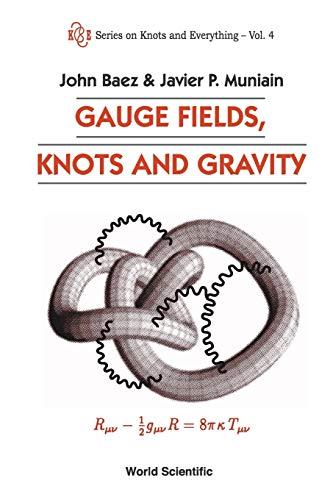
There are, however, large chunks of beautiful and formalizable math connected to the Standard Model, which one needs to understand to understand the Standard Model. I wrote a book about some of those - but not nearly all. My book doesn't try to explain the Standard Model, just some prerequisites.

@johncarlosbaez
> Physics is very different from math.  It involves understanding at a gut level what particles and fields tend to do in different situations.

Right, but can't the language of math help those who understand it build an intuition for a physical theory? Not as a means to get a rigorous, complete picture, just as a means of communication.

@andrejbauer

@glocq I think this is indeed the case, but only in a somewhat limited sense. Actually, this was what I was often doing back when I was studying physics: Trying to approach the physics by the underlying mathematical structures describing it. And it often did help me to develop a better understanding of the physics, but only insofar as it sharpens the language used to describe it, I guess. Nowadays, I think this approach was one of the reasons (there are probably many more) why I never developed a good physical intuition - because, in fact, physics *is* very different from math, and in particular, it is much more than the mathematics used to describe it.

(Which is in no way meant to downplay math, not at all. In fact, my approach probably signals that I was always at least as interested in mathematics as in physics. I guess for a physicist, my thinking is too mathematical, and for a mathematician, my thinking is too physical. In the end, I became neither a good physicist nor a good mathematician ;-))

By the way, I can only recommend "Gauge Fields, Knots and Gravity" to everyone interested in these matters - I still have it on my bookshelf.

@johncarlosbaez @andrejbauer

@glocq - Indeed it's impossible to understand modern physics without understanding some math. For the Standard Model the main prerequisites are Lie groups and their representations, connections on bundles, spinors, and operators on Hilbert spaces.
@johncarlosbaez @glocq there is one thing i remember from a book on analysis by harro heuser, i think it was related to exchanging the order of limits in an equation without strictly checking prerequisites, it stated something in the sense of: "the physicist exchanges the order of limits under the simple assumption that nature is beautiful". Thank you, your comments reminded me of this.
@Steharringer @glocq - indeed, if physicists had to stop and check that every manipulation they did was mathematically legitimate, they wouldn't get very far. They build bridges of rope and vines, and later mathematicians come along and build them using steel cables.
@johncarlosbaez Thanks for the great answer. I knew I couldn't just absorb all of physics, so I'd be quite happy with snippets. I'll have a look at your book!
@johncarlosbaez @andrejbauer I read this book ~27 years ago (oh god) and it’s still one of my favorite books in mathematical physics. Highly recommended.
@johncarlosbaez @andrejbauer I always thought that mathematics is like language, physics like thought. There are things that you can think but hardly express with language. Thought is far more complex and inexplicable. As a feeling or an intuition as is well said. And yes, the great revolutions in physics were ignited by intuition, not by rigorous logic. An apple falling on someone head or Einstein's dream of cows.
@Cazzandro @andrejbauer - that's a nice way to think of it. I often think something a bit different: physics is a massive extension of our ability to guess things like "how hard will I have to bend this branch before it snaps" or imagine what will happen when a thrown rock hits a wall. There are a lot of bodily sensations and visualization built into doing physics, refined by all the math and physics we learn. So, for example, if you can't imagine a bag full of virtual quarks, you probably won't be able to guess what protons do under various conditions.

@johncarlosbaez @andrejbauer Let me add another metaphor which is somewhat the same as @Cazzandro 's just in different clothing: Often the physics thinking works on the very basic level while the maths thinking is on a more complex level, which comes with heavier machinery than necessary. But the heavy machinery has its value in something else than bare necessity: It is the precision tool to assure the statements are understood exactly right (=non-ambiguous) in a most economic (=few words) way.

I want to make a maths analogy which I hope does fit (and I am aware that some here are lightyears more experienced than me in this topic, please be gentle):
one can do a surprising lot of things in maths without the heavy machinery of category theory but using fairly simple stuff, just constructively. For example, to define real numbers via Dedekind cuts one does not need the category theory notion of limits and to extend functions from finite stages to the full reals one does not need Kan extensions, comma categories etc to formulate and proof any of these things (of course one implicitly uses them, but "trivially" so).
But: the category theory language can be very useful for precision in the written text (i.e. if its not written as Agda program), and it is a very economic way of transporting the information content human to human (conditioned on the CT understanding). But this is at a price which may be precisely the price of (non_ambiguity)+(economy).

@johncarlosbaez @andrejbauer @Cazzandro And while John is of course right about his diagnosis about the SM, I think in the particular case of this post one could make a mathsy phrasing of what the "soup of quarks" means. Let me have a try at it.

Original: "protons and neutrons act like bags full of a soup [...] In the quark condensate, the clockwise spinning virtual quarks are entangled with counterclockwise spinning virtual antiquarks."

Mathsify: "SM Quarks are a local excitation in a 𝔰𝔲(3)⊕𝔰𝔲(2)⊕𝔲(1)-gauge 𝔰𝔬(3,1)-spinor bundle with respect to the fundamental representation. But they do not appear as isolated excitation because the Hamiltonian / Lagrangian (aka dynamics) prohibits this (strong coupling). Protons and Neutrons are a fairly stable form of a collective excitation. One can expand it in terms of representations using three fundamental representations (three quarks) but the dynamics makes things complicated, due to frustration of constraints (quark confinement versus charge repulsion etc). This has the effect of adding a whole bunch of virtual representations to the mix (i.e. the decomposition into three fundamental representations is not that clean but really there is a bit more than just that, and this "bit more" is not a clean representation but a superposition of things => the condensate). This has the effect of both, breaking the symmetry between the different Weyl sectors of the spinor bundle and of increasing the mass from the Higgs mass of the three quarks."

This is still only somewhat mathsy. I would be curious how to make this even sharper @johncarlosbaez?

@papalex @andrejbauer @Cazzandro - your mathification is a good preliminary intro to the Standard Model treatment of the proton and neutron. I could easily expand it for page upon page: for example, it says almost nothing about how pertubatively multiparticle states are described as vectors in Fock space, or how condensates are most simply (and too crudely) described as coherent states, or how confinement works in QCD, due to specific features of gluon self-interactions.

Would this expansion help @andrejbauer much? I doubt it.

Btw, I didn't say "soup of quarks", I said "soup of virtual quark-antiquark pairs". That's the condensate that carries most of the mass. It arises from chiral symmetry breaking. That's what I was actually trying to summarize, and I pointed to a Wikipedia article for more detail.

@johncarlosbaez @papalex @Cazzandro

> Would this expansion help @andrejbauer much? I doubt it.

It would not, especially not without a general definition. To my mind, perturbations have no place in the basic conceptual setup, they may at best be technique.

I looked at https://en.wikipedia.org/wiki/Fock_space It's quite low-level from a mathematical point of view. Surely there's a universal property that the Fock space is trying to capture, all those sums seem very computation-oriented (not a surprise).

Fock space - Wikipedia

@johncarlosbaez ah, sorry. Of course the soup was of a different taste. That was unintended sloppyness on my side.
@papalex - that's okay, soup is often sloppy.

@papalex @johncarlosbaez @Cazzandro May we back up a bit (or a lot)?

> 𝔰𝔲(3)⊕𝔰𝔲(2)⊕𝔲(1)-gauge 𝔰𝔬(3,1)-spinor bundle

So we'll work with bundles? Over what? What is their physical meaning? (And it seems like there's a relationship between bundles and fields. Are the fields sections of bundles?)

@andrejbauer @papalex @Cazzandro - classically, fields are sections of bundles over spacetime (which in the Standard Model is ℝ⁴).

"Classically" means that things get more complicated when we "quantize", which we must do... but that nonetheless, this is a good place to start the story.

@johncarlosbaez @andrejbauer @Cazzandro

To add some details on the “complicated” side of things:

In standard QM, we work with a complex Hilbert space where every vector has a clear physical meaning. Moving to QFT, we shift to Fock space, which aggregates these states. We replace individual particle states with field operators (ladder operators) that create the vacuum excitations. But we still work with a conventional complex Hilbert space.

However, there is no single "correct" Fock space here. Thanks to Haag’s Theorem, there is an infinite choice of unitarily inequivalent representations, meaning the way we define our particles is fundamentally linked to the state of the vacuum.

Then, things get messy when we move to gauge theory (which apparently we need to describe nature). We start by quantizing the fields, but this introduces massive redundancy because we quantized redundant degrees of freedom. The raw Fock space gets flooded with "unphysical" states that don't satisfy gauge symmetry. In many cases, these raw spaces contain negative-norm states, making a direct probabilistic interpretation impossible. To recover a physical Hilbert space, we have to "mod out" the gauge orbits and ghosts (aka undo the mistake of quantizing too much).

Finally, what I did not yet mention: transitioning to relativistic QM (aka Dirac equation) forces us to switch from complex scalar fields to slices of spinor bundles, which accounts to space time geometry.

@papalex @johncarlosbaez @Cazzandro @johncarlosbaez @papalex @Cazzandro Thanks for humoring me, I appreciate it.

ℝ⁴ to model a small portion of the universe, presumably, not too close to a black hole and such?

It is hard to reconcile the two replies. One tells me fields are sections of bundles, and the other tells me we work with complex Hilbert spaces. What's going on?

@andrejbauer wrote: "ℝ⁴ to model a small portion of the universe, presumably, not too close to a black hole and such?"

We're talking about the Standard Model, which does not include gravity. Nobody knows the right theory that includes particle physics and gravity. But yeah, we're talking about an approximate model of spacetime in a region around here.

"One tells me fields are sections of bundles, and the other tells me we work with complex Hilbert spaces."

This one is easy. We work with complex Hilbert spaces of sections of vector bundles.

@andrejbauer @johncarlosbaez Perhaps we should start with something simpler. What is the type-theoretical type of Newtonain mechanics? What does that question even mean?
@jhostert @andrejbauer - that's too hard but we can at least give answers - many answers! - to the question "what is the type of a classical mechanical system?", with one answer being "a symplectic manifold with a smooth real-valued function on it". There is no one accepted answer.
@johncarlosbaez @andrejbauer And the real-valued function is some sort of potential field / Hamiltonian / Lagrangian? (Admittedly, the few physics lectures I once took were years ago)

@jhostert @andrejbauer - It's called the Hamiltonian.

When you use a Lagangian, the setup is different: that's a function on a tangent bundle. And when you use a potential, the setup is different again: that's a function on a Riemannian manifold.

There are theorems relating these different formalizations of classical mechanics.

@andrejbauer @johncarlosbaez First, one needs to remember that physicists use mathematics to *model* physical scenarios. Therefore, there can be different mathematical formulations to model the same physical system. (A good example is general relativity.)

The standard model is formulated in QFT, but there are other (attempted) formulations, such a AQFT. While QFT is not mathematically very healthy, it is very successful as a physics theory. The other attempts are better mathematically, not very successful from a physics point of view.

@flippiefanus @andrejbauer - it's also worth noting that "QFT" as practiced by physicists involves many approaches which are not yet connected by theorems. For examples, perturbative QFT is good for studying high-energy electron-positron collisions but terrible for studying the spectrum of hadrons, while lattice gauge theory works the other way around. At some future time we may be able to rigorously relate these, but for now we just have heuristic arguments (which are extremely convincing).
@johncarlosbaez
The most surprising thing is that these virtual particles are able to bend spacetime. 98% of the mass of any star is virtual quarks and that's what generates their gravitational field.
@BartoszMilewski - it's virtually all virtual!