The Higgs boson gives elementary particles their mass, but 98% of the visible mass in the Universe (not dark matter) comes from a less famous mechanism: chiral symmetry breaking. This is why protons and neutrons are so much heavier than their quarks!

Briefly, protons and neutrons act like bags full of a soup of virtual quark-antiquark pairs, which give them most of their mass. This soup, called a 'quark condensate', breaks a certain symmetry that exists outside the bag: 'chiral symmetry', where you change the phase of the clockwise and counterclockwise rotating quarks separately. In the quark condensate, the clockwise spinning virtual quarks are entangled with counterclockwise spinning virtual antiquarks.

https://en.wikipedia.org/wiki/Chiral_symmetry_breaking

Chiral symmetry breaking - Wikipedia

@johncarlosbaez As a mathematician I have always imagined that I would understand the universe if someone described the Standard Model as a really fancy mathematical something-or-other, without saying things like "a neutron is a soup of quarks and anti-quarks" – these just distract from the math.

I only got a snippet of such a story from a physicist once, and I loved it. I asked what a particle really was, mathematically, and he said something like "eigenvector of a linear approximation to some-field-thing". I may be misremembering the "approximation part", but the important thing was that it was a straight mathematical answer. I felt comforted.

Where could I find out more of this? Is the Standard Model a huge vector field on a vector space, or on a manifold with Riemann metric? Can someone write down the type of the Standard Model in in type theory?

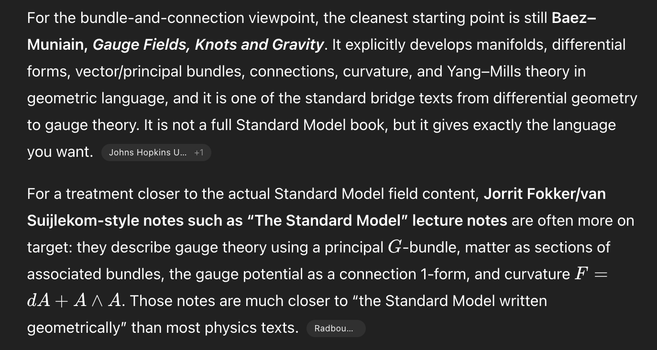
@andrejbauer @johncarlosbaez Funny when I asked ChatGPT, the first reference it gave was John's book.