 John Carlos Baez
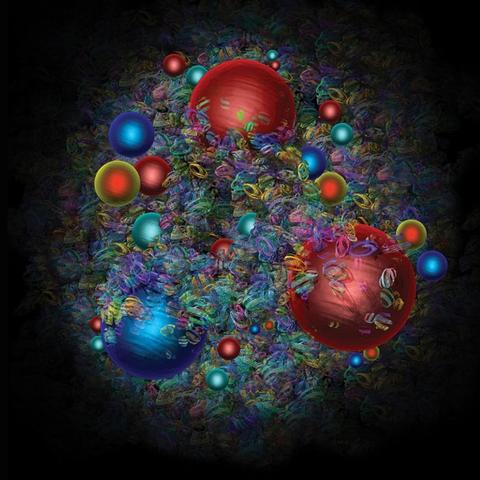
The Higgs boson gives elementary particles their mass, but 98% of the visible mass in the Universe (not dark matter) comes from a less famous mechanism: chiral symmetry breaking. This is why protons and neutrons are so much heavier than their quarks!
Briefly, protons and neutrons act like bags full of a soup of virtual quark-antiquark pairs, which give them most of their mass. This soup, called a 'quark condensate', breaks a certain symmetry that exists outside the bag: 'chiral symmetry', where you change the phase of the clockwise and counterclockwise rotating quarks separately. In the quark condensate, the clockwise spinning virtual quarks are entangled with counterclockwise spinning virtual antiquarks.
 Michael Porter