Ha ha ha.... the disgrace that is HS2 just gets worse.

Now, to save money the Govt. has decided to reduce the top speed of trains on the new lines (thereby reducing the specifications of the system & making it cheaper to construct).

Whatever might think of the original conception of High Speed Rail, this project has demonstrated the difficulty the UK in actually delivering infrastructure projects (and specifically railways).

Just ludicrous

#railways #HS2 #politics
h/t FT

@ChrisMayLA6 The average UK rail traveller doesn't know what real high speed is: at the moment the Eurostar is the fastest train in Britain as far as I know, and of course it only travels through a small part of England.
@ChrisMayLA6 This is infuriating!
All, the money, pollution, and land destroyed for something very few wanted, or will benefit from, and it's over budget, late, and now not even what it was supposed to be.
Just disgusting! 🤬
@ChrisMayLA6 Well, they've been telling us for a long time now that #HS2 is about capacity, not about shaving a couple of minutes off journey times. But they could avoid this sort of confusion by renaming it, I suppose.

@TimWardCam @ChrisMayLA6

And indeed it is about capacity. The mian problem I see is slower trains will *probably* mean trains that accelerate slower, which in turn means there will be less capacity from the longer gaps between trains. The Eurostar stock is a case in point. Hs1 runs below capacity because the trains aren't the best.

@ChrisMayLA6 do they think the 2 in HS2 is because “high speed” is 2 x the speed of Stephenson’s Rocket?
@ChrisMayLA6 while I'm sure the higher speed is a flagship headline for the project, I had understood that the extra capacity was the important thing, so maybe we shouldn't be so worried about the ultimate speed.

@robertklaschka @ChrisMayLA6 But the WAY HS2 provides extra capacity is by taking high speed traffic off the rest of the network, thereby freeing up lots more slots for commuter/freight trains! High speed trains require greater spacing because their acceleration/braking distance scales as the square of the speed.

This is idiocy.

@robertklaschka

That may be so, but that was not what it was originally sold, its only as the project has become bogged down in difficulties that the claimed emphasis has shifted to capacity - which says more about shifting the goalposts in desperation than about good project management

@ChrisMayLA6 I don't know, I have been hearing the capacity argument for much longer, including when the last administration cut the Northern part of the route.

To me it feels like a similar thing to the way the British military seem to work, with projects failing or going far overbudget because they started with too high an expectation. HS2 may be similar because it was meant to be one of the very fastest high speed lines globally. It would be interesting to know how much slower it would get.

@robertklaschka @ChrisMayLA6 So HS2 is just another railway line - which is how it should have been specified and sold to the Great British Public in the first place!
(I hear echos of how the Great Central 19th century route was proposed as a high speed line from Manchester & Sheffield to London but was ultimately a financial failure)

Capacity on the West Coast Mainline is a major issue and this should have been the selling point all along, let alone at the planning stages.

@ChrisMayLA6 building a modern rail network takes practice and persistence, it can't work if it gets turned off and on again every two decades.
@ChrisMayLA6 Meanwhile China builds more high speed lines than ever before with around 50,000 km currently in active service and well on track to hit 70,000 km by 2035. With speeds of up to 350kph. We are laughing stock (and not rolling stock!)
@ChrisMayLA6 My son-in-law was studying HS2 as part of his degree (he’s a Chartered Surveyer now) and the conclusion even then was that it was far from value for money. A big part of the problem is how it was sold on speed, not capacity. The latter is necessary. The former is a trivial gain even if everything is completed fully, but gaining it vastly increased the cost and construction time because of the routing decisions it forced to shave the travel time.

@ChrisMayLA6

Q1. Who benefits from extending the timelines and inflating the in-programme costs?

Q2. Who is paid to stop that happening?

Is there an asymmetry there?

@ChrisMayLA6 UK Rail - You can't get there from here.

@ChrisMayLA6 Ooof. The FT is usually good but this article is - not great.

First, notice the headline - 'consider slower trains'

Then later on it's talking about reducing the maximum speed of the trains to 320 Kmh (from 330 normal, 360 max).

Also doesn't specify whether the construction savings come from the construction of the trains or the track.

@ChrisMayLA6 If they are talking about the trains, that's not the end of the world - by the time that HS2 is extended to Manchester (let alone the Scottish central belt) we'll be decades down the line and new trains will be required anyway.

If they are talking about compromises in the track construction, that probably means changing to ballasted track construction. This will be cheaper up front (although entailing higher maintenance costs, including additional depots for maintenance vehicles).

@ChrisMayLA6 This doesn't stop the track being upgraded later for higher speeds (as the route, including the horizontal and vertical curve radii, and the consequent civil engineering works) on Phase 1 are pretty much locked in at this point. It will make future speed upgrades more expensive.

@beardie_jamie

I read it to be the latter - but was reading quickly....

@ChrisMayLA6 what this demonstrate very clearly is that the whole project was designed to be a commuter line from Birmingham to London. If it had been a real high speed line project it would have been started from the north and potentially the Midlands at the same time.

But by the time it is finished, it will just be another commuter line to London.

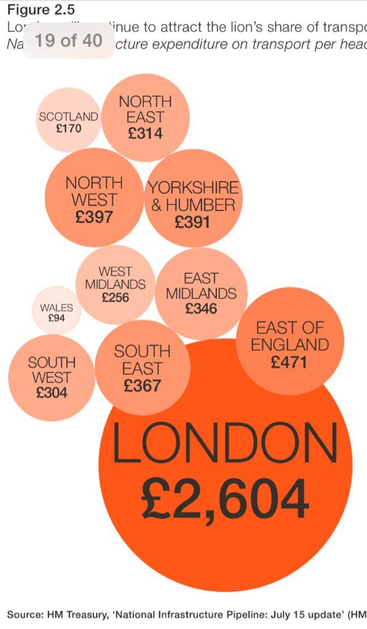
However, because it’s classed as national infrastructure and not local infrastructure, every single taxpayer in the UK is paying for it.

@peterbrown @ChrisMayLA6 According to the Barnett formula any expenditure by UK govt on an England-only project should grant a sum equal to 10% to Scotland and 5% to Wales. But the govt never paid Wales because HS2 would serve Crewe which is 'close' to Wales therefore Welsh people would benefit. But now HS2 isn't going to Crewe...

@ChrisMayLA6 Honestly the original speeds very vanity project stuff in the first place. Lower speeds means higher density means higher throughput.

The UK actually does pretty well delivering rail projects providing MPs are not allowed anywhere near it. Providing it's boring and they are kept away we normally do okay, although usually end up behind schedule.

Borders railway for example was on time and under budget because it wasn't designed in parliament.

@ChrisMayLA6 this is an example of what happens when knowledge and savoir faire are gone. It will take a couple of HS2 fiascos before we get it right.

Can it be avoided?
Yes, it can be avoided by not being arrogant, over confident, dismissive, and listening to others.

The sad thing is that the know-how still exist in Britain, but is being ignored and overlooked.

Gove openly admitted it when he said "people in this country have had enough of experts".

.

@littlemouse @ChrisMayLA6 There is some world class engineering being delivered across HS2 sites, but this does not make the news. Much of the problems with HS2 arise from the politicians, mainly Tory, who wanted 'world beating', then changed their minds again and again, awarded contracts too early then wondered why costs were rising etc.
In this country engineers can do infrastructure (see Elizabeth Line), but politicians can't (HS2 being one prime example).
@ChrisMayLA6 crazy how they don’t see that they are actively sabotaging every benefit that the line could bring.
@nr @ChrisMayLA6 well if Westminster produces a critical mass of green MPs there might be hope yet.
@ChrisMayLA6 Wasn't this suggested a few years back?
I'm pretty sure this came up some time ago, with a proposed top speed that wasn't all that far north of what they do currently, making this a very expensive way of achieving pretty much nothing.

@stuartb

'a very expensive way of achieving pretty much nothing' - which neatly sums up the current state of HS2