A true anarchist is not a knee-jerk reactionary against social convention for it's own sake. Not the one who screams 'no rules!', while trying to make everyone else follow theirs.

An anarchist has a code, a set of rules they hold themselves to, not anyone else. An anarchist is one who asks; 'who made this rule, and what purpose does it serve?' before deciding whether or not to follow it.

(1/2)

#anarchists #anarchy

An anarchist does not drive on the opposite side of the road just because what side to drive on has a rule. But they might treat a red light as a stop sign when there's little or no traffic.

Like models, rules are never universally right, but some are useful. Good rules are guidelines, that help keep us safe. Not policies to be policed, regardless of the likely outcome.

Following rules because they're rules is recorded in history as "just following orders". We know where that leads.

(2/2)

A couple of days ago I posted about what being an anarchist means to me. Obviously given the way I defined it, I can't determine what it means for anyone else. A contradiction, yes. But one that holds space for flexible ways of understanding that can better respond to our constantly shifting situations.

One thing my freedoms-based definition didn't address though, was how I apply it to political economy. For example, do I believe that all legitimate anarchist politics is anticapitalist?

(1/?)

So one thing I want to clarify is that although I see "anarcho-capitalism" as just fascism with better branding (Peter Thiel being an archetypal example of where it leads), I do accept that a person can be right-leaning economically, and still be an anarchist.

But there are limits, beyond which this becomes a contradiction in ways that are universalizing, and inflexible (again think of the neoreactionaries defending the freedom to deny others freedom).

(2/?)

When people claim that property is an inalienable right - like freedoms of expression or association are - then "property is theft", as Proudhon famously put it. But as long as they accept that property is a social agreement, subject to negotiation and consensus, then "property is freedom" (a lesser known quote from Proudhon).

Having said that, being open to the idea of a place for markets in a free society does *not* make an anarchist right-leaning. It just makes them not a Stalinist.

(3/?)

The reason I'm opposed to markets is I just can't figure out any way that 1) markets would not necessarily lead to authoritarian rule and 2) authoritarian rule would not necessarily be required for markets. So markets both cannot exist in a free society and a free society cannot persist with any sort of market in place. If you could manage it that markets didn't reward bullies and cheats and increase inequality until we're some warlord's bitch, I suppose it'd be fine. But how is that possible?

The best I heard we've managed is different tribes meeting for negotiation and trade. And some mediation strategies to try to handle grievances. But once everyone has to all agree (or be made to agree) on the value of a common currency, it's a downward spiral from there to slavery.

@cy
> So markets both cannot exist in a free society and a free society cannot persist with any sort of market in place

David Graeber covered this in Debt, better than I possibly could. If you haven't read that, I recommend you do. If you have, maybe time for a refresh?

But one argument against what you say here is that it's ahistorical. In his book Life Inc. Douglas Rushkoff pointed out that the importation of the tradition of the bazaar into Europe had a profoundly liberating effect.

Oh, you mean a "free" society. My bad.
@cy
What is the purpose of this snark? How does it help the conversation?
@strypey
Is there ever a purpose to snark? No reason to converse @[email protected] made it clear what they mean.
@cy @strypey What did they mean?
The freedom to do business without government interference.

CC: @[email protected]

@cy
> The freedom to do business without government interference.

This is some serious reading out of context. Did you even read the thread you're replying to? By what tortured logic did you extract that conclusion from references to Graeber and Rushkoff FFS?

@light

(1/?)

@cy Ok, now I've calmed down a bit, let me flesh out my point and see if it clarifies anything for you.

This turns on how we're defining "business". Does a subsistence farmer selling surplus veges in a bazaar-inspired medieval market, or a baker selling bread there, count as "business"? In the broadest sense, sure, but not in the sense that I think concerns you here.

For this explanation, I'll use 'bazaar' instead of 'market' to avoid confusion with other uses of 'market'.

@light

(2/?)

Were medieval bazaars free from central government interference (ie the King and the Crown)? Yes, as most governance functions in the Middle Ages were more localised. Nation-state scale government didn't become practical until the emergence of tech like national train networks and reliable postal system, which were originally inseparable from them.

Were bazaars unregulated? certainly not. For a start they existed by the grace of the local landlord and church authorities.

(3/?)

Within that, a bazaar was a commons, run by and for the community that bought and sold in it. Like any sustainable commons, this required regulation, eg to avoid having stallholders selling poisonous food or faulty goods, or people stealing from stallholders, or anything else that would threaten the market's reputation.

The modern equivalent would be a supermarket run as a multi-stakeholder co-op, where workers, producers and customers all have a stake in ownership and decision-making.

(4/?)

Is a bazaar or a co-op supermarket the ideal model for food exchange in a community too large to do it by trading veges over the back fence? The question makes no sense to me. There are no 'ideal' models, only what makes the most sense as a response to a given situation.

Gaining this understanding this is one thing that makes slogging through the dense prose of situationist writing worthwhile. Revolutionary Self-Theory isn't too hard a read, and is a good intro;

https://theanarchistlibrary.org/library/larry-law-revolutionary-self-theory

Revolutionary Self-Theory

Larry Law Revolutionary Self-Theory 1975 First published as “Self-Theory: the pleasure of thinking for yourself”, by The Spectacle, USA 1975. This version —...

The Anarchist Library

(5/5)

Are Farmer's Markets (also inspired by the medieval bazaar) and co-op supermarkets an improvement on corporate supermarkets and their highly centralised, too-big-to-fail supply chains? I think so. Keep in mind that union-driven projects like this were used to build worker self-management in the lead up to the Spanish revolution.

Could there be a place for them in a society run mostly on anarchist principles? On what basis could we suppress them without becoming Stalinists or Red Guards?

@strypey

while i agree with the goals here and am in favour of street markets and bazaars and farmwrs markets and mutual aid networks and worker co-ops and so on...
...i would step back and wonder what are prerequsites for those?

certainly all of the above have in common that they use money owned by the capitalists and billionaires, who would love all the above and then print money for themselves to buy the most popular ppl and products who are happy to receive lots of money we all work for

@strypey

... that IS the centralizing/consolidating/bullying effect @cy mentioned, but imho misleadingly associated it with any kind of market in general, ...its in the money we use.

@serapath
What about Thomas Greco's "credit clearing" institutions or perhaps a decentralised equivalent?
h/t @KevinCarson1
@strypey @cy

@light @KevinCarson1 @strypey @cy imho that has been tried by a project called "Ripple" and it didnt scale so that turned into XRP.

The best or closest system to that today is imho bitcoin lightning and its amazing.

Maybe theres a way to scale the original idea, but it requires imho open supply chain and a massive amount of people keen to try hard to work with this and even then its unclear. if it works we can still switch to it, but bitcoin lightning with open supply chains could get us there

@serapath @light @strypey @cy My problem with bitcoin in general is it's based on the myth of monetary scarcity -- that money has to be "backed" by something (i.e. mining/"proof of work").

@KevinCarson1 @light @strypey @cy

i think that is a misunderstanding

1. bitcoin is not backed by something and "proof of work" is just a mechanism to defend the network against attackers trying to rob everyone

2. money is never scarce. the wording is misleading - i agree. only goods and services can be scarce. a limited money supply does not make it scarce, it just standardizes it - is 1kg or 1m as a standard measurement unit scarce? ...would you want constant change in what 1m or 1kg means?

@KevinCarson1 @light @strypey @cy

i am saying this, because if you had more or less money in circulation and everything else stays the same (e.g. demand and supply of services and goods) then prices just adapt and you keep the same buying power.

nothing here is scarce and therr is no problem.

problems appear under fiat where the epstein class constantly prints money to defraud us, hence the growing divide between poor and rich. bitcoin inverts this by ending money printing to pay for upkeep

@serapath @light @strypey @cy The problem is the idea of money in "circulation," that has an independent value of its own. It's like saying there are feet and inches in circulation, independent of the boards being measured.

@KevinCarson1 @light @strypey @cy

nah, the measurement are prices.
you measure prices in a currency, but if the denominator changes, its a futile exeecise.

the money is just what you measure with.

price stability is a ridiculous concept invented by mad men, it shields ppl from feedback about growth or decline of the economy by seeing prices around them.

@serapath
> price stability is a ridiculous concept invented by mad men

Theoretically defensible, but politically sociopathic. As monetary policy, it says;

Keeping the value of a $ stable, as an objective measure of the value of things sold in markets, is more important than whether people can afford enough food to stay alive.

This is '#neoliberalism' and its hands-off central banking in a nutshell. Obsessed with controlling inflation, regardless of the effects.

@KevinCarson1 @light @cy

@strypey @KevinCarson1 @light @cy

I think this is just absolutely idiotic or even borderline evil.

If there is fixed monetary supply in an economy then price changes will give real feedback to people. Price changes will tell people whether the economy grows or shrinks or stays the same.

If ppl start hoarding, then prices will deflate, good for everyone, if ppl stop hoarding prices will inflate temporarily until nobody hoards and the maximum is in circulation.

@serapath @strypey @light @cy The paradigm by which there is a "supply" in "circulation," that can be "hoarded," is the problem.
@serapath @strypey @light @cy The root of the problem lies in the ideology, and associated practice, of goldbuggery and other assorted "hard money" systems.

@KevinCarson1 @strypey @light @cy

i dont really understand what you are saying or what problem you are referring to.

are you saying you want to work for money which others print to becoke billionaires and you watch house prices explode? ...it that a fetish you have?

also -goldbugs and bitcoin share little to nothing. some goldbugs converted to bitcoin, many others didnt, but also ppl from all other backgrounds like bitcoin. its not a goldbug thing and there is little in common

(1/?)

@serapath
> goldbugs and bitcoin share little to nothing

Everything you say about the political economy of BitCoin is derived from the arguments goldbugs make about gold. As @KevinCarson1 pointed out - and as we've discussed many times - the core of tokenomics it's the faulty paradigm of seeing money as a commodity - whose most important value is a stable price - vs. seeing it as currency, whose most important values is facilitating the maximum number of useful transactions.

@light @cy

(2/?)
> are you saying you want to work for money which others print to become billionaires and you watch house prices explode?

As we've discussed before - again, *many* times - we all agree that capitalists using banks to issue new money as mortgages on land and buildings (and other real world resources, but mainly real estate) is a problem. Enabling rampant property speculation, in order to profit from capital gains, while driving up prices *relative to incomes*.

(3/?)

But this problem can't be solved by going back to the Gold Standard. Any more than it can be solved by clicking your heels together and saying "there's no place like home". This is just political economy 101;

https://www.investopedia.com/ask/answers/09/gold-standard.asp

Neither can it be solved by going to a BitCoin Standard, for *exactly the same reasons*. Again this is political economy 101 stuff.

What Is the Gold Standard? Advantages, Alternatives, and History

Learn more about the gold standard, including its complicated global history and its connection to the fiat system and the U.S. dollar today.

Investopedia

(4/?)

There are a number of alternatives, each with its own pros and cons.

Social democrats propose returning to Keynesianism. Having democratic governments moderate the money supply. By tracking whether the real economy (of available goods and services) is growing or shrinking, and running surpluses or deficits as appropriate.

This is fine in theory, but relies on the existence of a state democratically controlled by the population it governs, not the 1% and their lackeys. Not the case now.

(5/?)

My preferred solution is mutual credit. Where workers can issue a credit representing a 'promise to pay' against the future value of our labour, retailers against their goods, tradies and professionals against their services, etc. The downside, as you've pointed out, is that it's challenging to build enough reputation data into the system to get it to scale up beyond a #Dunbar2 (everyone we trust directly, and at 1 degree of separation).

(6/?)

But maybe, as Douglas Rushkoff has pointed out many times on Team Human, the problem is the obsession with scale? Most of the problems trade is supposed to solve are local in nature.

Highly abstracted financial engineering (including with blockchains) is not necessary for these. Just some basic mechanisms that enable people to trust that people who don't keep their 'promise to pay' can't keep issuing credit willy-nilly. Cashless aimed to create these by building on social network tech.

(7/?)

For stuff that does require larger scale coordination, most of it isn't P2P transactions but B2B (Business-2-Business, using the term 'business' in the widest possible sense).

Business entities have to make all sorts of decisions about their institutional dependencies, so evaluating which other entities can be trusted is just part of their day-to-day. A lot of their exchanges *already* depends on mutual credit logic, to avoid paying lots of fees to third parties for formal transactions.

(8/?)

The Open Credit Network attempted to formalise this B2B mutual credit, especially for enabling co-ops to trade with each other without dependence on back-issued, debt-based money;

https://wiki.p2pfoundation.net/Open_Credit_Network

Not sure whether it's still live, I haven't checked in for a while, and their website seems to be down today.

#cooperatives #OpenCreditNetwork

Open Credit Network - P2P Foundation Wiki

(9/9)

At the root of all this, as Graeber points out in Debt, is the fact that all money systems are based on a set of social agreements about how economic exchange works. Trying to change those agreements by changing how money works, is putting the cart before the horse. This is the critical flaw in the gold/cryptobug approach.

If we can build a new social consensus around how we want our economies to work, a new exchange system (monetary or otherwise) will naturally emerge to fit.

@strypey i agree, but which money we use is part of it.

whatever direct agreement exists between ppl or businesses in a supply chain, by using a particular kind of money you opt into that system too and if its a money some billionaires can print, then essentially you allow them to buy from your community for free and everyone pays via inflation... that exacrly why we have the poor rich divide

@strypey
But isn't mutual credit "changing how money works"?

@strypey

i dont think local supply chain are enough for more than survival.

all modern goods and service from natural resources to finished product are insanely complex

@serapath
> dont think local supply chain are enough for more than survival

This very predictable rebuttal was anticipated and answered in the *very next post*. You'd waste a lot less of your time if you read my whole response before starting to reply, and replied in context. The numbering system on my posts is there precisely so you don't have to guess when I'm finished making my point.

@strypey i imagine this is a good idea and should definitely be used complementary to bitcoin ...and lets see how much it can scale up 🙂

@serapath
> should definitely be used complementary to bitcoin

If you replace "should" with "could" ("should" is an implicitly authoritarian word and is best avoided, along with its negation), I can pragmatically agree with this. On a 'let a thousand flowers bloom' basis.

The one time I used BTC was to move money from a Chinese bank account to a NZ bank account, which is otherwise a Kafkaesque experience. It was practically useful in that instance.

@strypey yes, its better than everything else for a lot of things, including not getting defrauded 🙂

@strypey

also, the "should" was just saying how i see it in terms of recommendation - ppl do what ppl do.
It's just a should if you ask for my opinion, thats all.

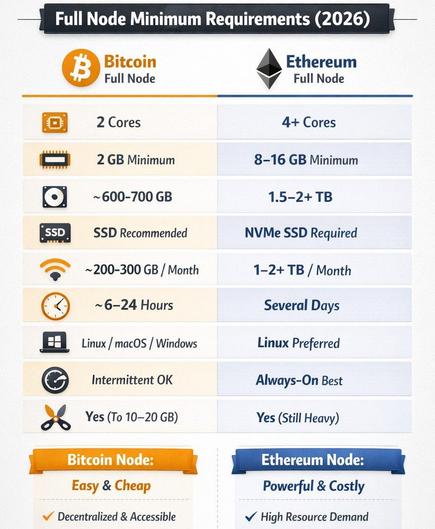
you do you and everyone what they think they should. eth started 2014/2015. bitco8n 2008/2009

here are the stats regarding sustainability

@strypey

yeah. that is the promise since forwver and it doesnt ever do anything. waiting for the establishment and their promises is doomed to failure

@strypey

yes. bitcoin isnt sufficient.

we only solve it with e.g. open source and commons networks and mutual aid networks and worker coops etc... but without bitcoin, we wont, because the billionaires print away any progress we make.

we have to do this while using a currency they cant print

@serapath
> we wont, because the billionaires print away any progress we make

This, again, is goldbug logic. I just wrote a 9 post thread explaining - once again - why political economy doesn't work like this. But maybe this is an unshakeable article of faith for you. Received wisdom, delivered to you at some formative stage of your thinking on the digital ledger equivalent of stone tablets. An example maybe of how you can't reason someone out of a position they didn't reason themselves into.

@strypey

feel free to share with me how you believe the billionaires of this world made their businesses and turned them into billionaires?

i'm curious - you seem to think it wasnt their money printer. so hpw did they do it? 🙂

@strypey @KevinCarson1 @light @cy

no current fiat is obsessed with stable price.

bitcoin doesnt care.
its about ending money printers privilege of the billionaire class.

(1/2)

@serapath
> no current fiat is obsessed with stable price

You're mistaking neoliberal monetarism for fiat currency in general. Again, fetishising the particular. Keynesian is also based on fiat currency - even more so than monetarism - but has no interest in stability in the price of money. Just in the price of essential goods and industrial inputs, again, *relative* to incomes (ie capacity to pay).

@KevinCarson1 @light @cy

(2/2)

You might benefit from reading a book called Sophie's World, which is the story of a fictionalised teenger taking a whistlestop tour through the history of philosophy, by having dialogues with various historical philosophers. Many significant economists are included, giving a really good nonpartisan overview of the major theories of political economy.

#books #novels #SophiesWorld #economics #PoliticalEconomy

@strypey i think i am familiar with the various economic schools of thought. it was part of my studies too, nut also have been continuously studying this myself.

keynsian economics is theory. the practice is those in charge print the money for themselves.

the poor vs rich divide is going on since forever and the global debt ...public and private too.

keynsian economics is the dominat mode of operation. its what brought us here. its the perfect excuse for money printing elites

@serapath @strypey @light @cy OK. Say there are two people networked to each other, and neither has any Bitcoin at all. Can one of them purchase 10 Bitcoin worth of services or merchandise from the other, be debited 10 Bitcoin, and run a negative balance of Bitcoin, without having to start with a positive Bitcoin balance? And then bring the balance up to zero by selling 10 BTC to the other person later? If so, it's a non-scarce system. If not, and they had to have a positive balance to start with in order to make a purchase, then it's scarce in exactly the same way as a gold-based system.

@KevinCarson1 @strypey @light @cy

yes they can.
bitcoin is just a social contrqct you can opt into buy using it.

it allows anyone to sell for bitcoin and have a guarantee from all others in the network they will sell to you for bitcoin.

if you dont have bitcoin you should start out by earning some first, but ...it doesnt prevent you by buying from somebody who trusts you to pay back later - thats always possible .... can even be a group, but its a individuals/group based special agreement

@KevinCarson1 @strypey @light @cy

....if that agreement doesnt work out its on those who made the agreement. it doesnt translate to the wider network. the wider network agreed of doing work for anyone who can present bitcoin numbers. its a protection mechanism against scammers - but if you have the trust of others you can always step outside that basic agreement and do what you proposed

@serapath @strypey @light @cy In an abundance-based system, it's the act of exchange -- not prior mining, "printing," or whatever -- that creates a positive or negative balance in the overall network.

@KevinCarson1 @strypey @light @cy

yes. also possible with bitcoin or dollar.

as i just tried to explain, that kind of "exchange" you mention creates a debt... it gives credit... its a loan.
...with positive and negative balances.

its not transferrable and wants to be settled.

settlement is what money is used for.
...or goods as in barter, but usually money

@serapath @strypey @light @cy "if you dont have bitcoin you should start out by earning some first" This is what I mean by scarcity of money. It's an idea of money as something with an independent existence of its own that has to be acquired before it can be spent, rather than something that's *created* by the act of exchange.

@KevinCarson1 @strypey @light @cy

???
i mean what i just said is true for all money.
That is the essence of money.
This is also reality for almost all people. They can only buy something after they got money - usually by earning it

But of course, maybe you get donations or inherited or receive welfare or stole it or found it on the street. This is the same for bitcoin as it is for all other money ...But some monies also allow some billionaire clas to print it - which imho is bad for all of us

@serapath @strypey @light @cy No, a mutual credit clearing system of the sort Greco has designed allows someone to spend money without having it first, just by running a negative account balance with the system. You keep using the word "print," as if the money is something with independent value that goes into circulation.

@KevinCarson1 @strypey @light @cy

if you spend without having it first, you have a negative balance (a debt). i am talking about fiat money (e.g. USD, EUR, etc...)

I am not familiar with any working system that works differently. What you talk about seems something exotic and negative balances (pay before you have it) sounds like a "loan" that is expected to be paid eventually 🤷‍♀️

@KevinCarson1 @strypey @light @cy

money is what ppl accept as payment.
most ppl agree they cant just print e.g. USD or EUR to buy whatever they want. usually they need to get an income first... unlike the billionaire class who can print it to buy whatever they want ... socialism for the rich

@KevinCarson1 @strypey @light @cy

money is not created by the act of exchange.

money is different from barter, but also from credit.

an act of bidirectional exchange is barter and comes with its own problems.

an exchanfe where just one side provides is a donation or a credit/loan

That is different too. a credit/loan has to be settled later on.

you use either goods (as in barter) or money to settle it.

So paying money is used to SETTLE debt 🙂

(1/2)

@serapath
> money is not created by the act of exchange

> money is different from barter, but also from credit

Exactly wrong. You're getting 'money' confused with *currency*. Which is indeed not created by exchange, it's issued by fiat of states, currently by trading banks on their behalf. Which does indeed make it different from barter (which emerges after money systems collapse, see Debt), and mutual credit, in which money *can* be created during exchange

@KevinCarson1 @light @cy

(2/2)

As I will continue to point out, you'd know all this if you'd done even the most basic nonpartisan reading on the history of political economy. Instead, you continue to embarrass yourself by posting these basic errors.

Fair warning; For as long as you keep posting about economics without educating yourself, I will mock you mercilessly for your nonsense. As you would (presumably) someone who takes creationism or flat earth theory seriously. I'm bored with this garbage in my @mentions.

@strypey
There's no need for that.
@light I've been very patient. But I've been down this rabbithole at least 3 times now and they've learned nothing from any of the counterarguments and evidence presented. They just restate their wrongheaded dogmas, over and over, as if that's supposed to be convincing. I think it's only fair to flag that my patience is wearing thin.

@strypey @KevinCarson1 @light @cy

Okay, lets get definitions clear please:

1. Money is denominated in a currency (e.g. USD, cigarettes, etc.. anything ppl accept as means of payment & price goods in)
2. sellers price stuff & buyers become debtors who owe sellers the price
3. debtor normally settles by paying price in money
4. Buyers need a positive transferable balance in a currency to be able to use it as money to pay debt

@strypey @KevinCarson1 @light @cy

Many things have been used as money throughout history, but today, the only money that matters is fiat currencies (the money created by (central) banks and/or governmemts) and maybe some alternative forms like bitcoin, crypto and so on - who all have different rules and properties governing them.

Fiat money is debt created by banks, not other market participants. Normal market participants cant create fiat money.

@strypey @KevinCarson1 @light @cy

just to make it clear:

different currency types are better/worse money based on inherent properties/rules that govern them.

BUT in fiat money, positive balance denominated in (e.g. USD, EUR, GDP, YEN, ...), are NOT created via buying/selling of goods or services, but by banks when others take out loans.

Loans mint new money.
debit: The money is the banks debt.
credit: The debtor ows the bank equally

They cancel each other out.
Paying back loans burn money.

@strypey @KevinCarson1 @light @cy

There is only ONE EXCEPTION:

When banks buy stuff, they create money and use it to pay the seller - that is THE ONLY WAY how banks can pay under fiat money 🙂

I appreciate questions to clarify this definition as needed.

As I understand it, when you check out money from a bank in the USA, they promise to check out that money for you, but don't actually do it. Then you use that promise (called "bank currency") to buy things. The bank can't provide the literal Federal Reserve Notes, but you all got suckered into using your bank cards for everything, because ohh, that cash is just so crude, and probably terrorists use it. So you never notice you don't even get the pretend money the USA created. You get a promise for the bank to pay you, in promises for the central bank to pay the government.

Why any business accepts credit/debit cards, when they're fully aware that it means they aren't getting paid any money, is beyond me. Why not just give away everything on your shelves!

...

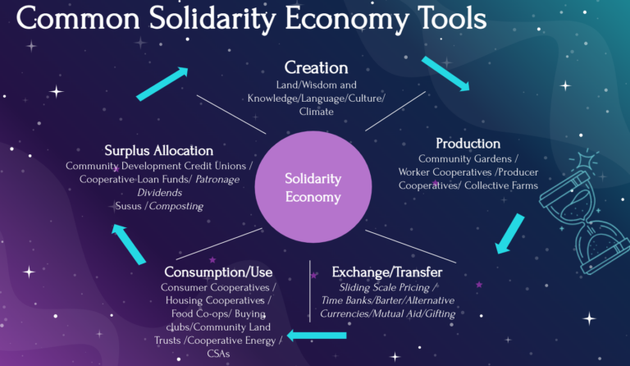
https://solidarityeconomyprinciples.org/what-do-we-mean-by-solidarity-economy/

CC: @[email protected] @[email protected] @[email protected]
What Do We Mean By Solidarity Economy? - Solidarity Economy Principles

What is solidarity economy organizing? It is building relationships between projects that are using solidarity economy principles and practices.

Solidarity Economy Principles

@cy @strypey @KevinCarson1 @light

no money works literally how i described.

vast majority of ppl and businesses arent aware of how money works and even for economists its mostly new post 2008 and still not well understood by most.

its not a discussion about free or not, more about if you use specific kind of money, what are the consequences.

@strypey @serapath @light @cy Yeah, the whole idea I'm attacking is that "currency" -- a circulating medium that serves as an independent store of value -- is necessary for exchange.

@KevinCarson1 @strypey @light @cy

its not necessary.
obviously you can do it trust based if everyone plays along.

supply chains are anonymously large and i've never seen trust scale apart from using money - and if one does then better not one a billionaire class prints to enrich themselves and scam us all, like e.g. elon & co.

Hey @serapath (and others), hellthreads like this would make me significantly less grumpy if you didn't tag me in to every
Single. Post.

If you're doing a multi-post reply, I only need a notification about the first 1. If you use a numbering system, or otherwise indicate that the post is the first in a series, I'll click on it to see the rest, and give it all some thought before replying

#FediTips

@KevinCarson1 @light @cy

Gargron's decision to mention everyone in the thread for every reply was A TERRIBLE IDEA

@strypey will do. sry 🙂

hope you saw my reply about "whats money" ...to figure out where our definitions differe or maybe what the misunderstanding is all about

You just mentioned us all again. OH NO I JUST DID IT TOO

CC: @[email protected] @[email protected] @[email protected]
@serapath @strypey @light @cy Yes, in the system I'm describing -- a system without money scarcity -- money IS created by the act of exchange. Again, you keep making assertions based on the assumptions shared by both goldbugs and bitcoiners -- the assumptions I wrote my piece to criticize.

@KevinCarson1 @strypey @light @cy

okay, you describe a new/different system, in which money seems to not be defined as something to settle debt via payment.

thats okay and i'm sure its interesting to explore, but imho not what ppl commonly understand as money - and i'm talking about our current fiat system (USD, EUR, YEN, ... etc)

@serapath
> bitcoin ... not a goldbug thing and there is little in common

Keep telling yourself that. But if you ever put the time into doing the reading about political economy, you'll learn otherwise.

As I said, most tokenomics is just goldbuggery adapted to digital tokens, and particularly among BitCoiners including *everything you're saying about it*.

@KevinCarson1 @light @cy

@strypey @KevinCarson1 @light @cy

I dont know what the "essence" of goldbuggery is for you, but gold and bitcoin have little to nothing in common, despite maybe "goldbugs" or some people claiming otherwise.

gold and bitcoin share no properties.
Thats also the reason why lots maybe most goldbugs dont touch bitcoin and only a small minority in bitcoin might have been former goldbugs who moved on.

tokenomics or tokens in general have nothing to do with gold either - much more with fiat

@serapath @strypey @light @cy The very language you use -- "fiat money," the obsession with inflationary "printing," etc. -- is essentially the same language used by right-wing Austrians, ancaps, goldbugs, and hard money people. You're just using it leftishly. There may not be a lot of overlap between Bitcoin adherents and goldbugs in terms of personnel, but their basic understanding of money is directly analogous.
lol mises.org is crazy stuff

Not saying printing money is necessarily a bad thing. It is a bad thing if the people printing it are the ones who get to have it though.

CC: @[email protected] @[email protected] @[email protected]

@cy @strypey @light @KevinCarson1

that is the system we live under.

all of the ngo money, the covid support all wellfare is only so that they legitimize a narrative that allows them to print 10x for themselves at the same time.

its the military budgets.
its the largest wealth transfer to billionaires during covid times, etc...