 Veronica Olsen
This is incredibly depressing news. Scam Altman is now in control of the supply chain of a significant portion of the Python community.
Fuck this shit.
This is incredibly depressing news. Scam Altman is now in control of the supply chain of a significant portion of the Python community.
Fuck this shit.
@veronica sigh. It never ends.
Stage 1: announce you will help "the community"
Stage 2: make an ok project people start to use.
Stage 3 (you are here): consolidate hold over entire ecosystem.
Stage 4: monetization.
Stage 5: Enshittify to increase profit extraction.
Stage 6: Abandon project to refocus priorities.
🙄
@veronica It seems people are now recommending PDM.
This is how you would install PDM:
python3 -m pip install --user pipx && pipx install pdm
@draeath @veronica If a project uses PDM, then any new contributor needs only to clone the git repository and execute 'pdm install' to get going. That command will automatically create the virtual environment.
For that to work, PDM obviously needs to be installed outside of your not-yet-existing project's virtual environment to be available. That typically leaves you with two options to install PDM:
pip install --user pdm
pipx install pdm
If you install more than one package into your user directory, then 'pip install --user' can lead to a dependency conflict.
'pipx install' avoids dependency conflicts because it isolates packages from one another. Thus pipx is the preferable command of those two.
In the case of PDM, you could also just rely on the official shell script for installation, which just downloads a "zip file" and extracts its contents to ~/.local/bin/pdm, but not every tool provides such a shell script. And if you've familiarized yourself with pipx already, it's convenient and a consistent experience to use it for everything.
@davidculley @veronica it seems like creating a venv isn't that difficult, especially so when one already is comfortable with python. I do it all the time.
The only pain point is when one needs a particular interpreter version (doubly so if the OS package manager doesn't offer it). I'll acknowledge one needs a solution for that.
@draeath @davidculley My main open source project is anyway distributed as an OS package or exe installer. The docs still recommend pipx for install from PyPi on platforms that I don't provide other packages for, so this isn't really a big deal for me. I'm comfortable using just plain pip myself, and the lock file isn't really necessary for this project (since it is designed to work with a wide range of Python and package versions).
My main issue, really, is replacing ruff.
@veronica No, this is a rather misleading statement. OpenAI has zero control over any version of the #Astral tools that came out before the acquisition (unless they were secretly pulling the strings of the Astral developers behind the scenes all along, but AFAIK there's zero evidence of that, and if they were doing it why would they bring on additional scrutiny by announcing an acquisition?), and going forward, the #Python community can just stop using those tools. There are pure-Python alternatives for all of them, as well as the forks that will inevitably spring up. This is why we have standards.
I'm sure there are a fair number of package developers that either don't know or don't care this is happening, and will keep using Astral tools out of sheer laziness, and I suppose those projects could be considered subject to some sort of "control" from OpenAI... but still, they have the choice to just, y'know, not be. Any time they want.
@veronica That "is now in control of" is the load-bearing phrase of the whole thread, though.
Anyway, my point is that with all the hype about the Astral tools (mostly uv) that's been going around the community the past few years, some people get the impression that it's the *only* viable tool for Python package management. A statement like "Altman is now in control of the supply chain of a significant portion of the Python community" only reinforces that impression.
@veronica I know you didn't claim that uv is the only viable tool. But, whether intentionally or not, your post reinforces that impression in people's heads.
I also have a hard time understanding the thought process that would lead a person to say what you said if they're aware of the other packaging and linting tools that exist in the Python ecosystem, but that doesn't actually matter for the point I was making.
@diazona May I suggest you don't go on long rants on other people's feeds (on a short form text platform no less) based on assumed meaning or intention in their posts that originates entirely in your head?
It's annoying.
There's no point answering your question since I made no such arguments or claims. We're done here.
@veronica No, I stand by what I said.
The short version of it would be, this is wrong and spreading FUD. I'm just not someone who says things like that without explaining myself.
@veronica This made me so sad. I don’t do a ton of open source or projects where package management is even a thing. But I just discovered how fast uv was about a year ago and started moving all my stuff away from pip.
We need a fork. I don’t want to give up uv, but I’m not going to use openAI tools.
Is there something as fast as uv (or at least faster than pip)?
🙁🙁🙁

 Nuvalon

 😭😭😭😭
😭😭😭😭 Eli Roberson (he/him)
 Paul - Antifa. LGBTQ+ safe.
 David Culley
 draeath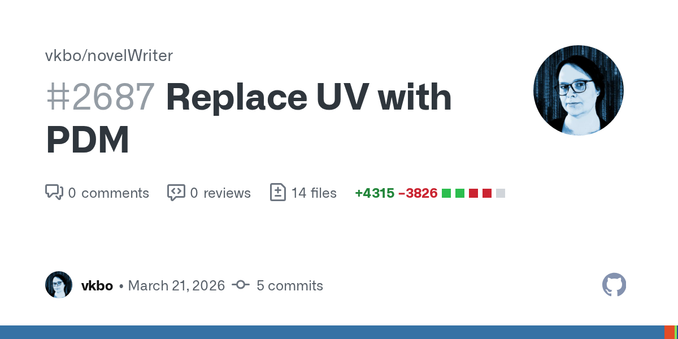
 Bruce Simpson, Ph.D.
 sherbang
 David Zaslavsky
 Timothée Mazzucotelli
 Paco Hope