In case you missed it, new particle just dropped. The LHC has confirmed (and in ridiculous accuracy) the existence of a heavier version of the proton.
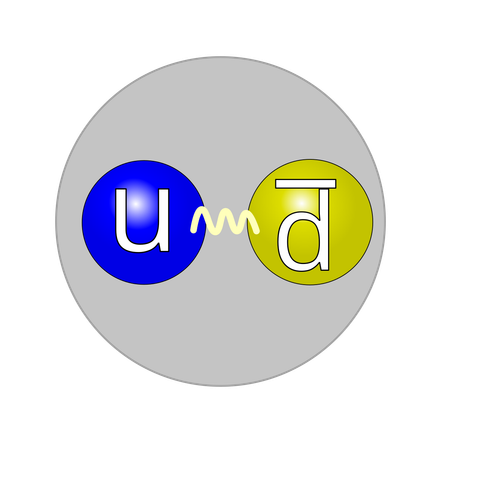
A proton is made of 3 quarks, up/up/down. This new particle is made of charm/charm/down, where the charm quark is basically the same as the up, just heavier.
So not groundbreaking like finding supersymmetric particles, but still cool. Further confirmation that the standard model of particle physics is reasonable.
https://home.cern/news/news/physics/lhcb-collaboration-discovers-new-proton-particle
LHCb Collaboration discovers new proton-like particle

The LHCb experiment at CERN’s Large Hadron Collider (LHC) has discovered a new particle consisting of two charm quarks and one down quark, a similar structure to the familiar proton, but with two heavy charm quarks replacing the two up quarks of the proton, thus quadrupling its mass. The discovery, presented at the ongoing Moriond conference, will help physicists better understand how the strong force binds protons, neutrons and other composite particles together. Quarks are fundamental building blocks of matter and come in six flavours: up, down, charm, strange, top and bottom. They usually combine in groups of twos and threes to form mesons and baryons, respectively. Unlike the stable proton, however, most of these mesons and baryons, which are collectively known as hadrons, are unstable and short-lived, making them a challenge to observe. Producing them requires smashing together high-energy particles in a machine such as the Large Hadron Collider (LHC). These unstable hadrons will quickly decay, but the more stable particles that are produced as a result of this decay can be detected and the properties of the original particle can therefore be deduced. Researchers have used this approach many times to find new hadrons, and the new particle just announced by the LHCb Collaboration brings the total number of hadrons discovered by LHC experiments up to 80. “This is the first new particle identified after the upgrades to the LHCb detector that were completed in 2023, and only the second time a baryon with two heavy quarks has been observed, the first having being observed by LHCb almost 10 years ago,” says LHCb Spokesperson Vincenzo Vagnoni. “The result will help theorists test models of quantum chromodynamics, the theory of the strong force that binds quarks into not only conventional baryons and mesons but also more exotic hadrons such as tetraquarks and pentaquarks.” In 2017, LHCb reported the discovery of a very similar particle, which consists of two charm quarks and one up quark. This up quark is the only difference between this particle and the new one, which has a down quark in its place. Despite the similarity, the new particle has a predicted lifetime that is up to six times shorter than its counterpart, due to complex quantum effects. This makes it even more challenging to observe. By analysing data from proton–proton collisions recorded by the LHCb detector during the third run of the LHC, the LHCb Collaboration observed the new baryon with a statistical significance of 7 sigma, well above the threshold of 5 sigma required to claim a discovery. “This major result is a fantastic example of how LHCb’s unique capabilities play a vital role in the success of the LHC,” says Mark Thomson, CERN Director-General. “It highlights how experimental upgrades at CERN directly lead to new discoveries, setting the stage for the transformative science we expect from the High-Luminosity LHC. These achievements are only possible thanks to the exceptional performance of CERN’s accelerator complex and the teams who make it all work and to the commitment of the scientists on the LHCb experiment.” Further information: LHCb presentation at Moriond is available here. LHCb news article.

CERN
For non physics types, the quark names "up, down, charm, strange, top and bottom" are completely arbitrary and mean nothing, they're just placeholder names. Which is annoying, cos top and bottom were originally truth and beauty, which I prefer.
The also come in colours, and are far, far, far smaller than the wavelength of visible light. Again, an arbitrary name.
Lesson to all you physics coders, dumb variable names can stick if you're unlucky. Don't predict the "YourMomHadron".

@_thegeoff aw I always found truth and beauty to be supremely weird. Like, the kind of names people would come up with if they were on drugs. (Which very well may have been the case, to be fair)

Strange and charm are also pretty weird but I guess I've become acclimated to them since there are no viable alternatives....

@diazona But you're fine with up and down? On the canvas of the Entire Universe?! ;)

There's a bit of me that respects them not being called Q+2/3P1 etc (yeah, looking at you, gauge theories). But it does imply things in the general popsci field. On the whole I say keep the weird hippy names. And yes, very probably cos 1960s drugs.

@_thegeoff 😂 yeah

All things considered, I prefer physics being weird to the opposite

@diazona Also did a biology course recently, PCR stuff, mentioned that drugs were involved in the discoverer's process, but not quite the extent...
(Professional note: drugs only *sometimes* lead to scientific breakthroughs, kids, and have other costs to consider in risk assessments...)
@_thegeoff @diazona iirc Buddhism was involved or that might have been the eight fold path bits
@diazona @_thegeoff "Strange" is at least understandable given the history.
@skyglowberlin @diazona I was a first year physics undergrad when the last quark discovery was announced. Much excitement through the department. You may say a "top" day...?
Thank you, I'll be here all weak.
@skyglowberlin @_thegeoff Oh yeah that's a good point. That's probably part of why I don't mind "strange" and "charm", too: the names have little historical lessons about their discoveries embedded in them. "Truth" and "beauty" on the other hand always felt completely arbitrary to me.

@diazona @_thegeoff I remember "strange particles", but I don't remember ever hearing an explanation for where "charm" came from.

I just looked it up on Wikipedia, and 🙄

Since up and down are also arbitrary, "strange" is the only name of the six that I think is reasonable 😂

@_thegeoff I don't think colours are _entirely_ arbitrary though: afaik they are related to SU(3) irreps, so there are 3 basis states, and we have 3 coloured sensors in eyes, so...

But yeah, it's just that 3 equals 3 and nothing deeper

@_thegeoff maybe they changed the names to give them unique starting letters?

It sounds like its one of those items that exists momentarily, is it likely to exist naturally, like in the middle of the sun for example?

@smallsees It'll exist everywhere that has high enough energy densities, but weirdly, no, I don't think the centre of a star is "hot" enough for that. Cosmic ray collisions with Earth's atmosphere are way more energetic than LHC collisions, which in turn are way more energetic than "mere" nuclear fusion events.

So if we've detected them, they exist all over the place, but only for trillionths of a second per particle (depending on your reference frame, relativity is in play)

@_thegeoff that's really cool. The neutron star example was interesting too. A bit further along than my "stuff gets squished and something weird happens" level of understanding.
@smallsees There's also stuff that tries to prevent it (electron degeneracy pressure based on Paulie's exclusion principle), and then theoretical other stages like "quark stars" before the final collapse into a black hole.
@_thegeoff looking forward to discovering the Konami code is a fundamental property of the universe
@_thegeoff when I did undergraduate physics either top/bottom or truth/beauty was acceptable, providing you were consistent. Did they decide to standardize in the last 30 years?
@ianturton I'd have been there about the same time, yeah, I think it settled into top/bottom fairly soon after.
@_thegeoff does it occur naturally, or is it something they created?
@avatastic It was created in the LHC, but much higher energy events happen naturally all over the universe, including when cosmic rays hit our atmosphere, daily. So they've never been observed in nature (tricky to get a hundred ton digital camera to the upper atmosphere in a trillionth of a second!), but it'd be unrealistic to say they don't.
@avatastic Basically the LHC recreates low energy versions of things that happen when Earth is hit by cosmic rays, but in a more controlled and predictable way, and crucially *right in front of a very big digital camera*
@_thegeoff groovy, thanks for that. i'm sure some undergraduate somewhere is now wondering if these can be created by supernova and that's why the stars gain enough mass to go neutron.
@avatastic Stars collapse into neutron stars because the electrons and quarks interact in a way that forces the up/up/down protons to flip into up/down/down neutrons. Moving up to the energy levels involving charm quarks would make things...interesting...!
Have a google on "strangelets" or "strange matter" if you fancy some of the scary scifi end of actual physics ;)
@_thegeoff I'm sorry but since it does not yet have an official name; we'll be referring to it as the "Chonk Proton" for now.
@_thegeoff This is really cool.
@kimlockhartga Yup. A lot of the stuff coming out of the LHC post-Higgs tends to fail to ignite popular curiosity, even though it's essentially part of the same model. But this being directly relatable to high school physics gives brownie points!
@_thegeoff @kimlockhartga If Lederman's publisher had allowed him to publish the book under his original title, "the god damned particle", I don't think the Higgs would have gotten nearly as much attention as it did. The nickname "the god particle" was what got all the attention imo

@bamboombibbitybop @_thegeoff This is such a funny behind the scenes detail.

I remain forever and always fascinated by physics.

@_thegeoff TIL:
- CERN is a TLD
- this is not a shitpost and charm quarks are real.
What would be the spin? (In case you're wondering, I am an NMR spectroscopist 😁)
@dr_rugby All quarks are spin 1/2....but could changing the flavour combo change the direction? You know more than me at this point.

RE: https://mastodon.social/@_thegeoff/116246263654294961

Another particle has been found!

In fact the Large Hadron Collider has found 80 new particles in addition to the Higgs boson. All of these 80 are 'hadrons', collections of quarks and/or antiquarks held together by the strong force. We *expect* there to be bucket loads of these, since there are 6 kinds of quarks and many ways for them to stick together. By now, studying these is more like chemistry - the working out of possibilities offered by a more or less understood theory - than truly groundbreaking fundamental physics.

Still, particles are cool. Here's a list of the 80 hadrons found by the Large Hadron Collider:

https://koppenburg.ch/particles.html

The most exciting are those made of 4 or 5 quarks, or 2 quarks and 2 antiquarks. Most hadrons are less fancy! Most are made of either 3 quarks (these are called 'baryons'), 3 antiquarks ('antibaryons'), or a quark and an antiquark ('mesons'). The newly discovered 'heavy proton' is a baryon made of two charm quarks and a down quark.

hmm i’ve assumed that a quark and its antiquark counterpart would annihilate each other, as it does for electron and positron but that doesn’t seem to be the case 👀

@johncarlosbaez

@xarvos - a meson consists of a quark and an antiquark. If they are of the same kind - e.g. an up quark and an up antiquark - they *do* annihilate each other!

But if they are of different kinds - e.g. an up quark and a down antiquark - they can't annihilate each other: something more complicated must happen.

This is why the meson made of an up quark and up antiquark lasts only about 10⁻¹⁶ seconds, while one made of an up quark and down antiquark lasts about 10⁻⁸ seconds!

https://en.wikipedia.org/wiki/Pion

Pion - Wikipedia

@johncarlosbaez i asked because i noticed the particles 22-24 in the linked list of particles are all made up of a charm pair and a strange pair.

they also have different masses. is that because they have different configurations with different bonding energies?

@xarvos - yes. These tetraquarks are hard to make and poorly understood, but for any given quark content there will be many different hadrons with that quark content. For something easier to read about, try the Delta baryons. There are 4 listed in this article. The uud Delta baryon has the same quarks in it as the proton! But the spins of all 3 quarks are aligned, so it has spin 3/2 instead of spin 1/2. And it has more energy, so a higher mass. And it's unstable, unlike the proton.

https://en.wikipedia.org/wiki/Delta_baryon

Delta baryon - Wikipedia

@xarvos - I had fun looking up some stuff:

After the Delta⁺, which is the lightest excited state of the proton, the next one is the Roper resonance N(1440), named that beause its mass is 1440 MeV/c². (The proton is 938 and the Delta⁺ is 1232.) Unlike the Delta⁺, the N(1440) has the same spin as the proton: it's a "radial excitation". Its mass is suspiciously light compared to simple-minded theoretical calculations, which forced physicists to think harder.

https://en.wikipedia.org/wiki/Roper_resonance

Roper resonance - Wikipedia

oh, interesting! new things i learned today

@johncarlosbaez

@_thegeoff We are getting so much use out of smashing rocks together. It's incredible.
@gudenau @_thegeoff totally fundamental to our existence. We've spent 10,000 doing this. We ought to be good at this by now.

@vandorb12 @gudenau @_thegeoff

"We'll be saying a big hello to all intelligent lifeforms everywhere and to everyone else out there, the secret is to bang the rocks together, guys!"

-- Douglas Adams, The Hitchhiker’s Guide to the Galaxy

@gudenau @_thegeoff Love the h/t to Douglas Adams.
@gudenau @alexpsmith "hat tip", respectful recognition / use of the origin of a reference. Which Douglas Adams *always* deserves 😎
@alexpsmith @_thegeoff Honestly I haven't read that book. I was just kind of like "huh, everything is banging rocks together" and posted...
@gudenau @alexpsmith Modern independent discovery, awesome 😂👍
Adams take was a galactic radio station:
"A big hello to all intelligent lifeforms everywhere and to everyone else out there, the secret is to bang the rocks together, guys."
@gudenau @alexpsmith The fact we both assumed you were referencing Douglas Adams is a very high compliment 😎👍
@gudenau @_thegeoff Oh boy, do I have to post you my copy all the way from Australia? Because I totally would do that if it meant initiating someone into the Cult of Douglas Adams.