 NomNom
Food CO2 emissions
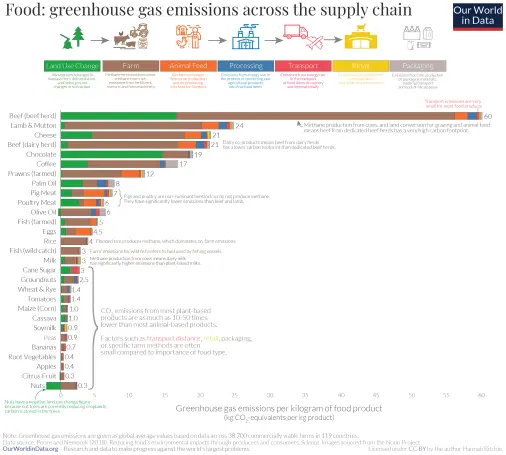
of course it’s not. Meta analyzes fly in the face of the guidance for LCAs. it’s just not good science.
since I’m already being tasked to address this again, it’s worth pointing out that poore and nemecek didn’t even gather the LCA data themselves. they, themselves, actually site other meta-analyzes of LCA data. those meta-analyzes do recognize that they are violating best practices in the text themselves, and just go ahead and do it anyway. egregiously, poore and nemecek Don’t even acknowledge this faux pas and pass off their “findings” as sound investigation.
To elaborate, LCA data is highly specific to a single production process, and might cover entirely different thing.
There’s a huge difference between “one liter of paint from prepared from pigment and solvent” and “Me driving over to get a house sanded and cleaned, then repainted, per square meter of wall”. But both are LCA’s for painting.
There are lots of sub-processes that have negative costs. Putting up a new streetlight has a environmental higher cost than replacing one, because replacing one gives you an old streetlight to recycle, but the LCA for a streetlight won’t show that.
They can even be very time-specific. If I’m sitting on a giant mountain of gravel, I can give you an LCA for your zen garden that’s much lower than last year when I had to import gravel from Norway.
Looking at chocolate here, they include lots of land-use-change, which is caused by cocoa farmers expanding and turning trees into cocoa farms. But that’s only because they’re expanding. The next harvest won’t have that change.
Water resources aren’t even on the chart. Probably because it’s about “greenhouse gas emissions across the supply chain”?
I just grabbed the first three. The real question is, why didn’t this data table mention it?
www.sciencedirect.com/…/S2772427122000560
But more bioavailability. People always forget that factor.
And that’s assuming the vegetables are raw, of course, because they lose a lot of the nutrients when cooked as well.
Fruits are a better source usually.
No.
It makes certain nutrients more bioavailabile, but destroys others that are heat sensitive, like Vitamin C.
And even then that is based on how you cook them. As you said, boiling for example leaches out potassium. But, if you’re still going to use or drink the liquid, your still get the potassium. It’s why you should drink the soup if you make bean soup - you have to boil beans.
But then there’s things like iron - that one is already bioavailabile in meat, but the kind plants have is different, and require an acid to preactivate them beforehand (that’s why it’s good to add some balsamic vinegar or lemon juice to a salad for example).
Others have nutrients that are poorly absorbed and irritate the stomach that you don’t want, especially since they’ll block absorption of other minerals. Pecans for example you need to soak and drain a few times ideally to get rid of this bad phosphorus (I think it was hexadecaphosphate?) for hours before roasting them to get the most minerals you can from them.
And there’s a lot more. You can learn and memorize this if you’re not vegan to eat healthier - or you can just eat a piece of meat. You can maybe see why people pick the latter. I don’t agree they should, btw, just explaining why some do.
I’m totally in favor of buying local! It preserves local culture, helps your neighbors, and deprives capital of a way to exploit people out of sight. The food is fresher, and having to cook with seasonal ingredients adds variety and gives fun challenges.
But it won’t prevent much carbon from entering the atmosphere.
Yes, all things being equal that’s true.
The first point is that even if it is true, for some products producing them takes much more energy than moving them. Cows are the extreme example, IIRC, where raising cows for meat takes like 80 times as much energy as delivering it.
The second point is that all things are rarely equal. You can raise bananas in a greenhouse, for example, but it will be a lot less energy efficient than shipping it from the tropics.
Cow raised 10 miles from my house. Killed on farm butchered on farm. I pick up cow and drive it 10 miles to my freezer. Cow sits in freezer for 1 year with other frozen farm products.
What are you talking about? I’m so confused at what you think but local means?
Right, that’s buying local. As opposed to having a cow raised 2000 km from your house and the meat shipped to you, which would be not buying local.
I’m not sure what you’re confused about.
Let’s compare 3 farms and please explain to me which one has the least amount of CO2 per pound of beef. You are incorrect and I shall demonstrate it, and I’d love to hear your theory on why you are correct given this context.
Farm A: Natural farm, no fertilizer inputs, no feed inputs, rotating pastures, butchered on site, sold to a local market. Pastures have been historic farms and landscape consists of healthy native plants.
Farm B. A start up funded by the Brazilian government, gifted 100 acres of rainforest, burned it down and added grass seed and fertilizer. Purchased corn from a different South American country to finish the product. Had the beef shipped across the country for slaughter, had the beef shipped across the world for sale. The land is still surrounded by some rich forests, but the grazed part is severely depleted and bordering dead.
Farm C. A feed lot in California. Cows are shipped in, water is shipped in, cows stand in dirt and erode the soil for most of their life. The land is barren and cannot take in any CO2. Cows are at a density of 100 head per acre. Standing shoulder by shoulder shitting. shit is transported out to local farms, cows are sold regionally and slaughtered locally.
Which one of these models generates the least amount of CO2 emissions per pound of beef
Because you’ve been fooled by the focus on those ships.
They’re not problematic because of their greenhouse emissions. Hauling stuff by sea is very efficient - by greenhouse gas emissions it is more efficient than rail freight. They’re problematic because they burn very dirty fuel which releases sulphur dioxide and particulates which are a different kind of pollutant. However, they’re released far from human population centres, and their most serious effects are localised, unlike greenhouse emissions, which are global. The environmental problems of cargo ships are there, but they are not the serious, urgent threat to human life that climate change is.
As such, they are a distraction.
Now do water requirements per gram of protein.
A kilo of ‘food’ can be dense and rich … or neither.
Questions for those who can answer them:
1.) What is the difference between “Milk” and “dairy herd” with regards to pollution and land use? Honest question.
2.) I’ve always wondered, but didn’t want to get flamed for asking: What if you have pet chickens? I don’t eat them, they live a great chicken life, but I end up with a ton of eggs that I give to people I know. Obviously those eggs are eaten. Does this count as some kind of horrible animal cruelty?
The dairy herd seems to be about beef from a dairy herd. So still meat, but offset by the fact that milk is produced as well. Not sure how they calculate it, nor have I ever seen beef labelled as that (…granted I also haven’t bought any in years), but it makes sense.
This just seems like a pet with a byproduct to me but maybe someone knows more about the effects of breeding for egg laying on chicken quality of life
I hadn’t considered that they would sell the meat from dairy cows, so thanks for that answer. My neighbor has cows but that’s the extent of my knowledge on them.
A few of my chickens are basically “mutts”, which haven’t been bred for anything specific. (we got them from a local who sells chickens, she turned out to know even less than I do about them, though. They’re not as healthy as the others and I suspect they are inbred) The rest of them were picked up from a farm supply store and seem to be specific “breeds”, I have some easter eggers, some Australorps, a welsummer, a black star, and some rhode island reds. I may not be doing everything right BUT my chickens have a half acre to run around on instead of being locked in a tiny box their entire lives, and the meanest thing any of them have endured is me catching them by the tail feathers before putting them back over the fence.
Dairy is the farm, milk is the product. As to pollution and land use factory farms will always cause pollution because they squeeze too many animals into an area smaller then they can live in healthily for profitability. (Cows for example need 2 acres per cow in lush lands or 50 acres per cow arid lands).
As for chickens. In my opinion as long as you have at least two chickens (they are social animals), maintain them properly, protect them from predation, keep up with vet visits/vaccinations, and let your chickens out to forage, they are a wonderful addition to a neighborhood. But make sure you read up on egg safety, especially if you plan to share your eggs.
See how they specified “beef” dairy herd. They are talking only about the livestock. The animals. The veal. The cattle they breed. The animals they cull and sell. They aren’t talking about the lactating products.
Then you have milk. The product. Lactating dairy cows have a productive phase when they are kept specifically and separately to produce milk. I know it comes off as cruel but in agriculture animals are livestock and thought of in terms of lineitems when listed out.
I hope that helps. It’s a bad graph, the creater carved out specific data points for their own personal politics which makes it hard to read. (Hence the cute notes littered around the chart). I too would have wrapped dairy cows and milk production into one line.
2.) I’ve always wondered, but didn’t want to get flamed for asking: What if you have pet chickens? I don’t eat them, they live a great chicken life, but I end up with a ton of eggs that I give to people I know. Obviously those eggs are eaten. Does this count as some kind of horrible animal cruelty?
Eh, it depends on how you look at it. Chickens are just domesticated Red Junglefowl, and we’ve bred them over the last few thousand years to be bigger, (probably tastier), and lay a lot more eggs.
IMO, egg layers and other common breeds are probably perfectly happy and comfortable birds without any ‘real’ cruelty. The way we’ve bred them certainly has made them more susceptible to certain health problems and shortened their max lifespan some (compared to their wild ancestors), but my experience with my birds has been that as long as they’re healthy, they seem to be perfectly happy with life.
I think of it the same as how we’ve bred Border Collies into existence. They’re very different from their pre-domestication ancestors, but they’re also not so severely altered that they have inherent health issues or other severe issues.
Broilers (meat chickens), however are definitely on the crueler side. Those poor things are only meant to convert feed to meat, and the whole living part is probably considered undesirable. Most only need to live somewhere between a month and a year before slaughter, and I imagine if you let them go any longer they’ll drop dead from health issues.
I’ve been reading about meat chickens, and you’re pretty much right. They grow for about 8 weeks, and then they’re bound for the nugget factory. If you try to keep them after that they aren’t healthy or happy at all.
Border collies are cool. Dad has one. We are into archery, and our range is next to the yard where the pup lives. That dog is intent on those arrows. She can’t catch one, they’re too fast, but she tries every time. She stares at the arrow on the bow, and when we shoot she will take a couple of steps toward the arrow as it flies, and then gives up at stares down the next arrow. She’s also fun with radio controlled cars.
Chickens are wonderful pets. They eat bugs and poop fertilizer. As a farmer I can tell you your land can sustain chickens, just like it can sustain hundreds of other native birds.
I’m guessing these stats are focusing on a cow farm that cut down a forest versus a cow farm that exists on a prairie. But like the carbon cycle on most land can handle a certain amount of cows.
I just really hate how these all demonize small scale farmers. Having a couple dozen chickens is much different than having 500,000 chickens. Agricultures byproducts and environmental impacts range widely.
If I buy half a cow from my neighbor, it doesn’t travel, it gets processed locally. The ecological foot print is different than me getting a cow from Brazil.
Having a couple dozen chickens is much different than having 500,000 chickens.
I’ve felt that but I haven’t really put it into words. My flock of modern dinosaurs gets to run around and eat all the ticks while standing in the sun and digging in the dirt. I’ve never had chickens before these, and the thing that surprised me is that they aren’t mindless balls of feathers. They have personalities. They communicate. They make lots of dinosaur noises too.
I like chickens more than people. They are wonderful little beings. They make me so incredibly happy as they run around and peck at each other.
Nature sequesters carbon. If you are farming within the natural limits of your land you shouldn’t be generating much carbon at all.
All these people have a hard time imagining an old timey farming. Pre Industrial Revolution. There are plenty of natural farms around to this day. Tons of farmers, honoring traditional farming practices.
2.) I’ve always wondered, but didn’t want to get flamed for asking: What if you have pet chickens? I don’t eat them, they live a great chicken life, but I end up with a ton of eggs that I give to people I know. Obviously those eggs are eaten. Does this count as some kind of horrible animal cruelty?
Hard to say without context. While taking chickens’ eggs does sound (and inherently is cruel), not even animal rights types care too much. It’s just so ingrained in society.
The difference is when we talk about factory egg farms. Y’know, when they put chckena into their cage so they can’t turn around in it, their head poking out into the feed box, and they can only lay their eggs into a hatch - no collection required.
Then the eggs get inspected, worse sent for birthing new chickens, and better ones being sold.
Then those for breeding chicken get inspected when the gender of the baby can be known, and 99.9% of male eggs get thrown into a fucking shredder (because you only need 1 rooster per 12-ish breeding hens).
This is what most concerned people have an issue with.
Just going to pitch in real quick. Growing your eggs on site is way better for the environment, since they don’t have to be shipped to your grocery store from miles away.
Your chickens, even if you are a pos that doesn’t take care of them at all, will still have a better life than in an egg laying factory.
I highly suggest it. I had some for a while. It’s surprising how many eggs you end up with as well, you don’t need that many and it’s easy to give them a nice life.
 pelespirit
 Porco
Porco SaneMartigan
 whyNotSquirrel
 khannie
 Dasus
Dasus Obi
Obi