 NomNom
Food CO2 emissions
I’m totally in favor of buying local! It preserves local culture, helps your neighbors, and deprives capital of a way to exploit people out of sight. The food is fresher, and having to cook with seasonal ingredients adds variety and gives fun challenges.
But it won’t prevent much carbon from entering the atmosphere.
Yes, all things being equal that’s true.
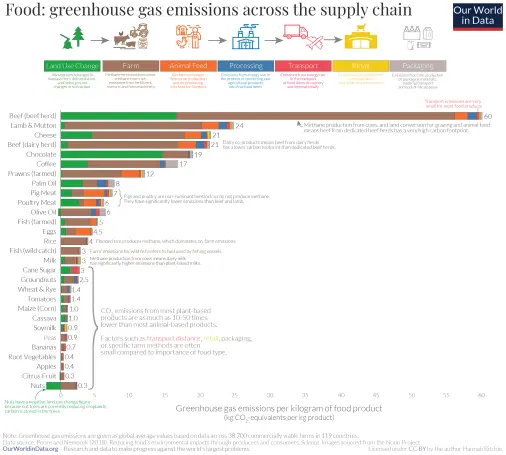
The first point is that even if it is true, for some products producing them takes much more energy than moving them. Cows are the extreme example, IIRC, where raising cows for meat takes like 80 times as much energy as delivering it.
The second point is that all things are rarely equal. You can raise bananas in a greenhouse, for example, but it will be a lot less energy efficient than shipping it from the tropics.
Cow raised 10 miles from my house. Killed on farm butchered on farm. I pick up cow and drive it 10 miles to my freezer. Cow sits in freezer for 1 year with other frozen farm products.
What are you talking about? I’m so confused at what you think but local means?
Right, that’s buying local. As opposed to having a cow raised 2000 km from your house and the meat shipped to you, which would be not buying local.
I’m not sure what you’re confused about.
Let’s compare 3 farms and please explain to me which one has the least amount of CO2 per pound of beef. You are incorrect and I shall demonstrate it, and I’d love to hear your theory on why you are correct given this context.
Farm A: Natural farm, no fertilizer inputs, no feed inputs, rotating pastures, butchered on site, sold to a local market. Pastures have been historic farms and landscape consists of healthy native plants.
Farm B. A start up funded by the Brazilian government, gifted 100 acres of rainforest, burned it down and added grass seed and fertilizer. Purchased corn from a different South American country to finish the product. Had the beef shipped across the country for slaughter, had the beef shipped across the world for sale. The land is still surrounded by some rich forests, but the grazed part is severely depleted and bordering dead.
Farm C. A feed lot in California. Cows are shipped in, water is shipped in, cows stand in dirt and erode the soil for most of their life. The land is barren and cannot take in any CO2. Cows are at a density of 100 head per acre. Standing shoulder by shoulder shitting. shit is transported out to local farms, cows are sold regionally and slaughtered locally.
Which one of these models generates the least amount of CO2 emissions per pound of beef
Because you’ve been fooled by the focus on those ships.
They’re not problematic because of their greenhouse emissions. Hauling stuff by sea is very efficient - by greenhouse gas emissions it is more efficient than rail freight. They’re problematic because they burn very dirty fuel which releases sulphur dioxide and particulates which are a different kind of pollutant. However, they’re released far from human population centres, and their most serious effects are localised, unlike greenhouse emissions, which are global. The environmental problems of cargo ships are there, but they are not the serious, urgent threat to human life that climate change is.
As such, they are a distraction.
 SaneMartigan