 David Ho
It doesn’t matter whether the rate of global warming is increasing. It’ll never cease to amaze me that people don’t care that it’s happening at all. It should be the most alarming thing ever.
 FediThing
This comedy sketch sort of sums it up: https://www.youtube.com/watch?v=I9M3go2bAIE
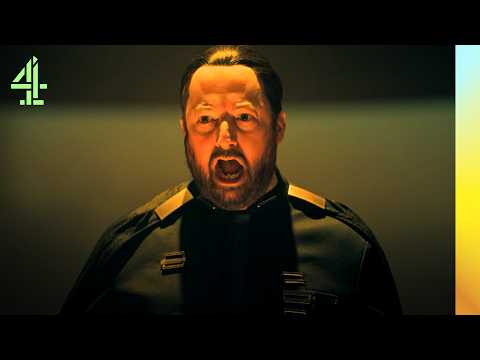
When The Baddie Plans To Destroy The World! | Mitchell And Webb Are Not Helping | Channel 4 Comedy
 Dr Susi Arnott
@FediThing @davidho
"Well, we don't want to... but hard to make it a priority..."
Horribly brilliant variation on the banality of evil
#56years #climatecomedy
"Well, we don't want to... but hard to make it a priority..."
Horribly brilliant variation on the banality of evil
#56years #climatecomedy
 Roadskater, Ph.D.
@davidho Wait til the public find out what all those de-orbiting SPaceX platforms will do to the stratosphrere. The response will be… nothing.
 AL
AL Gray Hairs
@davidho
They might be too busy working and taking care of children, elders, or others.
They might be too busy working and taking care of children, elders, or others.
 Thad
Thad gclef
gclef John Tinker
@davidho
That people don't care is perhaps the most alarming thing of all, as individuals we have no power against the foe of global warming of the climate. Only a movement can do it. I have felt the same way with regard to people letting a genocide go on for so long, a genocide that they armed. That they let a mobster mentality become top dog. Our polity is in an alarmingly poor condition to face these multiple crises.
That people don't care is perhaps the most alarming thing of all, as individuals we have no power against the foe of global warming of the climate. Only a movement can do it. I have felt the same way with regard to people letting a genocide go on for so long, a genocide that they armed. That they let a mobster mentality become top dog. Our polity is in an alarmingly poor condition to face these multiple crises.
 Cassandrich
@davidho How to lie when reporting on anything changing: keep taking derivatives until the sign tells the story you want.
 Ham on Wry
Those in power … those who don’t care … spend their lives in climate controlled offices and homes while looking at the rest of humanity as expendable
 Rudra
Rudra Crystal_Fish_Caves
@davidho the earth HAS been this hot and much hotter before.
It was billions of years ago, the air was poisonous, there was NO water, surface was molton rock, the newly condensed dust cloud still collapsing and life will not begin for eons, but yeah earth has been hot before.
#ai data centers now?! ummmm no.
 Rastal
@davidho It's not that people don't care. It's that war hawks see global warming as something that can effectively be used as a weapon of war. They think, why fix it when it serves US global dominance?
Look at #iran right now, if that side loses and it gets balkanised by US-Israel side, global warming will be used as a weapon to keep the resulting factions in failed states, fighting each other for generations, for access to drinking water. That's the US-Israel goal by harnessing global warming
 Mister Shade
@davidho Voting out the #republican party is an important step in addressing climate change.
Yes, everything is political. Everything has always been political.
No, the #democratic party isn’t going to usher in a new golden age. They’re just what we have to use to oppose the #Trump regime.
Hopefully enough people finally understand that inaction and non-participation are immoral, and are contributing to the world’s problems.
 Kent Navalesi ☕️
Most people fundamentally do not care about anything. Perhaps the most depressing realization of my middle-age.
@KentNavalesi most people care about many things. Some examples: economy, immigration, defence or offense (war), guns, their salary, family, status, religion etc. And people can do quite passionate protests in large numbers on these issues.
And climate change is not perceived as big issue, maybe because humans did no evolve to care about it (were not solving global issues throughout evolution). For comparison, imigration, displacement or war were huge issues affecting people.
@davidho
And climate change is not perceived as big issue, maybe because humans did no evolve to care about it (were not solving global issues throughout evolution). For comparison, imigration, displacement or war were huge issues affecting people.
@davidho
@KentNavalesi @davidho yes, people have an emotional brain.
 Hmm
Hmm Angie
Angie The Sneak
 Lord Caramac the Clueless, KSC
@davidho No, it should be the second most alarming thing. The most alarming thing should be the Sixth Extinction which is going on all around us. The insects are bloody disappearing, why isn't anybody panicking about it?
 CynBlogger ❌👑
@davidho
Pretty harsh (& not accurate, according to opinion polling) to say “people don’t care.”
Pretty harsh (& not accurate, according to opinion polling) to say “people don’t care.”
 Hugs4friends ♾🇺🇦 🇵🇸😷
 Koen 🇺🇦
@davidho it could be that the great filter is not some global nuclear war, just the human species slowly making earth unlivable/polluted beyond repair as they don't see the global urgency on their individual level --- + the money/power of the polluters destroying the true more complicated message of the few who are well informed
 Jonathan Schofield
@davidho people do care.
But we’re in a learned helplessness predicament https://overcast.fm/+BTumV_9HOY
A Guide to Staying Human (Part 1): Desperately Seeking Agency | Frankly 129 — The Great Simplification with Nate Hagens
In this week’s Frankly, Nate begins a new series called “Staying Human,” which focuses on what he sees as a precondition for everything else: recovering a sense of personal agency. He opens against the backdrop of Operation Epic Fury and the broader turbulence of 2026, but rather than offering geopolitical analysis, he turns inward toward a question that has been reshaping his theory of change: why does growing awareness of the more-than-human predicament so often produce paralysis rather than action? Nate traces the gap between awareness and agency through several layers. He draws on the science of learned helplessness and self-efficacy research to explain how nervous systems learn whether effort leads to outcomes, and how a digital environment designed to fragment attention can train people to stop investing in their own follow-through. He frames this not as a personal failing but as a predictable consequence of living inside a Superorganism that advertises choice while eroding the conditions for it.…
@davidho
…an extract from that link:
1/4
“We are asked to care deeply about outcomes that we have almost no leverage over, and at the same time, the information age is amplifying our awareness of things faster than our collective capacity to intervene and act. But here’s the thing, when awareness grows and agency does not, a sort of paralysis sets in, and that gap produces cynicism and shame and something that feels close to moral injury. People sense the magnitude of our predicament and…
@davidho
2/4
…“they also sense their smallness inside of it. And then they feel, wrongly in my opinion, that their inability to change it is some sort of a personal defect. Guilt and shame and resignation show up and when shame takes hold, people often respond by signaling purity or becoming overly certain and dogmatic, or by withdrawing entirely. People’s nervous systems learn that action is costly and exposure is risky, so people can end up being hyper aware and immobilized at the same time…
3/4
…“and at the macro level, that combination makes us easier to steer because it keeps people in reaction mode instead of proactive mode.
I increasingly think that many of us now live in a kind of soft feudalism. Yeah, we have comfort and convenience and entertainment and abundance of choice in the narrow consumer sense…
4/4
…“At the same time, there are walls and gates around us built out of institutions and incentives, ownership patterns, and the hard physics of a globally interconnected energy-intensive way of life. And those walls in an Orwellian sense we call freedoms in our culture, but for those paying attention, they increasingly look like prison gates. The feeling that nothing we can do makes a difference, is increasingly one of the biggest hurdles we face.”
A Guide to Staying Human (Part 1): Desperately Seeking Agency | Frankly 129 — The Great Simplification with Nate Hagens
In this week’s Frankly, Nate begins a new series called “Staying Human,” which focuses on what he sees as a precondition for everything else: recovering a sense of personal agency. He opens against the backdrop of Operation Epic Fury and the broader turbulence of 2026, but rather than offering geopolitical analysis, he turns inward toward a question that has been reshaping his theory of change: why does growing awareness of the more-than-human predicament so often produce paralysis rather than action? Nate traces the gap between awareness and agency through several layers. He draws on the science of learned helplessness and self-efficacy research to explain how nervous systems learn whether effort leads to outcomes, and how a digital environment designed to fragment attention can train people to stop investing in their own follow-through. He frames this not as a personal failing but as a predictable consequence of living inside a Superorganism that advertises choice while eroding the conditions for it.…