Genuine and possibly dumb question

Why do watch makers advertise "quartz"?

Is it the name of the movement or the actual mineral? Isn't it like one of the cheapest and most abundant minerals? Why is it worthy of advertising?

I never understood this.

@chu

@MelissaBearTrix might be able to answer this.

@davidtheeviloverlord @chu

Inside the watch is a thin crystal of quartz, it vibrates around 32.3 somethings per second, and there is a chip that counts, and then sends a signal to the little motor to take a spin, well rotate

Hugz & xXx

@MelissaBearTrix @davidtheeviloverlord @chu To add on to this, quartz has piezo electric qualities. If you strike it, it generates a charge, but if you run a charge through it it bends, completing a circuit. If you take particularly pure quartz, and shape it very precisely, you can make a highly accurate clock circuit, pretty much the most accurate you can get short of using atomic clocks. During WW2 quartz crystals were considered a military secret by the british, as they were used to tune their radios (for radar, etc). Early computers used them extensively, highest I ever saw was 33Mhz.

By writing "quartz" on the watch, they're advertising that it's pretty damn accurate. Compared to pre-quartz based time measurement.

I know modern devices use MEMS devices -- essentially a very tiny tuning fork made on a silicon chip -- for their low frequency clocks (ballpark of 15khz, the standby clock in a phone will use this), I'm not sure how the 100Mhz + signals are made
@chu @davidtheeviloverlord @MelissaBearTrix This doco is a cute view at the technology back when it was the Next Big Thing - https://www.youtube.com/watch?v=duZlWWwxIPQ
From Raw Crystal to Crystal Oscillator - Crystals go to War in 1943

YouTube

@sophie @chu @davidtheeviloverlord

That's all about correct, 32.xxxx is the frequency, and from 30 plus years ago, divisible by 60, I think

Omega also made a 120 mega Quartz and also a dual quartz

Hugz & xXx

@MelissaBearTrix @chu @davidtheeviloverlord 32768, or 2 to the 15th power, a very convenient number for simple computers to work with. I suspect that number is as much selected for the ease of honing in on with cheaper equipment than anything else. If it's off by a few dozen Hz, the device is still accurate to a few seconds per day. Heck it can be off by a few hundred and still be good enough.

@sophie @chu @davidtheeviloverlord

That's the number

Thanks

Hugz & xXx

@MelissaBearTrix @chu @davidtheeviloverlord The intersection of watch people, oldschool computer people, and very oldschool radio people.

@sophie @davidtheeviloverlord @MelissaBearTrix

This is why I'm on this platform.

Love this place.

@chu @sophie @davidtheeviloverlord @MelissaBearTrix this thread reminds me of why multiple people with very specific special interests beats LLMs every time. It makes me happy.

@Kellyshenanigans @sophie @davidtheeviloverlord @MelissaBearTrix

I'm now somewhat curious to know what a similar inquiry into LLM would yield.

But not curious enough to reactivate an account and do it. I tried chatgpt at first out of curiosity but it's been a while.
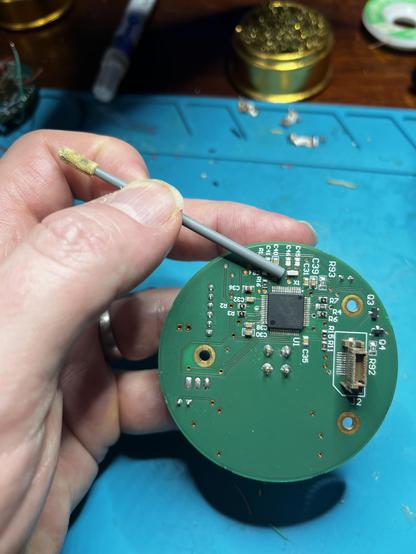
@chu @sophie @davidtheeviloverlord @MelissaBearTrix just because I happened to be in the lab when I saw this thread: here’s some of my electronics that uses a 32kHz quartz crystal oscillator (that’s the tiny silver part I’m pointing to) as both the system clock source oscillator (via a PLL) for my microcontroller and as the clock for a low power timer that wakes up the electronics every 60 minutes.
@sophie @chu @davidtheeviloverlord @MelissaBearTrix
I want to add here
The reason they choose that frequency is they can run it through a series of very simple latching flip-flop circuits to half the frequency again and again until they get back to one second, and 2^15 is the first power of 2 that most people can't hear
@sophie @chu @davidtheeviloverlord @MelissaBearTrix they actually test the accuracy of quartz clocks with ultrasonic microphones

@RnDanger @sophie @chu @davidtheeviloverlord @MelissaBearTrix

That, I didn't know, but totally makes sense. I did the quick mental math and 2^15 would be 32 kHz, above human hearing, and one below that would be only 16, which I could totally hear when younger. Most humans top off around 20k.

Neat!

@chu @davidtheeviloverlord @MelissaBearTrix @sophie interesting: I knew some of the quartz stuff, but not all. Integrated circuits have used quartz as (one of) the insulating materials for a long time. I guess not crystalline enough to make a tuned oscillator
@sophie @chu @davidtheeviloverlord @MelissaBearTrix To get higher frequencies you use a low MHz quartz with a PLL, which is basically a feedback stabilised frequency multiplier.
@sophie @chu @davidtheeviloverlord @MelissaBearTrix I think 33 Mhz is the max they can naturally ocsillate under their own energy or something like that. But the quartz clocks in computers is why early machines had just these wacky clock speeds like 18.333 Mhz, but I remember reading an article saying that thise old IBM mainframes kept time more accurately than modern machines do.
@praetor above ~30MHz one generally uses so called PLLs or phase locked loops. It kinda works the same as with a quartz where you oscillate at 32767 times per second and count to 2**15 and you finish counting in 1.00000 seconds, but here you start with a digital oscillator at say 4.3 GHz and divide by counting till say 2**16 (about 65536) , and then compare that pulse with a quartz clock or MEMS clock that accurately runs in the high kHz range (say 65kHz for a 4.3GHz system), and you speed up or slow down your 4.3GHz thing depending how much too late or too early you finished counting.
@sophie @chu @davidtheeviloverlord @MelissaBearTrix

@otte_homan @praetor @sophie @davidtheeviloverlord @MelissaBearTrix

Shared this thread with a friend (he's not on mastodon so can't post) but he told me that the Japanese innovation, hence "Japanese quartz" that you sometimes see advertised is that they figured out back in the day you don't need to spend all that time and money precisely cutting the quartz. You can hack it any which way and then electronically calibrate its vibration frequency to set the time for each timepiece. Way cheaper to do it electronically and it was another way they got the cost down.

@chu possibly. Instead of counting to 2**15 (which in simple 74xx logic only requires a single 16 but counter and a single reset wire), of course in modern days you can count to any random number, which you can measure and then store in some NVRAM chip etc. @praetor @sophie @davidtheeviloverlord @MelissaBearTrix
@otte_homan that is very interesting. And probably how Intels Speedstep, or whatever they call it, works.
Just change the the clock timing depending on processor load to save your battery. @sophie @chu @davidtheeviloverlord @MelissaBearTrix

@praetor @sophie @chu @davidtheeviloverlord @MelissaBearTrix Since we live in a nonlinear world, you can also pull off odd harmonics from a crystal oscillator, so 3rd/5th/7th harmonics can be used.

I’m fond of telling people that quartz is at the heart of all radios, so they are talking through the magical power of quartz.

@sophie @chu @davidtheeviloverlord @MelissaBearTrix
Interesting as well is that the same piezoelectric quality is though to attract gold during earthquakes, potentially giving rise to the super enriched quartz gold veins that are often observed in nature.
https://www.nature.com/articles/s41561-024-01514-1
Gold nugget formation from earthquake-induced piezoelectricity in quartz - Nature Geoscience

Quartz emits a piezoelectric charge during deformation that may promote the formation of gold nuggets within veins in orogenic settings that experience earthquakes, according to a study using quartz deformation experiments and piezoelectric modelling.

Nature

@PhilGopon @sophie @chu @MelissaBearTrix

Interesting. I'm writing comic fantasy novels set in a version of Australia. And I haven't written about our gold rush yet.
I have...ideas.

@davidtheeviloverlord @sophie @chu @MelissaBearTrix
Once you are done with the Aussie goldrush I would love of someone did a historical comic about the original Aussie (Austria) goldrush in Roman times. I forsee something between Asterix and Lucky Luke.
🤣🇦🇹
#nokangaroosinaustria

@davidtheeviloverlord
Opals - put in opals! I recently went to a fossil and mineral expo and opals are just mindblowingly beautiful and magical.

Also, comic fantasy novels set in Australia-ish sound amazing. I am unavoidably now thinking of Tank Girl. (The comics, not the film). And Reboot.EXE - a brilliant RPG podcast series by Tabletop Time (https://player.fm/series/tabletop-time-roleplay) which is set in a postapocalyptic Australia. I love fantasy in non-European settings.

@GinevraCat

I'm now thinking of writing a book about comic fantasy Australia's gold rush.

The economy nearly collapsing because "no one wants to work", because everyone wants to strike it rich on the goldfields.

The Eureka Stockade.

Finally, the gold rush subsides. Things start to return to normal. And then someone finds opals...

@sophie @chu @davidtheeviloverlord @MelissaBearTrix
The quartz crystals that run at 32768 Hz are also in the shape of a tuning fork.
All quartz crystals are mechanical resonators. The piezo-electric effect is very convenient for driving them and getting an electrical signals from them, but it has next to no effect on the frequency. To make a bit of quartz resonate at 32768 the tuning fork is used. Crystals in the MHz range use a different mechanical resonance, called thickness-shear mode.

@sophie @chu @davidtheeviloverlord @MelissaBearTrix
Very high frequencies can be derived from low frequency sources, like a 32 kHz watch crystal, with a Phase-Locked Loop circuit.

https://en.wikipedia.org/wiki/Phase-locked_loop

Phase-locked loop - Wikipedia

@sophie @chu @davidtheeviloverlord @MelissaBearTrix

> I'm not sure how the 100Mhz + signals are made

They are generated by Phased-Locked Loops (PLLs), which are essentially a way to multiply the frequency of input clocks.

Formulas differ based on the PLL design, but it usually has a multiplier, a divider, and a divider by a power of two: output = (input * n / m) >> p

Create a clock tree using PLLs and you can raise the quarz's clock from a few MHz to multi GHz! And best of all, you can change the generated clock at will by tweaking the parameters anywhere along the chain of PLLs.

@MelissaBearTrix @davidtheeviloverlord @chu it vibrates exactly 32768 times per second. Why that odd number? Well a chip with 15 bits can count up to that number and then automatically resets to zero. And that reset action is the trigger to advance the watch by 1 second.
2^15=32768
@MelissaBearTrix my little mind just blown because realisation of the physics 😯🫂
@davidtheeviloverlord @chu
@MelissaBearTrix the quartz crystal is a very precise (as in: stable) electronic oscillator with the best stability vs power use vs size vs volume vs weight ratio for a watch (or a wall clock)given the time scale we're interested in (say minutes to months). On the time scale of a minute it is nearly the most precise oscillator one can have, and on the time scale of a month it only loses a few minutes or so, which is fine. There are other clock mechanisms (like mechanical pendulum clocks or atomic clocks or hydrogen masers or ...) that are way more precise over shorter (milliseconds) or longer time frames (years) but they are huge, take heaps of power, etc, and are not suitable as a watch that you need to wear on your wrist.
@davidtheeviloverlord @chu