Hey @gproenca, thanks for the follow request! Unfortunately there's not enough vibe on your profile to check, so...

You must choose one highly-specific, and utterly trivial hill you're totally willing to die on. What is it?

(if you already have one, you may share it instead of choosing a new one)

For me, it's use of the term "guys" for groups that aren't all guys. I've found myself more and more annoyed the more I talk about it. Now, I'm like at the point that I'm railing against the default-masculinity of language to random strangers at the grocery store! Also, it's not trivial! Language is important—it shapes our perceptions! How many guys have you slept with, huh? Huh??

#CAPTCHAlice

@alice this is truly UTTERLY trivial, but I always get a little bothered when someone says "This goes without saying..." / "This is self-explanatory, but..." and then *continues to say or explain it* 🥲🥲

Something is not adding up there...

@alice @gproenca The Oxford comma is better; it removes ambiguity and costs nothing. There is strictly no reason not to use it when it can only enhance meaning.

@theorangetheme @alice @gproenca “It costs nothing”

Excuse me, but it costs exactly one byte* times the amount it’s stored and transferred.

:P

* Assuming ascii or utf-8

@theorangetheme @alice @gproenca And no I’m not serious, and an Oxford comma enjoyer myself. :)
@ainmosni @alice @gproenca I just knew somebody was going to say this hehe. ;)
@theorangetheme @alice @gproenca here, too, shall I plant my colours.
@theorangetheme @alice @gproenca I occasionally just think about my favorite example sentence demonstrating why it's necessary: "I'd like to thank my parents, Oprah and God."
@shadow53 @alice @gproenca I've seen a variation of that on Wikipedia, with a book dedication: "To my parents, Ayn Rand and God" hehe.

@theorangetheme @alice @gproenca

There are indeed costs involved. Storage costs were mentioned. There is also a small but incremental cost in ink and paper when printed.

@w_b @alice @gproenca Nerd snipe question: how much extra ink and paper has been used throughout post-printing press history for the Oxford comma? ;)

@alice

no computer mouse should ever be produced with fewer than 3 top buttons (NOT including "click the scroll wheel") and 3 side buttons

@matildalove What does the third top button do?
@dieweltist middle click
@dieweltist clicking the scroll wheel is dumb and stupid. a wheel is not a button
@matildalove thinking about it, it is a struggle for me to press the wheel sometimes without accidentally scrolling, and I'm young and able-bodied 🤔

@dieweltist @matildalove 1000% this. Clicking a scroll wheel without moving the mouse or wheel is nigh impossible unless on a trackball, and then it is still very hard.

I propose the default bind for the first three thumb buttons be ctrl/alt/shift.

@matildalove
THIS

Yet in practice makes clicking awkward because of bad implementations.

(Thank gods for Ctrl+LMB.)

@dieweltist

@alice One! I mean, uh, one and a half.

Not at the same time. Do they count if it was one at a time?

I mean, uh, the meter of a piece of music can be just as impactful and expressive as the melody or lyrics.

@alice @gproenca britisher is a better demonym than briton

@alice
Fahrenheit is the superior system for human environments.

I will concede for *everything else*, Celsius is better.

@pockets @alice I'm over here on the other hill (which is in Canada).

Honestly what I believe is, whatever we're used to, we'll come up with reasons why they're the "superior" one, but those reasons are all post hoc.

I have no idea how hot or cold an outdoor temperature of -5 F is, but I immediately know what -20 C feels like. I similarly have no idea how hot a 225 C oven is, but I know exactly what I'd bake at 450 F.

(they're the same temperature in each case but I had to look it up)

@dragonfrog
The only distinction I feel between different sub-freezing temperatures is how quickly I get cold.

But I understand your perspective.
(Not saying I agree, else my opinion would be too malleable to meet the criteria of the original question.)

@alice

@alice
“Or” is not exclusive.

(Makes more sense if your language has separate words for “or” and “xor”, like Polish “lub” (“or”) and “albo” (“xor”) and still there is a totally redundant construct in use as “i/lub” (“and/or”).)

@alice In cricket, when a batter is out for 0, some commentators use the phrase "didn't trouble the scorers" to describe the innings.

That really grates. The scorer will already have written the player's name in the scorebook and details of the balls faced. Once you are named in the playing XI, you do in fact trouble the scorers.

And it also makes the scorers sound well grumpy. Which they aren't, in my experience. Most scorers enjoy their job and are very good at it.

If you don't have a scorer then you don't have a game of cricket.

@gproenca @alice Just gonna go ahead and volunteer mine

The printing press stole my favorite letter in the English alphabet: Þ. It represents the sound we now use the abominable "th" for. It's why all those signs say "ye olde", they were using a y to substitute for þe.

I want fewer nonsensical digraphs! Down with th, down with ch, give me unique letters for these clearly unique sounds!

While we are at it, x and q don't make unique sounds, so kill them. C only makes a unique sound when used with ch, so kill that and replace it with a letter for that sound.
@LivInTheLookingGlass
Given we have S and K, we don't really need C at all, so we?
@alice @gproenca
@LivInTheLookingGlass @alice @gproenca And for heaven's sake bring back Yogh (Ȝ). It's why no English person knows how to pronounce Dalȝiel, Menȝies,Cockenȝie, Kirkgunȝeon or Ȝetland.
@LivInTheLookingGlass @alice @gproenca Have you read the very old essay, Meihem in Ce Klasrum? I love it, and it takes your ideas and runs with them.
Meihem In Ce Klasrum

@LivInTheLookingGlass ah you poor bastard, learn some Polish before you open your damn yapp...

@alice @gproenca

@LivInTheLookingGlass @alice @gproenca you've hit my info dump trigger. Making a conlang and this is one of those things I'm "fixing" (at least it feels better to me).
- c says "sh" (already have k for "can" sound).
- j makes the "s" in leisure.
- neither "th" sound at all (it's hard for non-English folks and uncommon in most languages, apparently).
- "ch" sound comes from the (now natural) diphthong "tc" ("t" gliding fast into "sh" kind of sounds like this, right?).
- same for the "j" in "judge". That's now "dj" like the voiced version of "tc".

There's more. But I'll exercise at least _some_ self-restraint 😁

@LivInTheLookingGlass

We need glottal stops ɂɁ because my last name Lawɂn and the word gloɂl both have them, not “t”, in my language (northwest English—Lancashire)

@alice @gproenca

@LivInTheLookingGlass
I've spent 70 years explaining how to spell/pronounce my surname, Thane. So yeah bring back 'thorn'
@alice @gproenca

@LivInTheLookingGlass @alice @gproenca I speak multiple Romance languages and one other Germanic and teaching my son to read is an exercise in humiliation.

The sounds we need exist: thorn, chi, wynn…Latin is so not optimal

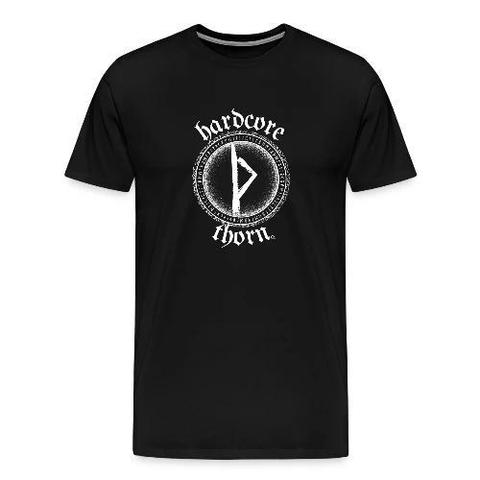
@LivInTheLookingGlass @gproenca @alice Hoping everyone in this chat has already heard of YouTuber RobWords, and especially the “Hardcore Thorn” merch!

https://robwords.com

@alice @gproenca Oh I like this one! Here's mine:

Em-dashes are American and en-dashes are British. Using em-dashes in British English is like dropping the 'u' in colour.

@alice

"Emails".

"Email" is a mass noun, like "air" and "snail mail". You don't say "the postman bought three mails" — you say "today's mail contains three letters" or "two letters and a parcel". Similarly, it's "two email messages" or, when the context is clear, just "two messages".

This is how the word was used in the early days of email.

I'm aware that this makes me sound positively palaeolithic. Please understand that that's because I am palaeolithic.

@gproenca

@CppGuy @alice @gproenca

Counter-pedancy, it's E-Mail.

@fennix @alice

It certainly used to be, but I find that too clumsy and self-conscious. (We also used to have "e-diary" in the days when most people kept their diaries on paper.)

@gproenca

@alice
I know it’s in Duden and the Germans can use it if they want but in Austria potatoes are called Erdäpfel, not Kartoffeln.
@gproenca

@alice @gproenca
Oh, I get so grumpy about how we name bike tire sizes.

There's a perfectly rational ISO standard for bike tire sizes, the ISO size is stamped on basically every bike tire manufactured this century, and importantly the ISO standard references dimensions that *actually exist and can be measured* on the tires.

But we go around naming them by all kinds of confusing and ambiguous names, mostly inch measurements that don't exist no matter what part of the tire you measure!

@alice @gproenca
If I told an extraterrestrial these common bike tire sizes are sorted from largest to smallest wheel diameter, they should rightly think me insane:
- two different sizes called 28"
- 27"
- a size that's called either 28" or 29" depending if you're talking to a road or mountain bike person
- a different 27"
- two different sizes called 26"
- 27.5"
- two more different sizes called 26"
- four different sizes called 24"
- five different sizes called 20"
...

@alice I have long looked forward to the captcha that leaves me unable to keep my mouth shut.

The lack of a common “xor” in conversational English is a glaring deficiency that bothers me. You can kind of use “and/or” to explicitly mean an “inclusive or”, and most people will understand that. But far fewer will use it that way. In general you can kind of mostly infer if an or is supposed to inclusive or exclusive. But there’s just enough ambiguity to bother me.

We should fix the English language, in a lot of ways actually, but this is the one that annoys me personally and deeply, and this is a hill I will die on.

@NineIsntPrime @alice I often miss German’s gleiche/selbe distinction in English. Both are “the same”, but in different senses.

Gleiche is two copies of the same thing, like two coins of the same denomination struck at the same mint on the same day.

Selbe is same as in “the same mint” or “the same day”. The same instance of the thing.

@NineIsntPrime @alice Either X or Y, but not both. Is that XOR? Can anyone do it in fewer words or clearer?

@semitones @NineIsntPrime @alice

Maybe (X || Y) && !(X && Y)

But I guess that's technically the same as those words.

@semitones @NineIsntPrime @alice "X if and only if not Y".

if you wanna piss off English professor's, you can do "X iff not Y", but it only works on writing. It isn't exactly the most flowery way to communicate it though.

@NineIsntPrime that English is less specific leads me to do one thing: when I need to machine translate a sentence to another language, I usually do it from German because I know the outcome is much more likely to be exactly what I want to express.
When machine translating from English the result always seems to miss grammatical Details if translate to a more complex language

@alice

@NineIsntPrime although in this specific case: I think German also doesn't have an exclusive or? 🤔 Or rather: "oder" is used mostly exclusive, even though grammatically it can be both... Do you have some example sentences where you would use an exclusive or in English so I can think how I would say those in German?

@alice

@NineIsntPrime @alice even worse: sometimes it's common to use "and" where you really mean "or", and vice versa.

Casual example: "My dad always calls me when I'm driving and when I'm at work". Hmm, unless you drive for work, you mean "or", not "and".

Math example: if we solve an inequality to find the set of all possible x values is across two intervals A∪B (A union B), for instance, [2, 3)U[5, 7], somebody might say "the range of all x values is A and B." No!!

The range is perhaps A + B, but it's not "A and B", because "A and B" would, if anything, be A∩B (A intersection B). Since A and B don't usually overlap, this would usually be equal to ∅, the empty set. That is, x has no valid solutions.

Basically I'm tired of people being ambiguous in their language when discussing math and sets, despite the fact that the words they use have very precise meanings that could be used instead.

(Does this matter? Probably not. Is it fun to talk about anyways? Yeah...)

Hey @alice can I borrow your nerd-snipe stamp for a moment?

@riverpunk

@NineIsntPrime @alice My wife (the English composition major and writer/editor) and I (the Math major and computer/database person) often come to (verbal and mostly good-natured (mostly)) blows about this. Many places she assumes an exclusive OR when it isn't absolutely required by context, whereas I assume inclusive OR.