New post, and this one's definitely one of my weirder ones: it's about how most of the tech industry shows symptoms of something that looks like gender dysphoria.

https://deadsimpletech.com/blog/carbon_dysphoria

Carbon Dysphoria | deadSimpleTech

And now the punchline: this depersonalisation, the weird relationship to their bodily existence, inability to enjoy things and an internal void that people constantly try and fill with what they're told they should want... all of these things are very similar to the experience of gender dysphoria.

deadSimpleTech
@iris_meredith That pitch was 100% on-point, I am sold already

@iris_meredith I have used similar language to describe some of my own problems with the tech industry and my personal life and honestly I want to say a whole lot more but it's way too upsetting and personal.

To put it mildly, you're definitely on to something here.

@iris_meredith fuck, this hits hard.

I would also include all the brilliant minds working hard on giving us depression from computers.

I saw a random comment on Reddit: ... many smart people tie their inherent value to their professional contribution. I can relate. AuDHD, I live and sleep in a constant mild to high strees, it takes high effort to not escape discomfort from the real world and inside my head. SwE allows it plus the validation that I exist. But this validation is my output.

@iris_meredith this is really interesting. my take as an autistic person (obviously there are a lot of us in tech) is when you lack proprioception, your bodily needs often don't become apparent until they're physically painful, and I can imagine the mindset that would keep meal replacement shakes on hand so they can go back to hyperfocussing on programming or videogames or whatever. and the more emotionally disregulated you are, the worse it gets, and I think a lot of tech bros are wallowing in a pit of self-hatred and online toxicity so it's a vicious cycle
@iris_meredith I think I meant interoception, not proprioception
@tinybird @iris_meredith i also sometimes get those two things confused and i think that’s because they’re related (awareness of where you are in space requires awareness of what signals your senses are giving you, which manifest as internal bodily sensations)

@chrisamaphone @tinybird @iris_meredith one contrarian data point: my proprioception has always been near-perfect (eg I can use my hands effectively while blindfolded), but my interioception is almost nonexistent (have to focus to tell whether I am feeling bad, very hard to figure out what kind of bad / what part of me hurts).

Perhaps “helpful, but not the whole picture”?

@iris_meredith If I'd focus on one aspect only.

I started to work in tech in 2000, IT crowd was in basements, away from real people, we were geeking out with a bunch of nerds, life was fun.

Fast-forward, and billionaires like Thiel and Brin telling employers that 60 hours a week is the "sweet spot" and Thiel wannabes tell me to "inspire" team to work 60h/week also leading by example.

@iris_meredith yeah, well put. it's always a delicate line trying to analyze the motivations of large groups of people like this, and you walked it carefully.

@iris_meredith Can confirm considerable cognitive dissonance between what I think creates value in the world and what "tech" is asked/made to build most of the time.

Can also confirm strong conflicts of this line of work with needs of body and soul. Some of that applies to any desk job, I think. On top of that, there's definitely many people who invest most of their free time to "stay on top" of developments (which of course normalizes that behaviour and creates expectations of techies to always know their way around the new stuff).

And _of course_ we make up narratives in an effort to make all of that make sense. How could we go on otherwise?

Are these narratives more malleable in tech than elsewhere? Interesting thought. 🤔 "Strong opinions loosely held" _is_ a meme, and adjusting opinions in the face of evidence _is_ a strength (imho).

Problem is: There's so little science behind software "engineering" it's almost embarrassing. I can see how in a field of low-evidence best practice, any new idea can shift opinions with little evidence in turn. Not sure how that's necessarily related to the cognitive dissonance / dysphoria line of thought, though. 🤔

@iris_meredith I would also add that while definitely many loud people jump on hype trains in tech -- maybe because of some internal malleability as you propose, maybe out of cynical financial tactics -- it's not been my impression that _most_ people follow along, not really. Most people seem to just keep doing their jobs; keeping your head down and letting the hype pass is in many ways safer (and easier) compared to voicing loud disagreement with the Cool Kids.

Come to think of it, _that's_ a lesson nerds learn in school, isn't it? 😕 Go along, shut up, or be isolated.

@iris_meredith oh... oh so that's why things went the way they did. we didn't even connect some of our experiences to gender dysphoria despite having known that we're trans for over 8 years now. okay.
@iris_meredith we're still kinda working on the whole having desires and such again. honestly I think a fair amount was also crushed out of us by the realities of capitalism. things we legitimately wanted seemed completely unattainable.

@iris_meredith A really thoughtful post. I think it makes sense.

I am definately going to need to read it a few more times.

@iris_meredith Imo the common denominator here, as you mentioned several times in the piece, is repressed feelings and societal pressure. Geeky/nerdy types — and I count myself among them — were often not allowed to express themselves as kids, and told to enjoy things they simply didn't. I'm obviously not saying it's the same, but... sound familiar? Being taught that your feelings aren't valid and that others dictate what you like is quite an awful blueprint for a healthy emotional life

1/2

@iris_meredith

The result is sad, but now, they're adults who need to take responsibility for their actions. A position of power and change, which is especially true of people working in AI, also comes with responsibility and accountability.

That's my take, anyway

2/2

@iris_meredith fascinating observations (thanks a lot for sharing your experience of gender dysphoria as a trans person!) and well written, thank you so much for writing!

I do relate to some of it, having alexithymia definitely doesn't help with embodiment.

But I also kept wondering if a lot of this is the oppression of the increasingly fascist hypercapitalism in big tech? I've been working in much more feminine startups in London and people and culture in these companies are much more healthy and humane.

@iris_meredith This is brilliant, and very much gives voice to many issues I've been grappling with lately -- and connects them to larger trends in tech.

For me, the issue was not gender dysphoria (I'm fine with my original plumbing), but I still struggled with all the symptoms of dysphoria you mention -- feeling disconnected, not knowing what I wanted, alienation from my body, alienation from my work. Not feeling like *me*.

Turns out there was a critical part of me that I sent away long ago, because there simply wasn't a safe place for it in this world. For various complicated reasons, that part of me strongly identifies as a horse. (Yes, species dysphoria is a thing.) Which makes a lot of sense in your thesis -- horses are deeply embodied and sensous creatures, so it makes sense that part of my soul latched on to it.

The past few months have been all about connecting and celebrating that part of me. Alas, transitioning is off the table, but there are many other outlets that let it shine.

@iris_meredith There are two fantasy tropes that I keep coming back to: the Horcrux (from Harry Potter) and Recission (from The Golden Compass).

Both involve a splitting of the soul. In the horcrux, the soul is split to hide part of it away, for survival. In recission, half the soul is destroyed. Both create monsters.

Long ago, I chose the path of the horcrux. I sent half my soul away to go live with the horses, because the other option was recission and soul death. I still remember doing it, too. Soul magic is weird. And I spent the next decade disconnected from myself.

But I'm thankful, too. Because that part of me managed to survive, even if hidden. And now that I've rediscovered it, I've found something else -- that part of me was my heart. Something I was sorely missing. And something that our industry seems to have forgotten.

I love living from my heart. I love feeling it in my chest. I love trusting that it knows what it wants. It's wonderful. ♥️

@iris_meredith This article really captures the feeling that society is just structured to generate a general dysphoria. Just constantly putting everyone in a state of massive discomfort and listlessness. You simply do not get to be who you want to be. Especially in America.

  • You are prescribe to drive a car and the values it brings.
  • You must find life-long employment in a field you will have minimal chance to leave once selected.
  • The career you pick will bring prescribed notions of how you will act
  • etc. etc. things you've articulated very well.

Careers are kinda a gender. I felt more or less prescribed to pursue a high-paying respectable job. My parents were super against career tech at my school cause they saw it as the place all the inept went to go straight to a job then fail in life. I choose the IT route over the Digital Design route cause I felt it was The Choice They'd Expect. And then I learned nobody in this field really gives a shit about when I was quiet passionate ._.

My desire has always been to pursue art, but the income simply doesn't exist so I'm stuck at a desk gig that pays vastly better for a fraction of the work and for work I just do not care about and simply perform the motions of.

Also, the segment about "tech works often having literally no interest outside of tech" is so painfully true. It can almost be unnerving when engaged upon en masse.

@iris_meredith Also, most of my work is erotic arts, which just adds a whole extra wall I depersonalize behind regularly.
Thank you for this perspective!

@iris_meredith

What is described here sounds very much like the culmination of the very specific flavor of masculinity that was being performed in tech in the 90s.

What myself have described as the "wounded masculinity" of a generation for whom being socially abused for being geeky or nerdy was still very fresh. (Something that, later in life, myself came to recognize as akin to the religious woundedness one encounters at a UU coffee klatch.)

Now that we're the other side of "nerds rule the world", that triumphant enthusiasm having been fully corporatized, all the steam of having proven the bullies wrong having long since been expended, what remains is a performance of masculinity.

Yet a masculinity that is a husk of the wounded masculinity that preceded it. Hollowed out of the deep yearning to prove oneself superior to one's tormentors, leaving only a faint echo in the drive to prove... something, to someone, whatever and whomever that might be.

@iris_meredith

Tangentially, thinking there might be some intersection here with Cyberlyra's discussion of the notion, absent in Usian language, of a "keener":

https://hachyderm.io/@cyberlyra/116074966881545815

To wit, doing something for the joy of it, with no other motive, does not compute. Dysphoria as being what cannot be named, let alone bodily embraced.

Cyberlyra (@[email protected])

I have lived in the US for 23 years. This week I used the word "keener" at a meeting and someone interrupted me to ask what that was. I explained it's a Canadian word for someone who's just earnestly enthusiastic, an eager beaver, selflessly just excited about learning stuff and participating. I alwasy thought it was just something we have a cooler word for that they don't -- like toque for beanie, or parkade for 'multi-story parking garage', or garburator for in-sink disposal unit (I mean, come on). But this week I realized--there is no equivalent in the US, for keeners. It's like that thought-language concept about linguistic relativity (no word for orange= can't see orange) except the other way around (no word for it because it is impossible). There is no word for keener in America because you can't be a keener in America. Love learning? You have to display it so you get the top grades and go to Yale and make lots of money as a lawyer. Work hard? Not because you love it but because you don't know any other way to be. Expert about something? You gotta hustle and monetize with YouTube videos else you're not an expert and also you can't afford to send your kids to college. Love music, or dancing? you have to do it eight times a week for a trillion dollars or you can't do it at all. Having elementary school aged children in the US has been eye-opening. It is Lord of the Flies in the classroom and on the playground. Children learn it's a hierarchy, and it's better to be on top, whatever that takes. Seven year olds on investment apps. Constant culture cramming. Playground games where they literally hit each other with sticks. Grabbing others' toys while some teacher you don't pay attention to says something useless about 'sharing' and you eventually turn that into 'an economy.' (1/2)

Hachyderm.io

@beadsland @iris_meredith

I was thinking about this post while reading as well. I feel like both situations are rooted in the death spiral of capitalism. in the u.s. we are taught the only thing that matters is making as much money as possible. we're being raised, and raising, people to only care about their financial status. this does not leave room for self improvement and/or self discovery. disassociation is the inevitable coping mechanism and that is the path to madness and cruelty.

@coolcalmcollected @iris_meredith

So much juicy discussion that Mastodon has been hiding from me in the black hole of missing filtered notifications.

The thing about the "nerds rule the world" culture of the 90s is that it was about perquisition. A subculture of folk who had been abused for being weird and different were suddenly in positions where being weird and different gave them access to the perks granted to those few who possessed the secret knowledge that would build a new future.

Exchange-value was not the primary motivator, ego-value was. This was coupled with exchange-value, yes, but only as receipts. It was proof that being smart made one superior to those who tormented the smart kids.

It was about power and prestige, mediated by money, perhaps, but power and prestige, nonetheless.

But again, that was a generation ago. The triumphalism has passed, and the culture has become a syncretization of that old woundedness and an influx of folk who came into the industry simply because it was, for a time, the next doctor or engineer, drawn by status and promised job security (unmourned retrofuture promises) without any attachment to the pain of having been outsiders.

Naturalist cosmogony, which would flatten all explanation to a monolith ("capitalism"), does not leave space for lived history, reducing all past, present and future to an ahistorical narrative of fetish objects.

@beadsland @iris_meredith I think there are many things at play here.

For one, I think the tech work force has far exceeded the pool of enthusiasts in pretty much any region, so even in places where "keeners" (love the term btw) still do exist, they are outnumbered by people who don't really like tech, but put up with it anyway for the sake of a paycheck.
But of course, tech culture was originally shaped by keeners, who would maintain open source projects in their spare time and whatnot else, which became a standard expectation of software engineers. This alone is utterly psychotic - imagine if we expected the same from surgeons or pilots or construction workers. So those people not only have to work in a field they don't really like, they have to pretend that they absolutely love it, to the point that it's most if not all of their personality.

Meanwhile, the keeners are in large parts covered by the blog post and your first post. But I think one thing to add there is that, not only is the vast majority of tech people forced to work on things that directly go against their interests, but all too often their contracts also prohibit them in some form or another to work on things that are in their interests and that were requirements for getting that job in the first place. (At Apple, any code you write outside of your job has to go through legal. At Google, you're free to write whatever, but it's all ©Google.) So they're trying really hard to extinguish any passion left.

And then there's of course the trends of tech as a whole. In 2010, I was excited to get a new phone. Today, that is a massive headache and there's absolutely nothing to be excited about anymore, it's just gonna be an equivalent device, but with more pain. Any new announcement by any tech company immediately has me thinking about how this will be used to abuse its users, and how to best mitigate that for myself. Apple Creator Studio? Shit, guess I gotta transition from iWork to LibreOffice or OnlyOffice. Discord gearing up for IPO? Fuck, better archive everything and get ready to jump ship, maybe look into self-hosting options. And if the embrace-extend-extinguish conspiracies hadn't been enough already, now open source projects are getting assaulted with AI slop.

So I feel like no matter whether you're a keener, just in it for the money, or a mere user, you're on the receiving end of a constant war. And you have to expend time, energy and usually also money just to defend the status quo.

@siguza
#PostOfTheWeek (season 3):
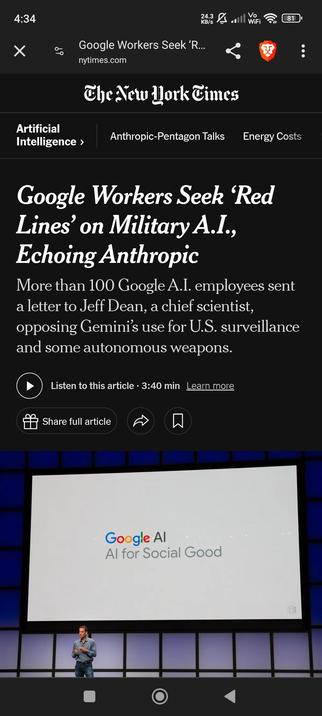
Over 360 Google and OpenAI employees signed an open letter backing Anthropic in its refusal to align with Pentagon demands, calling for "red lines" against AI-driven mass surveillance and autonomous weaponry. The employee movement aims to prevent military pressure from lowering industry ethical standards, echoing the 2018 Project Maven protest.

@siguza @iris_meredith

Mastodon has been hiding filtered notifications from me, so only just seeing this:

"by people who don't really like tech, but put up with it anyway for the sake of a paycheck."

My freshman undergraduate CS class in 1992 consisted of students the majority of whom had never touched a computer keyboard before. They were there because the field looked like the next doctor or engineer.

Of course, the stolen-valor title inflation of people who have no professional responsibility for human life and even less liability if things go wrong as "engineers", an affectation driven largely by Usian companies like Google, an entire industry of folk cosplaying as Margaret Hamilton, didn't help that situation. Which, again, goes to the wounded masculinity and "nerds rule the world" of it all.

1/2

@siguza @iris_meredith

To be clear, however, my contextualization of this as coming out of "a generation for whom being socially abused for being geeky and nerdy" speaks not simply to enthusiasm for the tech. The entire culture in the 90s (which, notably, had by this point all but fully displaced the prior culture of women programmers a decade prior) was defined around enthusiasm for all the standard interests of geeks and nerds of the era. This being part of why myself, self taught in 6502 machine language on loose leaf notepaper as a child, felt so out of place, as most of the concerns of franchise fandom fell flat for me even then.

It was this culture, that thought of itself as the new status quo, that was subsequently hollowed out, leaving only the husk of what preceded it. By 2010, this hollowing out was already entering its second generation.

2/2

@iris_meredith

Thank you for an insightful post.

I have the feeling that most of what you describe can also be traced back to a very deficient educational system.

We don't provide enough diversity, enough culture in education, we do not teach people that curiosity, reading and a life-long desire to know more are desirable. The results are staring at us now...

@iris_meredith It's interesting to see the connections you make, but overall I'd say the inhumanity of the tech industry is due to the capitalist superstructure rather than attributes of information workers.

As a programmer that does think of myself more of a mental being than a body, I can't relate to the ideas that studying complex systems leads to a weaker sense of self or that body disassociation is an indicator for sociopathic violence (cf. heightened sensuality may fuel racial animus).

Very interesting read!

It has me thinking about those ricers who build this elitist culture around hprland (or whichever one is trending) being the superior way to interact with your system, all other DEs are inferior and you're a loser for using them, yadda yadda yadda. Very masculine performing.

But then the other side of this, subculture I guess, is creating beautiful, aesthetic setups. Posting screencaps of your ricing. Getting the colors of the UI to match the wallpaper. Making a custom fastfetch with custom ASCII art and colors. Getting the window animations to smoothly move things across your screen.

It struck me as very feminine. (Or at least culturally feminine.) And it felt weird to me because what these folks are actually doing is so diametrically opposed to the atmosphere they give off. There's a mismatch. I bet many of these ricers would frown at interior design or visual art, dismissing it as womanly, as part of the outside world that doesn't matter. They are artists, but label it as something else to feel distant from it, and I can't imagine that being good for their psyche. I had trouble wrapping my head around this, but your article gave me a new lens to view this through.

@iris_meredith I don't know that I exactly enjoyed reading this. I most certainly felt it though. I'm lucky enough to feel generally ok in my body, but working in tech certainly creates a feeling that's reminiscent of what you describe.
I spent a good chubk of my adult life in the "disregard for the body" camp, though I did at least bathe regularly. But the concept of purely identifying yourself with your work is frighteningly familliar to me. 10-12 hour workdays where you do what you do without thinking too much about the consequences of it for society or yourself hits a little bittoo hard.

Breaking away from that is difficult. Most tech (especially the one that allows you to earn a living) exists within a hypercapitalistic environment. It felt hypercapitalistic 10 years ago, but damn qe've gone so much further since then.

To top that off you have multiple literal fascist takeovers around the world, which you need to basically ignore. That is for those of us lucky enough to not need to actively colavorate with and aid said takeovers as part of our job. I can't imagine (and hope I never have to) what it's like to have to choose between being employed and not working for neonazi cooks.
@iris_meredith to be honest, I'm alao not sure how good we techies generally are, to the extent that "techies" can even mean anything beyond "knows how to make compiter go beep-boop".

People in the replies already mentioned this sort of " reactive masculinity" that came from the nerds and geeks ending up on top after it turned out computers can make you money and you can use them.to control people.

When you're ostracized for something you are you could take that trait and turn it into a badge of honor. In theory that's maybe even a healthy way to respond to bullies. But also, if you end up becoming powerful (even mildly, by virtue of something stupid like being part of a made up mew "techie cast") and keep latching on to that trait as ypur singular badge of honor, you become what you described. The "person that's in tech". Not even a " person who codes", or "person who makes hardware", " person who likes math" or whatever. Just a "person in tech".
@iris_meredith maybe (and I apologize for now just going into a reply guy kind of train of thought mode here) that's the crux of it. Tech (capital T) isn't about the tech anymore. It got massively funded, it prooved it's a great tool to exert power and maintain control. That dragged in a bunch of people that only care about the power and control, certainly a lot of ego-driven people. The people who (at least used to) care about the tech (not Tech) are still mostly around. But they (we?) always desperately wanted to be accepted because they (we?) were weird geeks with little to no social circle. So what you described takes place, regardless of ypur motivation you "shut up and code" (sometimes you don't even code as much, depending on where within the wormforce ypu might have ended up), because ypu might have gone in it for the tech, but now that you're part of Tech, everyone says that's a bog deal. You're in a great position for yourself and you need to push through and keep it, regardless of what your motivation might have been initially.
@iris_meredith Wow, this one makes me so glad that I wound up dipping out of programming into being an academic sysadmin, and on top of that I always had outside interests, even if a bunch of them were stereotypical nerd ones. The "sucked into programming work" could have been an alternate me where I wound up being pressured to work long hours and those outside things dropped away.

@iris_meredith heh just today I posted re: "vulnerable among educated and professional people to being taken in by propaganda" (but without making the distinction between software and other engineering)

https://social.treehouse.systems/@valpackett/116075805782450692

@iris_meredith I think you're onto something here, but I disagree with a basic premise: there's nothing wrong with simply not liking or enjoying food, or sex, or whichever other bodily experiences you pick. (but then I don't consider myself human and take pride in it, so make of that what you will...)

edit: I wrote an extended reply here.

✧✦Catherine✦✧ (@[email protected])

I find myself both agreeing and disagreeing with "Carbon Dysphoria". for me, transitioning has solved the immediate "I fucking hate it when people refer to me as a guy, who I am not" problem, but didn't change much of anything else. I don't enjoy eating food in the way the rest of this society does it (I just eat the ~same thing every day), I'm aroace, and while there's quite a few books and media I have opinions on, lately I've shied away from the ones that are particularly emotionally provoking: my life has been emotionally provoking enough all on its own, without external stimuli however, I have never been a fan of existing as 'pure intelligence'. not only is there good evidence that intelligence must be embodied, but also I've always been intensely connected to the material world: I've been more proud of my achievements with computer hardware, electronics, chemistry, machining, and so on more so than I've been proud of my achievements in software (and the latter have mostly served to fuel the former). furthermore, in today's world it is more important than ever that all of us remember that both us and our enemies have blood and bones and flesh, for this flesh is the cornerstone of power. what I haven't been particularly connected with is my body. to me it's just a tool. food is just fuel; it is better that I like it (so that I actually, you know, eat) but I'm not into it to the extent to which I've seen people be into kink. and I don't think there's anything so wrong with this that it is indicative of underlying pathology ("dysphoria"). nor do I want to change it. I think the obsession people can have with food is as strange and alienating as the obsession with sex; and as someone who's been coerced into eating food others thought was good, I think the results of it are pretty gross, too.

Treehouse Mastodon
@whitequark I've given a bit of a longer response myself: in short, I think you're entirely correct on that point and for the fedi audience, it's a somewhat sloppy way of writing. The issue is that writing "disordered relationship with desire" in the abstract lands well with the Bluesky philosophy crowd, but most people find it a bit incomprehensible.
@iris_meredith yeah, that makes perfect sense.

@iris_meredith As a former infrastructure engineer who worked in varying degrees of proximity to software developers, this rings painfully true.

Having done that while unaware that I was trans makes it all the more relatable (and painful).

That crack about MongoDB being webscale, though... 💀

The mentality is far from new, though. From Neuromancer (1984): "the elite stance involved a certain relaxed contempt for the flesh." It seems unlikely that Gibson made that up out of whole cloth, however ignorant he personally was with regard to computers.

Seeing what's now coming to fruition after several decades, I wouldn't be surprised to find out that deliberately inducing this kind of dysphoria has been an intentional strategy. It would fit as a way of disrupting tendencies to organise and demand more control, and it only needs to be demonstrated by a few high-profile examples in order to be adopted by the rest of the management herd.

@iris_meredith this is a pleasant and relatable post, thanks for writing it!

@iris_meredith Thank you for this, article of the year so far.

I'm going to have to sit with this one for a while - I'm Disabled, my relationship with my body is fraught at the best of times and the "being of pure intellect" is... tempting, to say the least.

@iris_meredith
I agree that IT industry demands we make things that suck, I feel the pain.

However

You say that "Precision, diligence, carefully working through a dull task and making sure that things are going to work in all cases" are feminine skills.
But aren't those same skills needed in engineering disciplines?
Ok, maybe real engneering disciplines don't have this pressure for masculinity. But then shouldn't that lead to more women becoming aerospace, civil, structural, etc. engineers?

@wolf480pl @iris_meredith In my country, aerospace is heavily tied into the military and is very sexist and traditionalist. One would not have a good time there.

I'm not sure if the others are subject to the same dynamic.

@iris_meredith

it excludes so many possibilities for having fun, such as food, drink, combat sports, Warhammer, kinky sex and music

If you can simulate/dream them, does it really matter much?

The main advantage of a body is that you can run away if the place is burning down, but if you've got backups, does that even matter?

Not that this is pertinent as more than a thought experiment, such technology is beyond our century certainly.

I don't much like having a body which has as its main distinguishing trait that it persistently betrays me. It has almost all the nanomachinery required to do most things I'd want... and then it just completely ignores user input to commit to aberrant designs (even when it isn't actively malfunctioning on a medical level like organ failure or whatever). The betraying flesh denies my right to morphological freedom and I greatly resent it for this.

Modern medical technology also fails to correct for all the deviations from my intended designs. I am not particularly hopeful I will live long enough to see this change.

In the meantime, all maintenance merely makes me more aware of the deviations. And yet it is necessary.

It's as though many people in the tech industry have no real desires at all beyond the desires that they're told to have by their wider social circles.

I believe this is a result of those who let their thoughts be contaminated by the dictates of corposcum rather than hold to principles.

They get used to believing what they're told from so-called "figures of authority".

An awful lot of tech people don't read, don't listen to music, don't appreciate art or really do much of anything all.

That is strange. Especially since a lot of that can be done & had for free in ample amounts.

That some of it doubles as escapism in my enjoyment is not a coincidence, but some of it I do find genuinely endearing and pleasant without any envy or relation to escapism. Interesting or fun in its own merit.

The existence of soylent suggests that a significant minority of tech people don't even really like or enjoy food all that much

The enjoyment is typically far secondary to the sheer annoyance preparing it and cleaning afterward can bring. Restaurant is far too expensive to ever justify, especially how short it lasts. (If I had perfect memory and could simply relive the experience from that, I would reconsider.)

That being said I'm not rich and do not trust soylent to be adequate, so I have to manage by other means.

Ideally, I would eat only when I am in the mood for it and then I could justify paying somewhat more for better, since it wouldn't be a constant drain on me.

when you don't much desire or value anything, rejecting propaganda on the basis that it conflicts with your desires or values isn't a thing that really happens

On this, to me, the rejection is easy. Not just in term of values (which would be enough on its own), but that any desire for morphological freedom on my part sees its likelihood of being enabled decrease as bigoted projects hinder any possible progress.

People expect behaviours and emotional responses of her that don't come naturally to her, and when she's open about her actual emotions and desires, they're quickly shut down.

Gets even more "fun" when neurodiversity comes in.

what the general opinion tells them to do rather than out of any real care for their bodies or how they want to look.

Maintenance is necessary. Dying early makes the likelihood of enablement and freedom lower. (I live in a waiting room, haha.)

The first hypothesis is that merely being cis doesn't exclude you from having dysphoric experiences

There are other kinds of dysphoria indeed.

there's constant pressure to be the best, use the newest most cutting-edge technology and earn the most money and much of the power structure

Which makes so very little sense to me. What use do I have for money if it cannot buy what I want?

In the meantime, if it covers basics & maintenance it is enough.

As for the tech, if it's more expensive than I need or disrespects my freedom as a user, it can go get scraped.

While there have more recently been a fair number of people who went into the field of software engineering because it's a well-paying job, these people don't tend to form the core of the people who form or go along with general opinion in the tech world

Huh, I'm mildly surprised.

they suppress those underlying desires and pursue, for the most part, what general opinion, heavily influenced by propaganda actors, tells them they should be pursuing

Huh.

MongoDB (which we all know is Webscale)

lol, good times

try and fill the void in the socially accepted and encouraged ways

Ah... so that's where the cult vibes come from.

they are often placed in a situation with remarkable structural similarities to the ones that trans people find themselves in, and thus, humans being human, react in similar ways.

Address cognitive dissonance by first making it worse and then finally muting it through indoctrination. There's no way that could go wrong⸮

But that, in turn, means that building anything that creates value for your average human goes out the window

Ever underfunded Free Software.

(the open-plan working space is one of many examples of this kind of thing)

[hissing]

Dysphoria will really fuck you up, and unless you can resolve it in some way,

Haha.

Morally, I think creating a large workforce that we force to do work that's fundamentally opposed to what they want is abhorrent.

Capitalist exploitation in a nutshell. Or maybe just exploitation, all types.

Perhaps we could do compulsory opera outings or something, but I doubt that's going to land all that well.

With a persistent pandemic I sure wouldn't. People seem to care about the ravages of biological malware about as much as they do digital, despite the fact we have no backups for biological bodies.

VR attendance is fine though.

a salary grant program for developers working on projects likely to be of benefit to civil society

Nice as it would be, the state being a body of oppression is likely to conflict with this.

a state-funded and state-run tech ministry aimed at employing software professionals and putting them to use for the good of the state and its people.

What's good for the state asserting its "authority" is rarely good for the people.

bodies are fun

Let's agree to disagree. I'm not having much fun.

Exercising just for the sake of it, for the sake of being able to see how fast you can run that half-marathon

All that uncomfortable proprioceptive feedback.

how far you can throw that javelin

That has low-enough feedback to still be fun.

Dancing, learning how to move your body fluently for the sheer joy of it is really worthwhile

The annoying moment when one actually enjoys it on an artistic level but cannot deal with the feedback.

as is training your voice

Sadly, voicebox replacements have range comparable to Microsoft SAM's, rather than a vocaloid. If your flesh made decisions you disagree with to a sufficient degree, your options are few.

learning how to handle a musical instrument

That is fun. Sadly expensive for the ones I find most neat.

Bodily intimacy, in both the platonic and the unashamedly sexual forms, is something that's worth enjoying to the fullest

It must indeed be nice to be able to cope with the notion of one's form sufficiently for that to be palatable.

@iris_meredith - this is great, thanks.for publishing it.

Is gender dysphoria a special case of a broader range of conditions to do with suppressing and denying identities? Is that what dysphoria means?

Your second hypothesis that there may often be a mismatch between the social values of people in the tech industry and what the companies they work for actually do resonates, but I suspect there are other, potentially related issues.

A lot of people, myself included, got into tech because computers, internet culture and the hacker ethic formed a big part of their identity growing up. Corporate software development largely isn't like that. It's therefore more than not having the job you wanted, it's having part of your identity denied. Corporate software culture reinforces this, presenting the work as 'more than just a job', and I think a lot of people early in their careers believe that. I suspect a lot of people who are now developers were brought up being told they were smart, and as a result could have whatever kind of career they wanted.

Similarly, the long hours, mentally exhausting work and general burn out make it really hard to pursue creative hobbies outside of work, and that's a big part of defining and expressing your identity, so again l, we have a source of suppression. This is something I strongly feel myself, and only just starting to address after probably 20 years of gradually losing touch with activities (and people) which used to bring joy. I currently have a complex relationship with my gender, but most of this would be true regardless.

I'd like to see more effort to create opportunities for people to make careers in open source and socially motivated development, as you say, and I think there are some (small) promising signs in this area, but clearly much more to do. We could maybe also take more time to care for each other - maybe we're sometimes a little too laissez-faire when we see our colleagues displaying these traits.

@iris_meredith Good post.
I wonder if under diagnosed and unsupported neurodiversity is another explanation for bodily hatred in tech circles….

@iris_meredith Thank you for this!

(Also it feels a bit unsettling how relatable your post is, uhhh… and I guess that might be a good thing actually?)