My thinking is that the best place for developers to explore, learn and understand how/if agentic coding can be a part of your workflow is to use it to build internal developer tools. The code is only affecting you, but it still is actually useful.

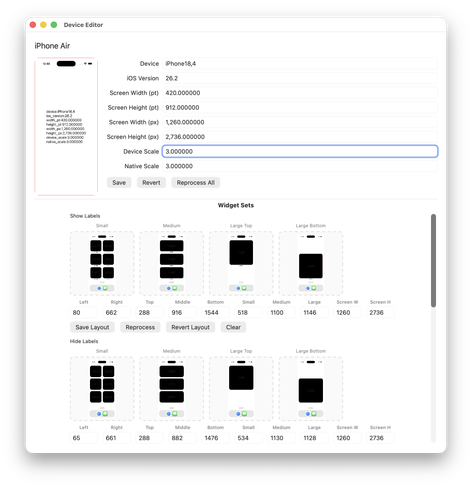
I am doing a project which requires know the precise location and size of every widget slot on iOS. This involves the generation and analysis of hundreds of screenshots. I worked with Codex to build a tool to automate the organization and analysis. 🧵

I started in terminal, then Codex Monitor, then Codex, and then today Xcode's integration. I’m a huge fan of using a GUI front ends. The same code gets written regardless, but I find it much easier for me to understand/review the output.

The main takeaway for me so far is how transformative this kind of tool is for building things which I just wouldn't try otherwise if I had to code them by hand. The experimentation possible when the turnaround is minutes rather than hours is meaningful. 🧵

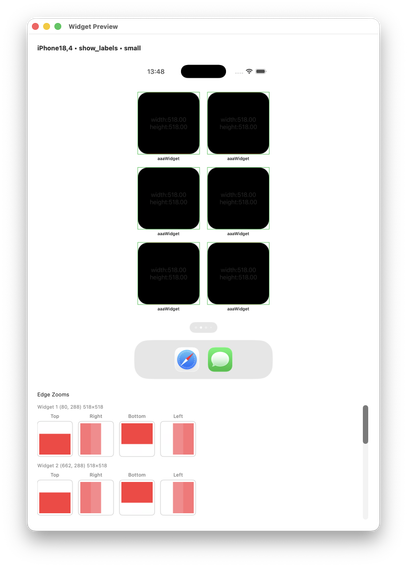
For example, in this project I wanted to have a mechanism for verifying my automatic bound detection algorithm. So I wondered if I could have the widgets render their bound values within them and then I could use OCR to read the value and compare the to computed value.

I know I could have worked out how the Vision framework does this and gotten it to work, but here I just asked and it built it. Which allowed me to catch a few bugs in my detection method, which I'd have missed otherwise. 🧵

The biggest thing I have found so far is that viewing these tools as black boxes doesn't work nearly as well as viewing them as the most personalized Stack Overflow resource you could imagine. Where every question or problem you encounter can have a thoughtfully written response with sample code.

Viewing it as a collaboration to help me learn is where the magic moments have happened for me so far. 🧵

I'll continue exploring the space with internal tools until I'm confident it would help my production work, but I doubt that point is very far off.

Even just the production of these internal tools (6 and counting!), has made me more efficient and effective in my "traditional" work which is a massive win I'm grateful for.

@_Davidsmith There’s a blog post from me in here somewhere, but…

I was working with Claude Code recently, and had it generate a function for me. I didn’t like what it did, and pointed out a way it could improve. It acknowledged what I said, came back with trade-offs to my approach, and then rejiggered what it had done.

It felt more like having a coworker — young, but a coworker nonetheless — than I have in a *long* time. I miss that.

@caseyliss @_Davidsmith Meanwhile, me asking Claude why it had done something, it pointing out the helper that I wrote that it was taking its cues from:
@caseyliss It's like a weird mix between pair programming with a junior developer and reviewing their PR. You get the whole diff at once, but it's a much faster feedback loop.
@caseyliss There is definitely something to that, especially as someone who has programmed essentially alone for years and years. It is just plain _nice_ to be ā€œtalking over the code". Kinda like an super advanced version of rubber duck debugging.

@_Davidsmith Exactly that.

I know full well that I *could* call you [or many of our mutuals] and discuss a problem, but:

1) I don’t want to be burdensome
2) It’ll take a while to bring you up to speed on wtf I’m talking about

Claude (or equivalent) isn’t burdened, and can grok the code in the span of a minute or two.

@caseyliss @_Davidsmith ā€œNot burdenedā€ is doing a lot of heavy lifting here in light of the tremendous environmental impact involved
@cris @caseyliss @_Davidsmith I feel like the pendulum has swung a bit too far on this environmental impact argument (on Mastodon). Taking a *single* even short-haul flight is more impactful than intensively using Claude Code *for years.* And AI inference is getting cheaper (= more energy-efficient) every month. It's good to be mindful of it and not waste energy on useless image generation prompts, but calling people out like this for using it to do their job is really not helpful IMO.
@leonoverweel @caseyliss @_Davidsmith If you have a source backing that up I would love to see it, because as recently as a few month ago AI data centers were causing local water crises due to their energy and cooling requirements.

@cris I was mostly talking about the energy / emissions side; here’s a good source on that: https://hannahritchie.substack.com/p/ai-footprint-august-2025

For water I think similar comparisons hold, for example with how much fresh water goes into industrial meat farming. But I work in (renewable) energy so I know a lot more about that than about water.

What's the carbon footprint of using ChatGPT or Gemini? [August 2025 update]

A new study from Google suggests its Gemini LLM uses around 0.24 Wh per text query. That's the same energy as using a microwave for one second.

By the Numbers

@leonoverweel I will need to read through the sources in more detail, but this still leaves me with big concerns.

First off, it seems like Ritchie's main sources are the AI companies themselves. I would like to see some independent information about how they conducted their studies and what might have been left out.

Second, it's all well and good to point to individual usage, but individuals are not using these tools in isolation. And those numbers don't take into account the massive training and background costs involved. The MIT study Ritchie cites, from May of last year, points out that ā€œthe carbon intensity of electricity used by data center was 48% higher than the US average.ā€ And they project that burden to grow as AI usage does, with a heavy reliance on dirty fuel sources to make that happen.

I know there is some nuance to all this. I'm just frustrated because ever since those individual usage number came out, I keep seeing folks lean on that without addressing the nuance on the other side of the issue.

@caseyliss @_Davidsmith I def think it would be much cooler to use the phone though.

One would say that's avant garde nowadays

@caseyliss @_Davidsmith I implemented a full TOTP solution for our system today with Claude code. It’s been on my todo list for _literally years_ and the whole thing was done across the span of 6 hours (because I had to do it between meetings)

I did send advanced apologies to the people that need to review and test it though, but I was good and actually checked it all myself first!

@caseyliss @_Davidsmith For me 2 doesn't always matter. I can talk about a problem with someone who doesn’t know shit about coding. But when I have to explain the problem I need to think about it in a different way which helps me. So talking to wall would probably also help but it's nicer to talk to a colleague.
@caseyliss @_Davidsmith so.. we are really replacing humans with this huh.. kinda makes me sad.
@caseyliss @_Davidsmith Peter Steinberger talks about how he discusses approaches to things with the agents a lot before he has it write any code. I found that part really interesting. https://overcast.fm/+ABKyPJycYhc
The creator of Clawd: ā€œI ship code I don’t readā€ — The Pragmatic Engineer

Brought to You By:• Statsig — ⁠ The unified platform for flags, analytics, experiments, and more.• Sonar – The makers of SonarQube, the industry standard for automated code review• WorkOS – Everything you need to make your app enterprise ready.—Peter Steinberger ships more code than I’ve seen a single person do: in January, he was at more than 6,600 commits alone. As he puts it: ā€œFrom the commits, it might appear like it’s a company. But it’s not. This is one dude sitting at home having fun.ā€How does he do it?Peter Steinberger is the creator of Clawdbot (as of yesterday: renamed to Moltbot) and founder of PSPDFKit. Moltbot – a work-in-progress AI agent that shows what the future of Siri could be like – is currently the hottest AI project in the tech industry, with more searches on Google than Claude Code or Codex. I sat down with Peter in London to talk about what building software looks like when you go all-in with AI tools like Claude and Codex.Peter’s background is fascinating. He built and scaled…

@_Davidsmith @caseyliss that’s exactly the way I’ve been thinking about it.

@Drwave @_Davidsmith @caseyliss rubber ducking with ChatGPT is how I finally got rid of an endless loop that haunted me all summer with iOS 18.

https://mastodon.social/@MuseumShuffle/113070626612759601

@caseyliss @_Davidsmith this is how it’s been for me 100%. It’s like working with someone who is not just writing code, but helping me solve problems. I review the code and accept or reject. Sometimes it does a clever thing or something I hadn’t considered so I even learn along the way. It’s neat.
@caseyliss @_Davidsmith it’s like working with a junior engineer who often does the wrong thing, but for the right reasons, and you have to explain the context to help it understand why it is wrong