 grobi
grobi2025 September 10
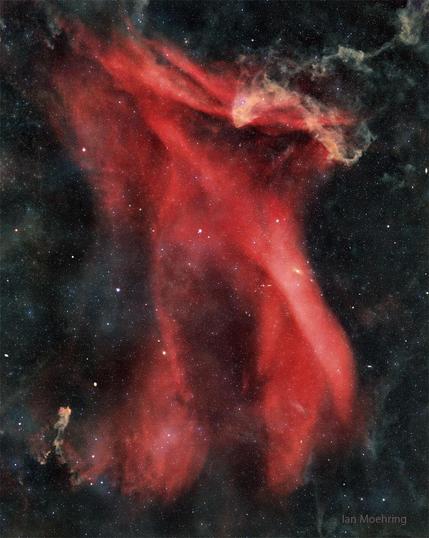
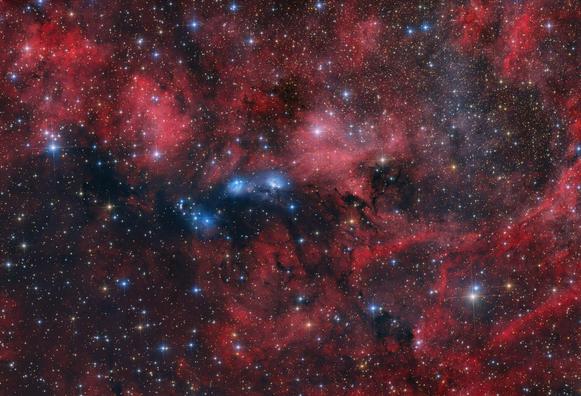
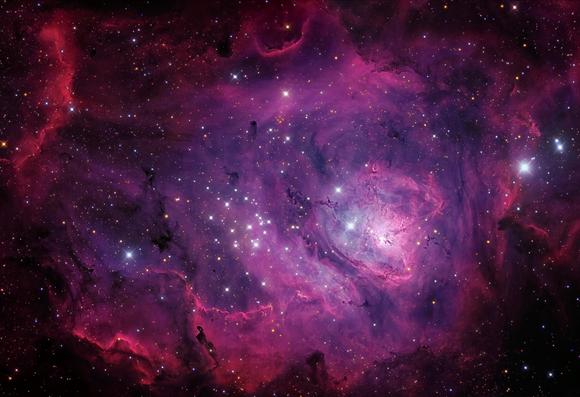
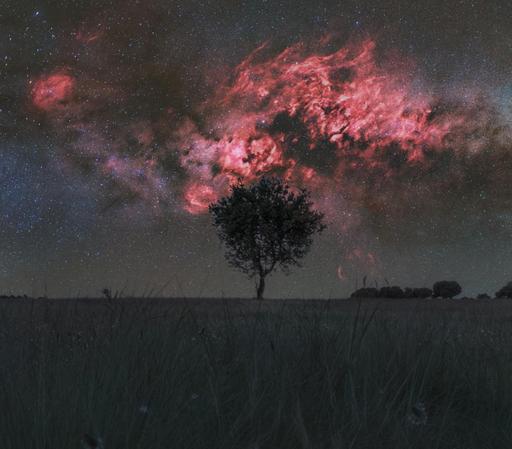
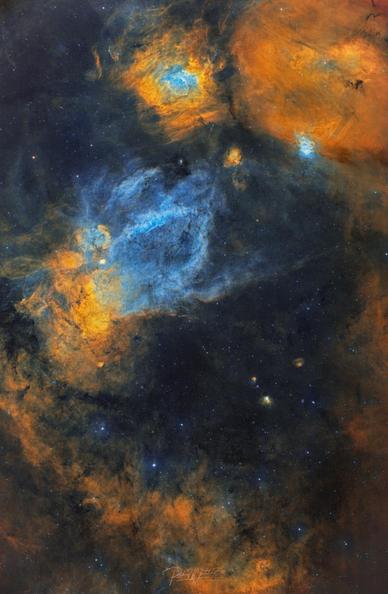
The Great Lacerta Nebula
* Image Credit & Copyright: Ian Moehring & Kevin Roylance
https://www.instagram.com/ianmoe66/
Explanation:
It is one of the largest nebulas on the sky -- why isn't it better known? Roughly the same angular size as the Andromeda Galaxy, the Great Lacerta Nebula can be found toward the constellation of the Lizard (Lacerta). The emission nebula is difficult to see with wide-field binoculars because it is so faint, but also usually difficult to see with a large telescope because it is so great in angle -- spanning about three degrees. The depth, breadth, waves, and beauty of the nebula -- cataloged as Sharpless 126 (Sh2-126) -- can best be seen and appreciated with a long duration camera exposure. The featured image is one such combined exposure -- in this case taken over three nights in August through dark skies in Moses Lake, Washington, USA. The hydrogen gas in the Great Lacerta Nebula glows red because it is excited by light from the bright star 10 Lacertae, one of the bright blue stars just to the left of the red-glowing nebula's center. Most of the stars and nebula are about 1,200 light years distant.
https://app.astrobin.com/i/6egtl5
https://astro4edu.org/resources/diagram/YQ69V022qi60/
https://science.nasa.gov/mission/hubble/science/explore-the-night-sky/hubble-messier-catalog/messier-31/
https://en.wikipedia.org/wiki/List_of_the_most_distant_astronomical_objects
https://science.nasa.gov/ems/03_behaviors/
https://www.geogebra.org/m/atq6mr3a
https://apod.nasa.gov/apod/ap250910.html
#space #nebula #astrophotography #photography #science #astronomy #nature #NASA





 Roy -- the dull one