2025 October 8

NGC 7380: The Wizard Nebula
* Images Credit & Copyright: Nevenka Blagovic Horvat & Miroslav Horvat
https://www.instagram.com/miroslav.horvat/
https://www.flickr.com/people/miroslav1/

Explanation:
What powers are being wielded in the Wizard Nebula? Gravitation strong enough to form stars, and stellar winds and radiations powerful enough to create and dissolve towers of gas. Located only 8,000 light years away, the Wizard nebula, featured here, surrounds developing open star cluster NGC 7380. Visually, the interplay of stars, gas, and dust has created a shape that appears to some like a fictional medieval sorcerer. The active star forming region spans about 100 light years, making it appear larger than the angular extent of the Moon. The Wizard Nebula can be located with a small telescope toward the constellation of the King of Aethiopia (Cepheus). Although the nebula may last only a few million years, some of the stars being formed may outlive our Sun.
https://en.wikipedia.org/wiki/Magician_(fantasy)#/media/File:Saluzzo-Castello_della_Manta-mago.jpg
https://en.wikipedia.org/wiki/NGC_7380
https://ui.adsabs.harvard.edu/abs/2011AJ....142...71C/abstract
https://lco.global/spacebook/sky/using-angles-describe-positions-and-apparent-sizes-objects/

https://apod.nasa.gov/apod/ap251008.html

#space #nebula #cluster #astrophotography #photography #science #astronomy #nature #NASA #ESA #apod #education

2025 October 21

IC 1805: The Heart Nebula
* Image Credit & Copyright: Toni Fabiani
https://app.astrobin.com/u/Toni_Fabiani#gallery

Explanation:
What electrifies the Heart Nebula? First, the large emission nebula on the left, catalogued as IC 1805, looks somewhat like a human heart. The nebula glows brightly in red light emitted by its most prominent element, hydrogen, but this long-exposure image was also blended with light emitted by sulfur (yellow) and oxygen (blue). In the center of the Heart Nebula are young stars from the open star cluster Melotte 15 that are eroding away several picturesque dust pillars with their atom-exciting energetic light and winds. The Heart Nebula is located about 7,500 light years away toward the constellation of Cassiopeia. At the top right of the Heart Nebula is the companion Fishhead Nebula. This wide and deep image clearly shows that glowing gas surrounds the Heart Nebula in all directions.

https://apod.nasa.gov/apod/ap251021.html

#space #nebula #cluster #astrophotography #photography #science #astronomy #nature #NASA #ESA #apod #education

2025 October 22

NGC 6995: The Bat Nebula
* Image Credit & Copyright: Francis Bozon & Jean-Luc Gangloff

Explanation:
Can you see the bat? It haunts this cosmic close-up of the eastern Veil Nebula. The Veil Nebula itself is a large supernova remnant, the expanding debris cloud from the death explosion of a massive star. While the Veil is roughly circular in shape and covers nearly 3 degrees on the sky toward the constellation of the Swan (Cygnus), NGC 6995, known informally as the Bat Nebula, spans only 1/2 degree, about the apparent size of the Moon. That translates to 12 light-years at the Veil's estimated distance, a reassuring 1,400 light-years from planet Earth. In the composite of image data recorded through several narrow band filters, with emission from hydrogen atoms in the remnant shown in red and with strong emission from oxygen atoms shown in hues of blue. Of course, in the western part of the Veil lies another seasonal apparition: the Witch's Broom Nebula.

https://chandra.harvard.edu/photo/scale_distance.html
https://periodic.lanl.gov/1.shtml

https://apod.nasa.gov/apod/ap251022.html

#space #nebula #cluster #astrophotography #photography #science #astronomy #nature #NASA #ESA #apod #education

2024 October 27

LDN 43: The Cosmic Bat Nebula
* Credit & Copyright: Mark Hanson and Mike Selby
https://www.hansonastronomy.com/bio
https://throughlightandtime.com/about/
* Text: Michelle Thaller (NASA's GSFC)
https://science.nasa.gov/people/michelle-thaller/
https://www.nasa.gov/
https://www.nasa.gov/goddard

Explanation:
What is the most spook-tacular nebula in the galaxy? One contender is LDN 43, which bears an astonishing resemblance to a vast cosmic bat flying amongst the stars on a dark Halloween night. Located about 1400 light years away in the constellation Ophiuchus, this molecular cloud is dense enough to block light not only from background stars, but from wisps of gas lit up by the nearby reflection nebula LBN 7. Far from being a harbinger of death, this 12-light year-long filament of gas and dust is actually a stellar nursery. Glowing with eerie light, the bat is lit up from inside by dense gaseous knots that have just formed young stars.
https://www.jthommes.com/Astro/LBN7_LDN43.htm
https://chandra.harvard.edu/photo/constellations/ophiuchus.html
https://en.wikipedia.org/wiki/Molecular_cloud
https://apod.nasa.gov/apod/ap230129.html
https://astronomy.swin.edu.au/cosmos/r/Reflection+Nebula
https://apod.nasa.gov/apod/ap030706.html

https://apod.nasa.gov/apod/ap241027.html

#space #nebula #cluster #astrophotography #photography #science #astronomy #nature #NASA #ESA

2025 Shuttober 26

Halloween and the Ghost Head Nebula
* Image Credit: NASA, ESA, Mohammad Heydari-Malayeri (Observatoire de Paris) et al.,
https://www.nasa.gov/
https://www.esa.int/
https://www.iau.org/Iau/Shared_Content/Contacts/ContactLayouts/Obituary.aspx?ID=29332
https://www.observatoiredeparis.psl.eu/

Explanation:
Halloween's origin is ancient and astronomical. Since the fifth century BC, Halloween has been celebrated as a cross-quarter day, a day halfway between an equinox (equal day / equal night) and a solstice (minimum day / maximum night in the northern hemisphere). With a modern calendar however, even though Halloween later this week, the real cross-quarter day will occur the next week. Another cross-quarter day is Groundhog Day. Halloween's modern celebration retains historic roots in dressing to scare away the spirits of the dead. Perhaps a fitting tribute to this ancient holiday is this view of the Ghost Head Nebula taken with the Hubble Space Telescope. Similar to the icon of a fictional ghost, NGC 2080 is actually a star forming region in the Large Magellanic Cloud, a satellite galaxy of our own Milky Way Galaxy. The Ghost Head Nebula (NGC 2080) spans about 50 light-years and is shown in representative colors.
https://science.nasa.gov/photojournal/pj-ghost-head-nebula/
https://en.wikipedia.org/wiki/NGC_2080
https://en.wikipedia.org/wiki/Halloween
https://www.neopagan.net/Halloween-Origins.html
👻 https://en.wikipedia.org/wiki/Casper_the_Friendly_Ghost
https://earthsky.org/astronomy-essentials/halloween-derived-from-ancient-celtic-cross-quarter-day/
https://www.webexhibits.org//calendars/year-countries.html
https://en.wikipedia.org/wiki/Quarter_days
https://en.wikipedia.org/wiki/Groundhog_Day
🎃 https://www.boredpanda.com/blog/wp-content/uploads/2016/10/halloween-cat-costumes-19-57f75fe01d15b__605.jpg

https://apod.nasa.gov/apod/fap/ap251026.html

#space #astronomy #science #astrophotography #photography #nature #nebula #NASA #Webb #apod

2025 October 29

Dust Shapes of the Ghost Nebula
* Image Credit & Copyright: Kent Wood
https://ssr.app.astrobin.com/u/kvwood#gallery

Explanation:
Do any shapes seem to jump out at you from this interstellar field of stars and dust? The jeweled expanse, filled with faint, starlight-reflecting clouds, drifts through the night in the royal constellation of Cepheus. Far from your own neighborhood on planet Earth, these ghostly apparitions lurk along the plane of the Milky Way at the edge of the Cepheus Flare molecular cloud complex some 1,200 light-years away. Over two light-years across and brighter than the other spooky chimeras, VdB 141 or Sh2-136 is also known as the Ghost Nebula, seen across the middle of the featured image. Within the reflection nebula are the telltale signs of dense cores collapsing in the early stages of star formation.
https://www.flickr.com/photos/kvwood/54828050686/in/dateposted-public/
https://en.wikipedia.org/wiki/Cepheus_(constellation)
https://en.wikipedia.org/wiki/Ghost_Nebula
https://noirlab.edu/public/images/noao-vdb141/
https://en.wikipedia.org/wiki/Reflection_nebula
https://arxiv.org/abs/0809.4761
https://ui.adsabs.harvard.edu/abs/2009ApJS..185..451K/abstract
https://www.jpl.nasa.gov/news/a-ghostly-trio-from-nasas-spitzer-space-telescope/
https://en.wikipedia.org/wiki/Chimera_(mythology)
👻 https://i.pinimg.com/736x/eb/62/1a/eb621ac58b9948269119f140ca2f8feb.jpg

https://apod.nasa.gov/apod/ap251029.html

#space #astronomy #science #astrophotography #photography #nature #nebula #NASA #apod

2025 October 31

Ghosts in Cassiopeia
* Image Credit & Copyright: Alex Rodriguez
https://www.instagram.com/astro_photo_alex/

Explanation:
Halloween is an astronomy holiday and spooky shapes always seem to lurk in in planet Earth's night skies. In fact, near the center of this telescopic view toward the constellation Cassiopeia these swept-back interstellar clouds IC 59 (left) and IC 63 look ghostly on a cosmic scale. About 600 light-years distant, the clouds aren't actually ghosts. They are slowly disappearing though, under the influence of energetic radiation from hot, luminous star gamma Cas. The brightest bluish star in the frame, Gamma Cas is physically located only 3 to 4 light-years from the nebulae. Slightly closer to gamma Cas, IC 63 is dominated by red H-alpha light emitted as hydrogen atoms ionized by the hot star's ultraviolet radiation recombine with electrons. Farther from the star IC 59 also shows H-alpha emission, and both nebulae shine with the characteristic blue tint of dust reflected star light. The field of view spans about 2 degrees or 20 light-years at the estimated distance of the interstellar apparitions.
https://www.instagram.com/jro_rm/p/DQHN4wSjH-N/
https://arxiv.org/abs/1809.01419
https://arxiv.org/abs/1705.04313
https://www.aavso.org/vsots_gammacas
https://iopscience.iop.org/article/10.1086/426912
https://science.nasa.gov/exoplanets/immersive/galaxy-of-horrors/

https://apod.nasa.gov/apod/ap251031.html

#space #astronomy #science #astrophotography #photography #nature #nebula #NASA #apod

2025 November 7

A Dark Seahorse in Cepheus
* Image Credit & Copyright: Jordi Jofre
https://app.astrobin.com/u/JJofre#gallery

Explanation:
Spanning light-years, this suggestive shape known as the Seahorse Nebula floats in silhouette against a rich background of of stars and glowing hydrogen gas. Seen toward the royal northern constellation of Cepheus, the dusty, dark nebula is part of a Milky Way molecular cloud some 1,200 light-years distant. It is also listed as Barnard 150 (B150), one of 182 dark markings of the sky cataloged in the early 20th century by astronomer E. E. Barnard. Packs of low mass stars are forming within, but their collapsing cores are only visible at long infrared wavelengths. Still, the luminous depths of the Milky Way in Cepheus add to this stunning galactic skyscape.
https://app.astrobin.com/i/pw6z9f
https://ui.adsabs.harvard.edu/abs/1916ApJ....43....1B/abstract
https://ui.adsabs.harvard.edu/abs/1919ApJ....49....1B/abstract
https://exhibit-archive.library.gatech.edu/barnard/
https://science.nasa.gov/ems/07_infraredwaves/

https://apod.nasa.gov/apod/ap251107.html

#space #nebula #astronomy #science #astrophotography #photography #nature #nebula #NASA #apod

2025 November 13

Orion and the Running Man
* Image Credit & Copyright: R. Jay Gabany
https://www.cosmotography.com/index.html

Explanation:
Few cosmic vistas can excite the imagination like The Great Nebula in Orion. Visible as a faint, bland celestial smudge to the naked-eye, the nearest large star-forming region sprawls across this sharp colorful telescopic image. Designated M42 in the Messier Catalog, the Orion Nebula's glowing gas and dust surrounds hot, young stars. About 40 light-years across, M42 is at the edge of an immense interstellar molecular cloud only 1,500 light-years away that lies within the same spiral arm of our Milky Way galaxy as the Sun. Including dusty bluish reflection nebula NGC 1977, also known as the Running Man nebula at left in the frame, the natal nebulae represent only a small fraction of our galactic neighborhood's wealth of star-forming material. Within the well-studied stellar nursery, astronomers have also identified what appear to be numerous infant solar systems.
https://cosmotography.com/images/small_gabany_M42_2025.html
https://science.nasa.gov/asset/hubble/the-orion-nebulas-trapezium-cluster/
https://science.nasa.gov/mission/hubble/science/explore-the-night-sky/hubble-messier-catalog/messier-42/
https://en.wikipedia.org/wiki/Orion_molecular_cloud_complex
https://science.nasa.gov/image-detail/orion-nebula-proplyd-atlas/

https://science.nasa.gov/universe/

https://apod.nasa.gov/apod/ap251113.html

#space #nebula #astronomy #science #astrophotography #photography #nature #nebula #NASA #apod

Orion Nebula proplyd atlas

This atlas features 30 proplyds, or protoplanetary discs, that were recently discovered in the majestic Orion Nebula. Using the wide field channel on Hubble’s Advanced Camera for Surveys (ACS), astronomers discovered a total of 42 new discs that could be the seeds of planetary systems to come. Within the awe-inspiring, gaseous folds of Orion, researchers have identified two different types of discs around young and forming stars: those that lie close to the brightest star in the cluster (Theta 1 Orionis C) and those farther away from it. The bright star heats up the gas in the nearby discs, causing them to shine brightly. The discs that are farther away do not receive enough of the energetic radiation from the star to set the gas ablaze; thus, they can only be detected as dark silhouettes against the background of the bright nebula, as the dust that surrounds these discs absorbs background visible light. By studying these silhouetted discs, astronomers are better able to characterize the properties of the dust grains that are thought to bind together and possibly form planets like our own. In the brighter discs the excited material produces many glowing cusps, which all face the bright star, but from our point of view are randomly oriented through the nebula, so we see some edge on, and others face on, for instance. Other interesting features enhance the look of these captivating objects, such as emerging jets of matter and shock waves. The dramatic shock waves are formed when the stellar wind from the nearby massive star collides with the gas in the nebula, sculpting boomerang shapes or arrows or even, in the case of 181-825, a space jellyfish! [...] (see ALT-text)

Image Credit:
NASA, ESA, and L. Ricci (ESO)

https://science.nasa.gov/image-detail/orion-nebula-proplyd-atlas/

#space #nebula #astronomy #science #astrophotography #photography #nature #nebula #NASA #ESA

Hubble Spies Brown Dwarfs in Nearby Stellar Nursery

[...]
Appearing like glistening precious stones surrounding a setting of sparkling diamonds, more than 300 fledgling stars and brown dwarfs surround the brightest, most massive stars [center of picture] in Hubble's view of the Trapezium cluster's central region. All of the celestial objects in the Trapezium were born together in this hotbed of star formation. The cluster is named for the trapezoidal alignment of those central massive stars.

Brown dwarfs are gaseous objects with masses so low their cores never become hot enough to fuse hydrogen, the thermonuclear fuel stars like the Sun need to shine steadily. Instead, these gaseous objects fade and cool as they grow older. [...]

This finding, along with observations from ground-based telescopes, is further evidence that brown dwarfs, once considered exotic objects, are nearly as abundant as stars. The image and results appear in the Sept. 20 issue of the Astrophysical Journal.

The brown dwarfs are too dim to be seen in a visible-light image taken by the Hubble telescope's Wide Field and Planetary Camera 2 [picture at left]. This view also doesn't show the assemblage of infant stars seen in the near-infrared image. That's because the young stars are embedded in dense clouds of dust and gas. The Hubble telescope's near-infrared camera, the Near Infrared Camera and Multi-Object Spectrometer, penetrated those clouds to capture a view of those objects. The brown dwarfs are the faintest objects in the image. Surveying the cluster's central region, the Hubble telescope spied brown dwarfs with masses equaling 10 to 80 Jupiters. Researchers think there may be less massive brown dwarfs that are beyond the limits of Hubble's vision.
[...] (see more in ALT-text)

https://science.nasa.gov/asset/hubble/infrared-image-shows-brown-dwarfs-and-infant-stars-in-orion-nebulas-trapezium-cluster/

#space #nebula #astronomy #science #astrophot ography #photography #nature #nebula #NASA #ESA

Messier 42 (The Orion Nebula)
* by Andrea Gianopoulos

You can spot Messier 42, better known as the Orion Nebula, with the unaided eye from a dark sky site.

Believed to be the cosmic fire of creation by the Maya of Mesoamerica, M42 blazes brightly in the constellation Orion. Popularly called the Orion Nebula, this stellar nursery has been known to many different cultures throughout human history. The nebula is only 1,500 light-years away, making it the closest large star-forming region to Earth and giving it a relatively bright apparent magnitude of 4. Because of its brightness and prominent location just below Orion’s belt, M42 can be spotted with the naked eye, while offering an excellent peek at stellar birth for those with telescopes. It is best observed during January.

The Mayan culture’s likening of the Orion Nebula to a cosmic fire of creation is very apt. The nebula is an enormous cloud of dust and gas where vast numbers of new stars are being forged. Its bright, central region is the home of four massive, young stars that shape the nebula. The four hefty stars are called the Trapezium because they are arranged in a trapezoidal pattern. Ultraviolet light unleashed by these stars is carving a cavity in the nebula and disrupting the growth of hundreds of smaller stars.

This stunning Hubble image offers the sharpest view of the Orion Nebula ever obtained. Created using 520 different Hubble exposures taken in multiple wavelengths of light, this mosaic contains over one billion pixels. Hubble imaged most of the nebula, but ground-based images were used to fill in the gaps in its observations. The orange color in the image can be attributed to hydrogen, green represents oxygen, and the red represents both sulfur and observations made in infrared light.

https://science.nasa.gov/mission/hubble/science/explore-the-night-sky/hubble-messier-catalog/messier-42/

FYI:
https://science.nasa.gov/missions/hubble/hubble-panoramic-view-of-orion-nebula-reveals-thousands-of-stars/
https://science.nasa.gov/missions/hubble/hubble-discovery-of-runaway-star-yields-clues-to-breakup-of-multiple-star-system/

#space #nebula #astronomy #science #astrophotography #photography #nature #nebula #NASA #ESA

Trapezium Zoom
Messier 42 (The Orion Nebula)

+ Distance: 1,500 light-years
+ Apparent Magnitude: 4.0
+ Constellation: Orion
+ Object Type: Nebula

+ Release Date: August 24, 2000
+ Science Release: Hubble Spies Brown Dwarfs in Nearby Stellar Nursery

Credit
Bryan Preston (STScI AVL)

https://science.nasa.gov/missions/hubble/hubble-spies-brown-dwarfs-in-nearby-stellar-nursery/

#space #nebula #astronomy #science #astrophotography #photography #nature #nebula #NASA #ESA

2025 November 19

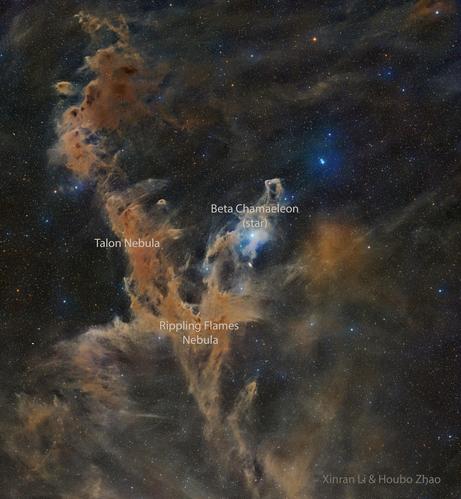
Chamaeleon Dark Nebulas
* Image Credit & Copyright: Xinran Li & Houbo Zhou
https://app.astrobin.com/u/Flying_Dutchman#gallery

Explanation:
Sometimes the dark dust of interstellar space has an angular elegance. Such is the case toward the far-south constellation of Chamaeleon. Normally too faint to see, dark dust is best known for blocking visible light from stars and galaxies behind it. In this 11.4-hour exposure, however, the dust is seen mostly in light of its own, with its strong red and near-infrared colors creating a brown hue. Contrastingly blue, a bright star Beta Chamaeleontis is visible on the upper right of the V, with the dust that surrounds it preferentially reflecting blue light from its primarily blue-white color. All of the pictured stars and dust occur in our own Milky Way Galaxy with one notable exception: a white spot just below Beta Chamaeleontis is the galaxy IC 3104 which lies far in the distance. Interstellar dust is mostly created in the cool atmospheres of giant stars and dispersed into space by stellar light, stellar winds, and stellar explosions such as supernovas.
https://en.wikipedia.org/wiki/Chamaeleon
https://en.wikipedia.org/wiki/Beta_Chamaeleontis
https://www.flickr.com/photos/hiroc/47807534932
http://www.werbeagentur.org/oldwexi/gallery.html
https://theskylive.com/sky/deepsky/ic3104-object
https://apod.nasa.gov/apod/ap180628.html

https://www.science.org/content/article/interstellar-dust-may-come-supernovae-after-all
https://en.wikipedia.org/wiki/List_of_stellar_explosion_types
https://en.wikipedia.org/wiki/Red_giant
https://astronomy.swin.edu.au/cosmos/d/Dust+Grain
https://apod.nasa.gov/apod/ap000318.html
https://science.nasa.gov/ems/07_infraredwaves/

https://apod.nasa.gov/apod/ap251119.html

#space #nebula #astronomy #science #astrophotography #photography #nature #nebula #NASA #apod

Annotated Hi-Res image for previews post.

Chamaeleon Dark Nebulas
* Image Credit & Copyright: Xinran Li & Houbo Zhou

https://apod.nasa.gov/apod/fap/ap251119.html

#space #nebula #astronomy #science #astrophotography #photography #nature #nebula #NASA #apod

2025 November 20

Alnitak, Alnilam, Mintaka
* Image Credit & Copyright: Aygen Erkaslan
https://app.astrobin.com/u/a.erkaslan#gallery

Explanation:
Alnitak, Alnilam, and Mintaka are the bright bluish stars from east to west (upper right to lower left) along the diagonal in this cosmic vista. Otherwise known as the Belt of Orion, these three blue supergiant stars are hotter and much more massive than the Sun. They lie from 700 to 2,000 light-years away, born of Orion's well-studied interstellar clouds. In fact, clouds of gas and dust adrift in this region have some surprisingly familiar shapes, including the dark Horsehead Nebula and Flame Nebula near Alnitak at the upper right. The famous Orion Nebula itself is off the right edge of this colorful starfield. The telescopic frame spans almost 4 degrees on the sky.
http://stars.astro.illinois.edu/sow/alnitak.html
http://stars.astro.illinois.edu/sow/alnilam.html
http://stars.astro.illinois.edu/sow/mintaka.html
https://app.astrobin.com/u/a.erkaslan?i=6igdue#gallery
https://www.gb.nrao.edu/~rmaddale/Education/OrionTourCenter/optical.html
https://apod.nasa.gov/apod/ap200919.html
https://apod.nasa.gov/apod/ap250902.html
https://apod.nasa.gov/apod/ap251113.html
https://apod.nasa.gov/apod/ap120119.html

https://apod.nasa.gov/apod/ap251120.html

#space #nebula #astronomy #science #astrophotography #photography #nature #nebula #NASA #apod

2016 September 9

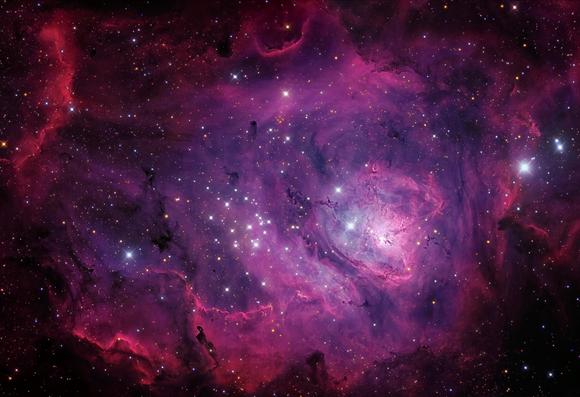
The Wide and Deep Lagoon
* Image Credit & Copyright: Michael Miller, Jimmy Walker
http://www.remarkableheavens.com/
https://www.darkskywalker.com/

Explanation:
Ridges of glowing interstellar gas and dark dust clouds inhabit the turbulent, cosmic depths of the Lagoon Nebula. Also known as M8, the bright star forming region is about 5,000 light-years distant. But it still makes for a popular stop on telescopic tours of the constellation Sagittarius, toward the center of our Milky Way Galaxy. Dominated by the telltale red emission of ionized hydrogen atoms recombining with stripped electrons, this stunning, deep view of the Lagoon is nearly 100 light-years across. Right of center, the bright, compact, hourglass shape is gas ionized and sculpted by energetic radiation and extreme stellar winds from a massive young star. In fact, the many bright stars of open cluster NGC 6530 drift within the nebula, just formed in the Lagoon several million years ago.
https://science.nasa.gov/mission/hubble/
https://apod.nasa.gov/apod/ap141125.html
https://apod.nasa.gov/apod/ap140820.html
https://arxiv.org/abs/1311.1201
https://arxiv.org/abs/1209.0898

https://apod.nasa.gov/apod/ap160909.html

#space #nebula #astrophotography #photography #science #astronomy #nature #NASA #ESA

26 December 2008

W5,

a radio source within the nebula, spans an area of sky equivalent to four full moons and is about 6,500 light-years away in the constellation Cassiopeia. Like other massive star-forming regions, such as Orion and Carina, W5 contains large cavities that were carved out by radiation and winds from the region's most massive stars. According to the theory of triggered star formation, the carving out of these cavities pushes gas together, causing it to ignite into successive generations of new stars. The image in the gallery above contains some of the best evidence yet for the triggered star formation theory. Scientists analyzing the photo have been able to show that the ages of the stars become progressively and systematically younger with distance from the center of the cavities.

https://en.wikipedia.org/wiki/File:The_W5_Stellar_Blast_Furnace.ogv

CREDIT
NASA JPL
This is a file from the Wikimedia Commons.

#space #nebula #astrophotography #photography #science #astronomy #nature #NASA #ESA

2025 December 9

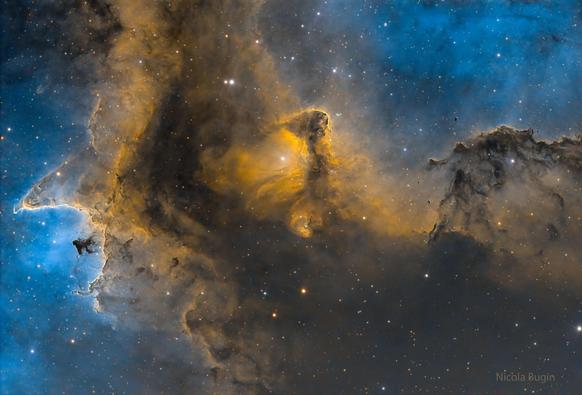
The Heart of the Soul Nebula
* Image Credit & Copyright: Nicola Bugin
https://app.astrobin.com/u/nicolabugin#gallery

Explanation:
This cosmic close-up looks deep inside the Soul Nebula. The dark and brooding dust clouds outlined by bright ridges of glowing gas are cataloged as IC 1871. About 25 light-years across, the telescopic field of view spans only a small part of the much larger Heart and Soul nebulae. At an estimated distance of 6,500 light-years, the star-forming complex lies within the Perseus spiral arm of the Milky Way, seen in planet Earth's skies toward the constellation of the Queen of Aethiopia (Cassiopeia). An example of triggered star formation, the dense star-forming clouds of IC 1871 are themselves sculpted by the intense winds and radiation of the region's massive young stars. This color image adopts a palette made popular in Hubble images of star-forming regions.
https://app.astrobin.com/u/nicolabugin?i=e85jcd#gallery
https://science.nasa.gov/exoplanets/what-is-a-light-year/
https://science.nasa.gov/ems/10_ultravioletwaves/
https://spaceplace.nasa.gov/constellations/en/
https://en.wikipedia.org/wiki/Cassiopeia_(constellation)
https://esahubble.org/wordbank/stellar-wind/
https://delsaert.com/deep-sky/nebulae/h-alpha/

https://apod.nasa.gov/apod/ap251209.html

#space #nebula #astrophotography #photography #science #astronomy #nature #NASA #ESA #apod

2025 December 10

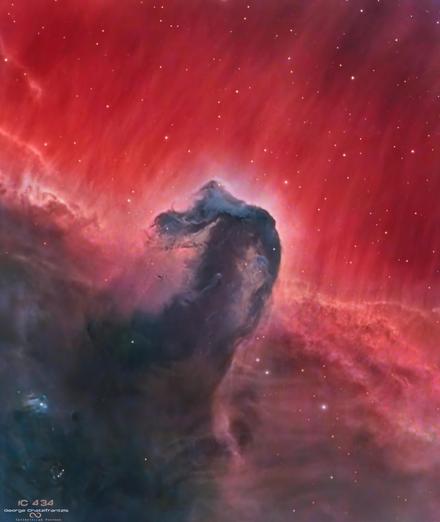
The Horsehead Nebula
* Image Credit & Copyright: George Chatzifrantzis
https://app.astrobin.com/u/pithagoras#gallery

Explanation:
Sculpted by stellar winds and radiation, this dusty interstellar molecular cloud has by chance has assumed an immediately recognizable shape. Fittingly known as The Horsehead Nebula, it lies some 1,500 light-years distant, embedded in the vast Orion cloud complex. About five light-years "tall," the dark cloud is cataloged as Barnard 33, first identified on a photographic plate taken in the late 19th century. B33 is visible primarily because its obscuring dust is silhouetted against the glow of emission nebula IC 434. Hubble space telescope images from the early 21st century find young stars forming within B33. Of course, the magnificent interstellar cloud will slowly shift its apparent shape over the next few million years. But for now the Horsehead Nebula is a rewarding though difficult object to view with small telescopes from planet Earth.
https://app.astrobin.com/u/pithagoras?i=a4dajf#gallery
https://science.nasa.gov/asset/hubble/the-horsehead-nebula/
http://www.messier.seds.org/xtra/ngc/b33.html

https://apod.nasa.gov/apod/ap251210.html

#space #nebula #astrophotography #photography #science #astronomy #nature #NASA #ESA #apod

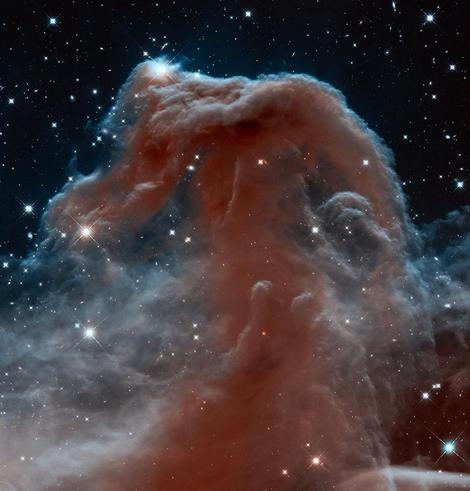
Hubble Sees a Horsehead of a Different Color

Looking like an apparition rising from whitecaps of interstellar foam, the iconic Horsehead Nebula has graced astronomy books ever since its discovery over a century ago. The nebula is a favorite target for amateur and professional astronomers.

In this new Hubble Space Telescope view, the nebula appears in a new light, as seen in infrared wavelengths. The nebula, shadowy in optical light, appears transparent and ethereal when seen in the infrared, represented here with visible shades. The rich tapestry of the Horsehead Nebula pops out against the backdrop of Milky Way stars and distant galaxies that are easily seen in infrared light.

The Horsehead was photographed in celebration of the 23rd anniversary of the launch of Hubble aboard the space shuttle Discovery. Over its two decades of producing ground-breaking science, Hubble has benefited from a slew of upgrades, including the 2009 addition of a new imaging workhorse: the high-resolution Wide Field Camera 3 that was used to take this portrait of the Horsehead.

The backlit wisps along the Horsehead's upper ridge are being illuminated by Sigma Orionis, a young five-star system just off the top of the Hubble image. A harsh ultraviolet glare from one of these bright stars is slowly evaporating the nebula. Along the nebula's top ridge, two fledgling stars peek out from their now-exposed nurseries.

Gas clouds surrounding the Horsehead have already dissipated, but the tip of the jutting pillar contains a slightly higher density of hydrogen and helium, laced with dust. This casts a shadow that protects material behind it from being photo-evaporated, and a pillar structure forms. Astronomers estimate that the Horsehead formation has about five million years left before it too disintegrates.

The Horsehead Nebula is part of a much larger complex in the constellation Orion. Known collectively as the Orion Molecular Cloud, it also houses other famous objects such as the Great Orion Nebula (M42), the Flame Nebula, and Barnard's Loop. At about 1,500 light-years away, this complex is one of the nearest and most easily photographed regions in which massive stars are being formed.

Hubble's pairing of infrared sensitivity and unparalleled resolution offers a tantalizing hint of what the upcoming James Webb Space Telescope, set for launch in 2018, will be able to do.
https://assets.science.nasa.gov/content/dam/science/missions/hubble/releases/2013/04/STScI-01EVVCMQDS6P6418TY12DGX7CM.tif/jcr:content/renditions/STScI-01EVVCMSRXKFZ2H3S26CSSE6K7.pdf

Credit
NASA, ESA, Hubble Heritage Project

https://science.nasa.gov/asset/hubble/hubble-sees-a-horsehead-of-a-different-color/

#space #nebula #astrophotography #photography #science #astronomy #nature #NASA #ESA

2025 December 17

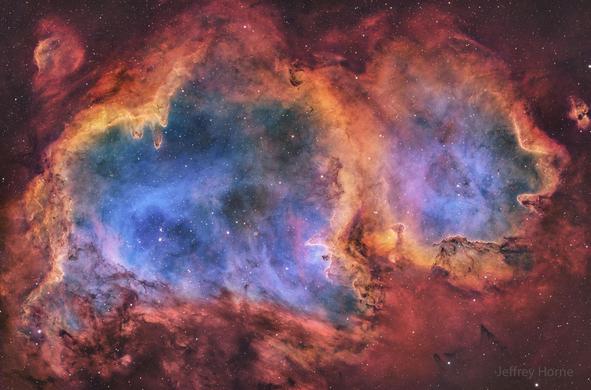
W5: The Soul Nebula
* Image Credit & Copyright: Jeffrey Horne
https://jeffrey-horne.darkroom.com/
https://app.astrobin.com/u/Jeffreyhorne#gallery

Explanation:
Stars are forming in the Soul of the Queen of Aethopia. More specifically, a large star forming region called the Soul Nebula can be found in the direction of the constellation Cassiopeia, whom Greek mythology credits as the vain wife of a King who long ago ruled lands surrounding the upper Nile river. Also known as Westerhout 5 (W5), the Soul Nebula houses several open clusters of stars, ridges and pillars darkened by cosmic dust, and huge evacuated bubbles formed by the winds of young massive stars. Located about 6,500 light years away, the Soul Nebula spans about 100 light years and is usually imaged next to its celestial neighbor the Heart Nebula (IC 1805). The featured image, taken from near Nashville, Tennessee, USA, is a composite of 234 hours of exposures made in different colors: red as emitted by hydrogen gas, yellow as emitted by sulfur, and blue as emitted by oxygen.
https://en.wikipedia.org/wiki/Westerhout_5
https://en.wikipedia.org/wiki/Cassiopeia_%28constellation%29
https://en.wikipedia.org/wiki/Cassiopeia_(mother_of_Andromeda)
https://apod.nasa.gov/apod/ap151029.html
https://asterisk.apod.com/viewtopic.php?f=24&t=18009
https://apod.nasa.gov/apod/ap221020.html
https://apod.nasa.gov/apod/ap030706.html
https://science.nasa.gov/universe/stars/
https://apod.nasa.gov/apod/ap171004.html
https://spaceplace.nasa.gov/light-year/en/
https://apod.nasa.gov/apod/ap100601.html
https://apod.nasa.gov/apod/ap220214.html
https://www.youtube.com/watch?v=nLuOM9aOWvk
https://en.wikipedia.org/wiki/Sulfur
https://periodic.lanl.gov/8.shtml

https://apod.nasa.gov/apod/ap251217.html

#space #nebula #astrophotography #photography #science #astronomy #nature #NASA #ESA #apod

2025 December 25

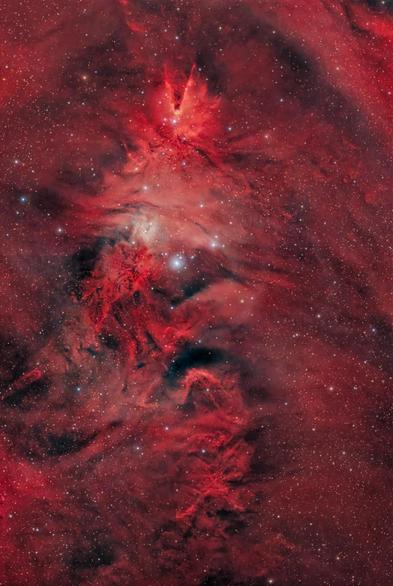
Unicorn, Fox Fur and Christmas Tree
* Image Credit & Copyright: Michael Kalika
https://michaelkalika.com/
https://app.astrobin.com/u/mkalika#gallery

Explanation:
A star forming region cataloged as NGC 2264, this beautiful but complex arrangement of interstellar gas and dust is about 2,700 light-years distant in the faint but fanciful constellation Monoceros, the Unicorn. Seen toward the celestial equator and near the plane of our Milky Way galaxy, the seasonal skyscape mixes reddish emission nebulae excited by energetic light from newborn stars with dark interstellar dust clouds. Where the otherwise obscuring dust clouds lie close to the hot, young stars, they also reflect starlight, forming blue reflection nebulae. In fact, bright variable star S Monocerotis is immersed in a blue-tinted haze near center. Arrayed with a simple triangular outline above S Monocerotis, the stars of NGC 2264 are popularly known as the Christmas Tree star cluster. Carved by energetic starlight, the Cone Nebula sits upside down at the apex of this cosmic Christmas tree while the dusty, convoluted pelt of glowing gas and dust under the tree is called the Fox Fur Nebula. This rich telescopic frame spans about 1.5 degrees or 3 full moons on the sky top to bottom, covering nearly 80 light-years at the distance of NGC 2264.
https://app.astrobin.com/u/mkalika?i=ummasw#gallery
http://www.messier.seds.org/xtra/ngc/n2264.html
http://stars.astro.illinois.edu/sow/15mon.html
https://en.wikipedia.org/wiki/Monoceros

https://apod.nasa.gov/apod/ap251225.html

#space #nebula #astrophotography #photography #science #astronomy #nature #NASA #ESA #apod

Christmas Greetings from grobi ..

Hang a Shining Star Upon the Highest Bough

This new view of the “Christmas tree cluster” NGC 2264, released on Dec. 17, 2024, combines data from NASA’s Chandra X-ray Observatory and optical data from astrophotographer Michael Clow’s telescope in Arizona. Chandra data is represented in red, purple, blue, and white, while optical data is in green and violet.

Located about 2,500 light-years from Earth, NGC 2264 is a cluster of young stars between one and five million years old. The stars are seen here as blue and white lights surrounded by swirls of gas—the “pine needles” of the tree—with green representing light in the visible spectrum.

CREDIT:
* X-ray: NASA/CXC/SAO
* Optical: Clow, M.
* Image Processing: NASA/CXC/SAO/L. Frattare and K. Arcand

Text:
* Monika Luabeya
* Lee Mohon
* Sarah A. Loff

https://www.nasa.gov/image-article/hang-a-shining-star-upon-the-highest-bough/

#space #nebula #astrophotography #photography #science #astronomy #nature #NASA #ESA #apod #Christmas

2025 December 31

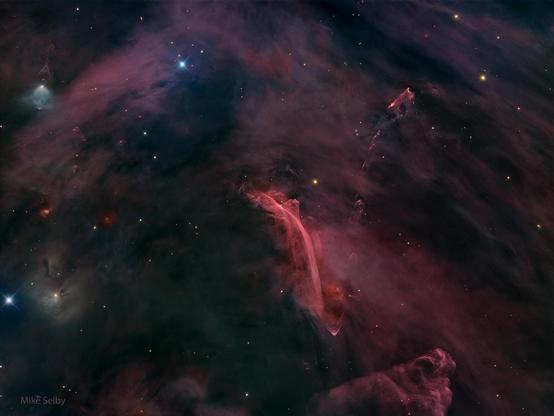
HH-222: The Waterfall Nebula
* Image Credit & Copyright: Mike Selby
https://throughlightandtime.com/about/

Explanation:
What created the Waterfall Nebula? The origin is still being researched. The structure, officially designated Herbig-Haro 222, appears in the region of NGC 1999 in the Great Orion Molecular Cloud complex. The elongated gaseous stream stretches about ten light years but appears similar to a long waterfall on Earth. Recent observations indicate that HH-222 is likely a gigantic gaseous bow shock, similar to a wave of water caused by a fast-moving ship. The origin of this shock wave is thought to be a jet outflow from the multiple star system V380 Orionis off the lower left of the frame. Therefore, gas does not flow along the waterfall, but rather the entire structure moves toward the upper right. The Waterfall Nebula lies about 1,500 light years away toward the constellation of Orion. The featured image was captured earlier this month from El Sauce Observatory in Chile.

https://apod.nasa.gov/apod/ap251231.html

#space #nebula #astrophotography #photography #science #astronomy #nature #NASA #ESA #apod

2026 January 16

NGC 7023: The Iris Nebula
* Image Credit & Copyright: Justus Falk
https://jf-astronomy.de/

Explanation:
These cosmic clouds have blossomed 1,300 light-years away in the fertile starfields of the constellation Cepheus. Called the Iris Nebula, NGC 7023 is not the only nebula to evoke the imagery of flowers. Still, this deep telescopic image shows off the Iris Nebula's range of colors and symmetries embedded in surrounding fields of interstellar dust. Within the Iris itself, dusty nebular material surrounds a hot, young star. The dominant color of the brighter reflection nebula is blue, characteristic of dust grains reflecting starlight. Central filaments of the reflection nebula glow with a faint reddish photoluminescence as some dust grains effectively convert the star's invisible ultraviolet radiation to visible red light. Infrared observations indicate that this nebula contains complex carbon molecules known as PAHs. The dusty blue petals of the Iris Nebula span about six light-years.
http://hawastsoc.org/deepsky/cep/index.html
http://www.universetoday.com/17597/ngc-7023-iris-from-the-dust-by-kent-wood/
https://apod.nasa.gov/apod/fap/ap080214.html
https://jf-astronomy.de/nebulae/
http://www.spacetelescope.org/news/heic0915/
http://adsabs.harvard.edu/cgi-bin/nph-bib_query?bibcode=1989ApJ...347L..25W&db_key=AST&high=3bc4bede8e21358
http://cdsads.u-strasbg.fr/cgi-bin/nph-bib_query?2000A%26A...354L..17M&db_key=AST&nosetcookie=1
https://www.spitzer.caltech.edu/news/feature07-03-spitzer-learns-about-carbons-cosmic-life

https://apod.nasa.gov/apod/ap260116.html

#space #nebula #astrophotography #photography #science #astronomy #nature #NASA #ESA #apod

2026 January 22

LDN 1622: Dark Nebula in Orion
* Image Credit & Copyright: Chris Fellows
https://app.astrobin.com/u/SliverSnake#gallery

Explanation:
The silhouette of an intriguing dark nebula inhabits this cosmic scene. Lynds' Dark Nebula (LDN) 1622 appears against a faint background of glowing hydrogen gas only visible in long telescopic exposures of the region. In contrast, a brighter reflection nebula, vdB 62, is more easily seen just above the dusty dark nebula. LDN 1622 lies near the plane of our Milky Way Galaxy, close on the sky to Barnard's Loop, a large cloud surrounding the rich complex of emission nebulae found in the Belt and Sword of Orion. With swept-back outlines, the obscuring dust of LDN 1622 is thought to lie at a similar distance, perhaps 1,500 light-years away. At that distance, this 3 degree wide field of view would span about 100 light-years. Young stars do lie hidden within the dark expanse and have been revealed in Spitzer Space telescope infrared images. Still, the foreboding visual appearance of LDN 1622 inspires its popular name, the Boogeyman Nebula.
http://en.wikipedia.org/wiki/Dark_nebula
https://app.astrobin.com/u/SliverSnake?i=0wg4a0#gallery
https://ui.adsabs.harvard.edu/abs/1962ApJS....7....1L/abstract
https://www.emilivanov.com/CCD%20Images/Catalog_VdB.htm
http://www.messier.seds.org/xtra/ngc/b-loop.html
https://apod.nasa.gov/apod/ap101023.html
https://ui.adsabs.harvard.edu/abs/2009AJ....137.3843B/abstract
https://www.researchgate.net/figure/The-L1622-cloud-as-seen-by-Spitzer-36-m-blue-8-m-green-and-24-m-red-Emission_fig10_235684871
https://en.wikipedia.org/wiki/Bogeyman#/media/File:Francisco_de_Goya,_Que_viene_el_coco_(Here_Comes_the_Bogey-Man),_published_1799,_NGA_7459.jpg
https://apod.nasa.gov/apod/ap230125.html

https://apod.nasa.gov/apod/ap260122.html

#space #nebula #astrophotography #photography #science #astronomy #nature #NASA #ESA #apod

2026 January 27

Orion's Treasures over Snowy Mountains
* Image Credit & Copyright: Włodzimierz Bubak
https://www.instagram.com/trzeci_plan/
* Text: Ogetay Kayali (MTU)
https://www.ogetay.com/
https://www.mtu.edu/physics/

Explanation:
Rising over a frozen valley in the Tatra Mountains, the familiar stars and nebulas of Orion dominate this wide-field nightscape. The featured deep photo was taken in southern Poland's highest mountain range last month, where dark skies and alpine terrain combined to reveal both Earth's rugged beauty and the structure of our galaxy. Above the snowy mountains, Orion's bright belt stars anchor a region of glowing interstellar clouds. The Great Orion Nebula, a vast stellar nursery visible even to the unaided eye, shines near the center of the scene. Surrounding it is the enormous arc of Barnard's Loop, a faint shell of ionized hydrogen gas spanning much of the constellation. To the left, the round Rosette Nebula glows softly, while the grayish Witch Head Nebula hovers to the right, illuminated by nearby starlight. Near the top, the orange supergiant Betelgeuse marks the hunter's shoulder.
https://youtu.be/Dg-8W57X7lY
https://apod.nasa.gov/apod/ap240131.html
https://www.instagram.com/p/DSK39XzDHJ1/
https://en.wikipedia.org/wiki/Poland
https://apod.nasa.gov/apod/ap200408.html

https://apod.nasa.gov/apod/ap260127.html

#space #nebula #astrophotography #photography #science #nature #NASA #apod

2026 January 28

M78: Reflecting Blue in a Sea of Red
* Image Credit & Copyright: Daniel McCauley
https://www.flickr.com/photos/141763086@N06/

Explanation:
In the vast Orion Molecular Cloud complex, several bright blue nebulas are particularly apparent. Pictured here in the center are two of the most prominent reflection nebulas - dust clouds lit by the reflecting light of bright embedded stars. The more famous nebula is M78, in the image center, cataloged over 200 years ago. To its upper left is the lesser known NGC 2071. Astronomers continue to study these reflection nebulas to better understand how interior stars form. The overall red glow is from diffuse hydrogen gas that covers much of the Orion complex that spans much of the constellation of Orion. Nearby in the greater complex, which lies about 1,500 light years away, are the Orion Nebula, the Horsehead Nebula, and Barnard's Loop -- partially seen here as the white band on the upper left.
https://apod.nasa.gov/apod/fap/ap161204.html
https://www.flickr.com/photos/141763086@N06/54983729233/
https://apod.nasa.gov/apod/reflection_nebulae.html
https://apod.nasa.gov/apod/ap990509.html
https://science.nasa.gov/astrophysics/focus-areas/how-do-stars-form-and-evolve
https://www.nasa.gov/image-article/reflection-nebula/
http://68.media.tumblr.com/tumblr_m5hfctHc7i1rrgr1no1_1280.jpg
https://en.wikipedia.org/wiki/Hydrogen-alpha
https://astrobiology.nasa.gov/news/deep-hydrogen/
https://apod.nasa.gov/apod/ap070125.html
http://www.hawastsoc.org/deepsky/ori/
https://apod.nasa.gov/apod/ap151123.html
https://science.nasa.gov/exoplanets/what-is-a-light-year/
https://apod.nasa.gov/apod/ap250420.html
https://apod.nasa.gov/apod/ap251210.html
https://en.wikipedia.org/wiki/Barnard%27s_Loop

https://apod.nasa.gov/apod/ap260128.html

#space #nebula #astrophotography #photography #science #nature #NASA #apod

2026 January 30

NGC 1333: Stellar Nursery in Perseus
* Image Credit & Copyright: Robert Eder
https://www.astrobin.com/users/Robsi/

Explanation:
NGC 1333 is seen in visible light as a reflection nebula, dominated by bluish hues characteristic of starlight reflected by interstellar dust. A mere 1,000 light-years distant toward the heroic constellation Perseus, it lies at the edge of a large, star-forming molecular cloud. This telescopic close-up spans over two full moons on the sky or just over 15 light-years at the estimated distance of NGC 1333. It shows details of the dusty region along with telltale hints of contrasty red emission from Herbig-Haro objects, jets and shocked glowing gas emanating from recently formed stars. In fact, NGC 1333 contains hundreds of stars less than a million years old, most still hidden from optical telescopes by the pervasive stardust. The chaotic environment may be similar to one in which our own Sun formed over 4.5 billion years ago.
https://astronomy.swin.edu.au/cms/astro/cosmos/R/Reflection+Nebula
http://www.hawastsoc.org/deepsky/per/index.html
https://arxiv.org/abs/astro-ph/0602089
https://app.astrobin.com/u/Robsi?i=lcq7o0
https://en.wikipedia.org/wiki/Herbig-Haro_object#Discovery_and_history_of_observations
https://apod.nasa.gov/apod/ap240912.html
https://www.spitzer.caltech.edu/news/224-ssc2005-24-Beautiful-Chaos-of-Star-Birth
https://apod.nasa.gov/apod/ap210318.html

https://apod.nasa.gov/apod/ap260130.html

#space #nebula #astrophotography #photography #science #nature #NASA #apod

2026 February 2

Orion: The Running Man Nebula
* Image Credit & Copyright: Robert G. Lyons (Robservatory)
https://robservatory.ca/about

Explanation:
What part of Orion is this? Just north of the famous Orion Nebula is a picturesque star forming region in Orion's Sword that contains a lot of intricate dust -- some of which appears blue because it reflects the light of bright embedded stars. The region's popular name is the Running Man Nebula because, looked at from the right, part of the brown dust appears to be running legs. Cataloged as Sharpless 279, the reflection nebula is not only part of the constellation of Orion, but part of the greater Orion molecular cloud complex. Light from the Running Man's bright stars, including 42 Orionis, the bright star closest to the featured image center, is slowly destroying and reshaping the surrounding dust, which will likely be completely gone in about 10 million years. The nebula spans about 15 light years and lies about 1,500 light years away.
https://apod.nasa.gov/apod/ap251113.html
https://science.nasa.gov/universe/stars/
https://en.wikipedia.org/wiki/Orion%27s_Sword
https://science.nasa.gov/universe/dust-in-the-stellar-wind-a-cosmological-primer/
https://apod.nasa.gov/apod/ap250825.html
https://apod.nasa.gov/apod/ap160113.html
https://en.wikipedia.org/wiki/Sh_2-279
https://en.wikipedia.org/wiki/Orion_(constellation)
https://apod.nasa.gov/apod/ap101226.html
https://en.wikipedia.org/wiki/Orion_molecular_cloud_complex
https://theskylive.com/sky/stars/42-orionis-star
https://media.istockphoto.com/id/1029915086/photo/cat-leaving-the-house-through-cat-flap.jpg?s=612x612&w=0&k=20&c=xKa2CPQas0dy-hh6ZtiNhksHQd25Yzh42uJzTTjpFCA=
https://spaceplace.nasa.gov/light-year/

https://apod.nasa.gov/apod/ap260202.html

#space #nebula #astrophotography #photography #science #nature #NASA #apod

2026 February 14

Roses are Red
* Image Credit & Copyright: Raffaele Calcagno
https://www.instagram.com/p/DS7eyyGDDhI/
https://cosmo2050.com/2026/02/09/foto-di-raffaele-calcagno-ngc-2237-rosette-nebula/
* Text: Keighley Rockcliffe
https://kerockcliffe.com/
(NASA GSFC, UMBC CSST, CRESST II)

Explanation:
Roses are red, nebulas are too, and this Valentine's gift is a stunning view! Pictured is a loving look at the Rosette Nebula (NGC 2237): a cosmic bloom of bright young stars sitting atop a stem of glowing hot gas. The rose’s blue-white speckles are among the most luminous stars in the galaxy, with some burning millions of times brighter than the Sun. Their stellar winds sculpt the famed rose shape by pushing gas and dust away from the center. Though only a few million years old, these massive stars are already nearing the end of their lives, while dimmer stars embedded in the nebula will burn for billions of years to come. The vibrant red hue comes from hydrogen gas, ionized by the ultraviolet light from the young stars. The rose’s blue-white center is falsely colored to indicate the presence of similarly ionized oxygen. The Rosette Nebula reminds us of the beauty and transformation woven into the fabric of the universe.
https://science.nasa.gov/asset/hubble/rosette-nebula-context-image/
https://apod.nasa.gov/apod/ap960214.html
https://apod.nasa.gov/apod/ap070726.html
https://esahubble.org/wordbank/stellar-wind/
https://science.nasa.gov/universe/the-lives-times-and-deaths-of-stars/
https://science.nasa.gov/mission/webb/science-overview/science-explainers/spectroscopy-101-how-absorption-and-emission-spectra-work/
https://astronomy.swin.edu.au/cosmos/*/Ultraviolet
https://science.nasa.gov/ems/04_energytoimage/

https://apod.nasa.gov/apod/ap260214.html

#space #nebula #astrophotography #photography #science #nature #NASA #apod #valentine

2026 February 18

Orion's Cradle
* Image Credit & Copyright: Piotr Czerski
https://app.astrobin.com/u/PiotrC#gallery

Explanation:
Cradled in red-glowing hydrogen gas, stars are being born in Orion. These stellar nurseries lie at the edge of the giant Orion molecular cloud complex, some 1,500 light-years away. This detailed view spans about 12 degrees across the center of the well-known constellation, with the Great Orion Nebula, the closest large star-forming region, visible toward the lower right. The deep mosaic also includes, near the top center, the Flame Nebula and the Horsehead Nebula. Image data acquired with a hydrogen-alpha filter adds other remarkable features to this wide-angle cosmic vista: pervasive tendrils of energized atomic hydrogen gas and portions of the surrounding Barnard's Loop. While the Orion Nebula and many stars in Orion are easy to see with the unaided eye, emission from the extensive interstellar gas is faint and much harder to record, even in telescopic views of the nebula-rich complex.
https://www.nasa.gov/centers-and-facilities/jpl/where-are-stars-made-nasas-spitzer-spies-a-hot-spot/
https://en.wikipedia.org/wiki/Orion_molecular_cloud_complex
https://science.nasa.gov/exoplanets/what-is-a-light-year/
https://app.astrobin.com/u/PiotrC?i=59s59h
https://planetcalc.com/1897/
https://apod.nasa.gov/apod/ap241104.html
https://science.nasa.gov/universe/stars/
https://apod.nasa.gov/apod/ap210412.html
https://apod.nasa.gov/apod/ap251210.html
https://en.wikipedia.org/wiki/Hydrogen-alpha
https://apod.nasa.gov/apod/ap090224.html
https://en.wikipedia.org/wiki/Orion_Nebula
https://apod.nasa.gov/apod/ap220111.html
https://en.wikipedia.org/wiki/Interstellar_medium

https://apod.nasa.gov/apod/ap260218.html

#space #nebula #astrophotography #photography #science #physics #astrophysics #nature #NASA #apod

2026 February 19

IC 2574: Coddington's Nebula
* Image Credit & Copyright: Dane Vetter
https://app.astrobin.com/u/Dane_Vetter

Explanation:
Grand spiral galaxies often seem to get all the glory, flaunting their young, bright, blue star clusters in beautiful, symmetric spiral arms. But small, irregular galaxies form stars too. In fact, dwarf galaxy IC 2574 shows clear evidence of intense star forming activity in its telltale reddish regions of glowing hydrogen gas. Just as in spiral galaxies, the turbulent star-forming regions in IC 2574 are churned by stellar winds and supernova explosions spewing material into the galaxy's interstellar medium and triggering further star formation. A mere 12 million light-years distant, IC 2574 is part of the M81 group of galaxies, seen toward the northern constellation Ursa Major. Also known as Coddington's Nebula, the faint but intriguing island universe is about 50,000 light-years across, discovered by American astronomer Edwin Coddington in 1898.
https://apod.nasa.gov/apod/ap210813.html
https://apod.nasa.gov/apod/ap080517.html
https://app.astrobin.com/u/Dane_Vetter?i=xti9o5
http://arxiv.org/abs/0808.0193
https://apod.nasa.gov/apod/ap240627.html
https://apod.nasa.gov/apod/ap250203.html
https://apod.nasa.gov/apod/ap111120.html
https://history.aip.org/exhibits/cosmology/ideas/island.htm

https://apod.nasa.gov/apod/ap260219.html

#space #nebula #astrophotography #photography #science #nature #NASA #apod

2026 February 20

B93: A Dark Interstellar Ghost
* Image Credit & Copyright: Christian Bertincourt
https://app.astrobin.com/u/BERTINCOURT
* Text: Keighley Rockcliffe (NASA GSFC, UMBC CSST, CRESST II)
https://kerockcliffe.com/
https://science.gsfc.nasa.gov/sci/bio/keighley.e.rockcliffe
https://www.nasa.gov/goddard/
https://physics.umbc.edu/research/astrophysics/
https://csst.umbc.edu/directory/
https://cresst2.umd.edu/

Explanation:
"A ghost in the Milky Way…” says Christian Bertincourt, the astrophotographer behind this striking image of Barnard 93 (B93). The 93rd entry in Barnard’s Catalogue of Dark Nebulae, B93 lies within the Small Sagittarius Star Cloud (Messier 24), where its darkness stands in stark contrast to bright stars and gas in the background. In some ways, B93 is really like a ghost, because it contains gas and dust that was dispersed by the deaths of stars, like supernovas. B93 appears as a dark void not because it is empty, but because its dust blocks the light emitted by more distant stars and glowing gas. Like other dark nebulas, some gas from B93, if dense and massive enough, will eventually gravitationally condense to form new stars. If so, then once these stars ignite, B93 will transform from a dark ghost into a brilliant cradle of newborn stars.
https://app.astrobin.com/i/s3hdtc
https://ui.adsabs.harvard.edu/abs/1919ApJ....49....1B/abstract
https://apod.nasa.gov/apod/ap220407.html
https://science.nasa.gov/mission/hubble/science/explore-the-night-sky/hubble-messier-catalog/messier-24/
https://apod.nasa.gov/apod/ap230129.html
https://en.wikipedia.org/wiki/Ghost
https://science.nasa.gov/mission/hubble/science/science-highlights/the-death-throes-of-stars/
https://apod.nasa.gov/apod/ap960623.html
https://apod.nasa.gov/apod/ap231201.html
http://www.messier.seds.org/more/m024_b93.html
https://i.ytimg.com/vi/pLbkUmVzXMs/hq720.jpg
https://science.nasa.gov/universe/stars/
https://science.nasa.gov/mission/hubble/science/science-highlights/exploring-the-birth-of-stars/
https://apod.nasa.gov/apod/ap260218.html

https://apod.nasa.gov/apod/ap260220.html

#space #nebula #astrophotography #photography #science #nature #NASA #apod

2026 March 11

CG 4: The Globule and the Galaxy
* Image Credit & Copyright: William Vrbasso
https://www.stellaraustralis.com/
* Text: Cecilia Chirenti (NASA GSFC, UMCP, CRESST II)
https://science.gsfc.nasa.gov/sci/bio/cecilia.bertonimarthahadlerchirenti
https://www.nasa.gov/
https://www.nasa.gov/goddard/
https://www.astro.umd.edu/people/cecilia-chirenti
https://cresst2.umd.edu/

Explanation:
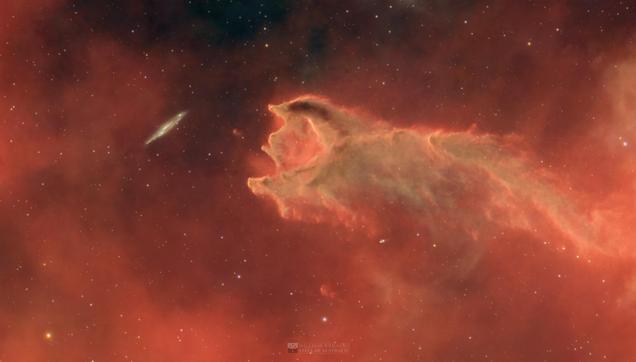
Is this a cosmic monster ready to devour an unsuspecting galaxy? Thankfully, that is not the case. The red “monster” shown in the featured image is Cometary Globule CG 4, 1,300 light-years away in the Constellation Puppis. CG 4 is a molecular cloud, where hydrogen becomes cold enough to form molecules that can be brought together by gravity to create stars. The shape of CG 4 resembles that of a comet, but its head is 1.5 light-year in diameter and its tail is 8 light-years long; for comparison, the distance from the Earth to the sun is only 8 light-minutes. Astronomers believe that the tail of a cometary globule could have been shaped by a nearby supernova explosion or by irradiation from hot, massive stars. Indeed, CG 4 and other nearby globules point away from the Vela Supernova Remnant, at the center of the Gum Nebula. The edge-on spiral galaxy, ESO 257-19, is more than a hundred million light-years beyond CG 4, and is completely safe from the “monster”.
https://www.instagram.com/p/DVM1o0MkyDe/
https://apod.nasa.gov/apod/ap240716.html
https://earthsky.org/constellations/puppis-the-stern-argo-navis/
https://www.britannica.com/science/molecular-cloud
https://www.acs.org/molecule-of-the-week/archive/h/hydrogen.html
https://en.wikipedia.org/wiki/Molecule
https://science.nasa.gov/universe/stars/#birth
https://en.wikipedia.org/wiki/Pareidolia
https://science.nasa.gov/exoplanets/what-is-a-light-year/
https://www2.hao.ucar.edu/education/about-the-sun/how-far-away-sun
https://noirlab.edu/public/news/noirlab2412/
https://www.eso.org/public/news/eso1503/
https://apod.nasa.gov/apod/ap190110.html
https://apod.nasa.gov/apod/ap221129.html
https://science.nasa.gov/universe/galaxies/types/
https://plus.unsplash.com/premium_photo-1720922579207-251b22182659

https://apod.nasa.gov/apod/ap260311.html

#space #nebula #astrophotography #photography #science #nature #NASA #apod

2026 March 17

The Tadpoles of IC 410
* Image Credit & Copyright: Nico Carver
https://www.nicocarver.com/about

Explanation:
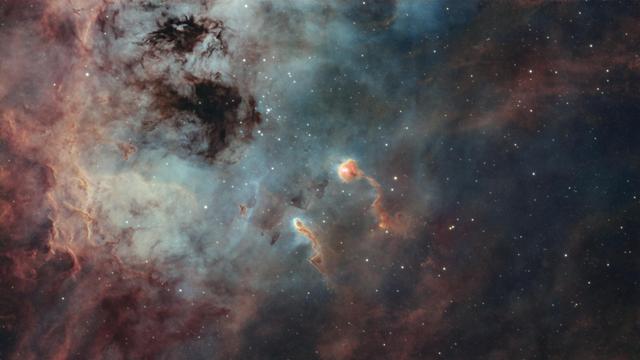
This telescopic close-up shows off the central regions of otherwise faint emission nebula IC 410, captured under backyard skies. Presented in a Hubble color palette, the image combines visible broadband and narrowband data with data from the near-infrared. Below and right of center are two remarkable inhabitants of the interstellar pond of gas and dust. the Tadpoles of IC 410. Partly obscured by foreground dust, the nebula itself surrounds NGC 1893, a young galactic cluster of stars. Formed in the interstellar cloud a mere 4 million years ago, the intensely hot, bright cluster stars energize the glowing gas. But the cosmic tadpoles themselves are composed of denser cooler gas and dust. Around 10 light-years long they are likely sites of ongoing star formation. Sculpted by stellar winds and radiation their heads are outlined by bright ridges of ionized gas while their tails trail away from the cluster's central young stars. IC 410 lies some 10,000 light-years away, toward the nebula-rich constellation Auriga.
https://app.astrobin.com/u/nebulaphotos?i=07is4o
https://www.youtube.com/watch?v=okEPUA_k2xQ
http://arxiv.org/abs/1207.5632
https://apod.nasa.gov/apod/ap070726.html
https://science.nasa.gov/mission/hubble/science/science-highlights/exploring-the-birth-of-stars/
https://science.nasa.gov/missions/hubble/embryonic-stars-emerge-from-interstellar-eggs/
https://apod.nasa.gov/apod/ap240202.html
https://apod.nasa.gov/apod/ap140213.html

https://apod.nasa.gov/apod/ap260317.html

#space #nebula #astrophotography #photography #science #nature #NASA #apod

2026 March 18

Cygnus and the Solitary Tree
* Image Credit & Copyright: 2025 Horacio Lander / AstroHoracio
http://astrohoracio.com/
* Text: Keighley Rockcliffe (NASA GSFC, UMBC CSST, CRESST II)
https://kerockcliffe.com/
https://science.gsfc.nasa.gov/sci/bio/keighley.e.rockcliffe
https://www.nasa.gov/goddard/
https://csst.umbc.edu/directory/
https://cresst2.umd.edu/

Explanation:
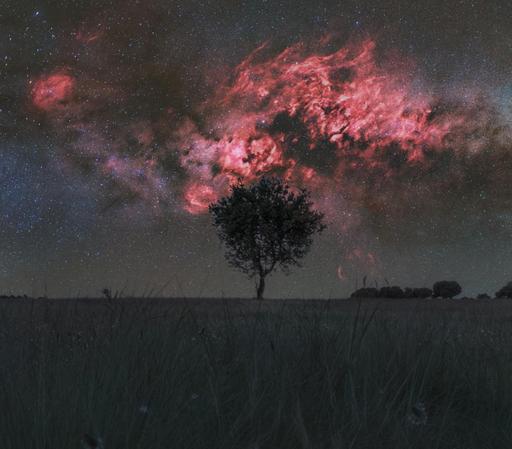
A lone tree stands in a quiet meadow in Guadalajara, Spain, silhouetted against the Cygnus region rising above like flames in the night sky. This deep night skyscape is a composite of exposures that reveals a range of brightness and color human eyes can't quite see on their own. Spanning over a thousand times the angular size of the full moon, Cygnus sets the sky afire with active star formation where clouds of gas and dust collapse under gravity until nuclear fusion ignites and new stars are born. These stars ionize the surrounding hydrogen gas, causing it to glow crimson, while tendrils of interstellar dust absorb some of that light and cast dark shadows across the sky. Cygnus is a trove of celestial treasures, notably the Veil, Crescent, and Pelican nebulae, as well as Cygnus X-1, the first confirmed black hole. Cygnus continues to yield fresh science, including a new three-dimensional model of the Cygnus Loop made possible by the Chandra X-ray Observatory.
https://www.guadalajara.es/en/tourism/discover-guadalajara/
https://apod.nasa.gov/apod/ap210211.html
https://earthsky.org/astronomy-essentials/sky-measurements-degrees-arc-minutes-arc-seconds/
https://noirlab.edu/public/education/constellations/cygnus/
https://courses.lumenlearning.com/towson-astronomy/chapter/star-formation/
https://courses.ems.psu.edu/astro801/content/l5_p4.html
https://energyeducation.ca/encyclopedia/Ionization
https://science.nasa.gov/mission/webb/science-overview/science-explainers/spectroscopy-101-how-absorption-and-emission-spectra-work/
https://apod.nasa.gov/apod/ap251119.html
https://apod.nasa.gov/apod/ap250602.html
https://apod.nasa.gov/apod/ap251128.html
https://apod.nasa.gov/apod/ap210301.html
https://apod.nasa.gov/apod/ap240828.html
https://science.nasa.gov/universe/black-holes/
https://chandra.harvard.edu/deadstar/cygnus.html
https://apod.nasa.gov/apod/ap200928.html
https://www.nasa.gov/mission/chandra-x-ray-observatory/

https://apod.nasa.gov/apod/ap260318.html

#space #nebula #astrophotography #photography #science #nature #NASA #apod

@grobi

Beautiful photo! I'm glad, however, that our vision doesn't have the spectral range to see all that. I enjoy a peaceful, dark sky at night. Thanks for sharing, and special thanks for explaining that the image is enhanced!

@oldclumsy_nowmad

Thank you for your support and recognition.

I would like to perceive the night sky with the visual senses of different animals. maybe in a documentation film ..

@grobi

That would be cool! Good luck with that project!

p.s. One science fiction writer published a story in which he envisioned a person who inherited a nervous-system mutation giving her the power to see a vast range of the electromagnetic spectrum - visible, uv, ir, even radio. Absurd, of course, and terrifying if it were to happen to someone. But it raises many interesting questions for us to consider, doesn't it?

I don't remember which writer that was, probably Aldiss or Simak.