
The first #Starhopper flight was in πŸ“† 2019. First #Starship landing (without #RUD πŸ’₯) πŸ“† 2021. First #atmospheric entry πŸ“† 2024. When do you expect the first (uncrewed) Starship #Mars πŸ”΄ landing attempt ? πŸ€”
2025
1%
2027
25.3%
2029
24.2%
> 2030
49.5%
Poll ended at .
#SpaceX will launch its first #Starships πŸš€ to #Mars πŸ”΄ in two years. "These will be uncrewed to test the reliability of landing intact on Mars" https://www.reuters.com/technology/space/musk-says-spacex-launch-first-uncrewed-starships-mars-two-years-2024-09-07/

If the uncrewed test missions succeed, #crewed πŸ‘¨β€πŸš€ πŸ‘©β€πŸš€ missions are expected in πŸ“† 2028 https://www.cnet.com/science/space/spacex-plans-5-missions-to-mars-by-2026-elon-musk-says/

#SpaceX #Starship #Mars

SpaceX Plans 5 Missions to Mars by 2026, Elon Musk Says

If the uncrewed test missions succeed, crewed missions are expected in 2028.

CNET

"#Mars πŸ”΄ serves as a simplified laboratory for testing #climate models and scenarios, without oceans and biology, that we can then use to better understand πŸ€”πŸ’­ Earth systems." #Mars can tilt more than Earth, causing the Red Planet's poles to receive more direct sunlight than its midlatitudes, making for longer summer days with higher temperatures https://www.space.com/33001-mars-ice-age-ending-now.html
#ClimateChange

Red Planet Heats Up: Ice Age Ending on Mars

Mars is emerging from an ice age, a finding that could shed light on the past and future climates of both Mars and Earth, researchers say.

Space
Injecting tiny particles into #Mars’s atmosphere could warm 🌑️ the planet by more than 10Β°C in a matter of months, researchers find - enough to sustain liquid water πŸ’§. The 2 million tons of particles represent roughly 0.1% of the industrial metals mined βš’οΈ on Earth each year. #Terraforming research shows how important it is to study Earth. β€œCan we understand πŸ€”πŸ’­ #climate and ecosystems well enough to build them elsewhere ?” https://www.science.org/content/article/terraforming-mars-could-be-easier-scientists-thought
β€œThe barrier to warming #Mars πŸ”΄ to allow liquid water πŸ’§ is not as high as previously thought” : Changing the shape of the planet’s #dust https://news.weinberg.northwestern.edu/2024/08/26/how-we-could-warm-mars/
How we could warm Mars – Weinberg College News

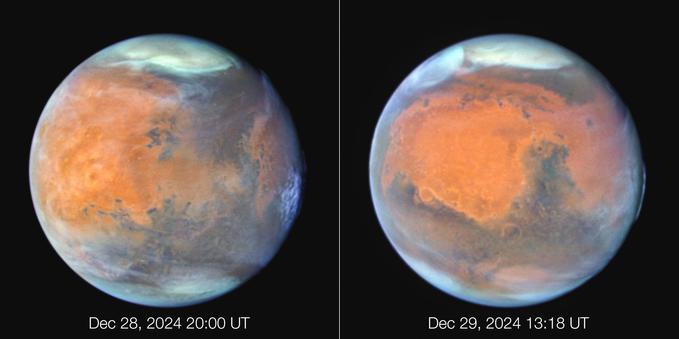
#ESA #Hubble #SpaceTelescope πŸ”­ images of #Mars taken December 2024. Thin #water-ice ❄️ clouds are apparent in ultraviolet light https://www.esa.int/ESA_Multimedia/Images/2025/04/Mars_December_2024
Mars (December 2024)

Mars (December 2024)

Researchers found that the mid-crust, about 10-20 kilometers down, may be riddled with cracks and pores filled with water πŸ’§. A rough estimate predicts these cracks could hold enough #water to cover all of #Mars πŸ”΄ with an ocean 🌊 1-2 kilometers deep https://www.planetary.org/articles/mars-may-host-oceans-worth-of-water-deep-underground
Mars may host oceans’ worth of water deep underground

The tentative discovery hints at an habitat where life could potentially thrive.

The Planetary Society

Only hydrated #minerals as a water source cover the needs to produce propellants and life support #waterπŸ’§. Extraction from #regolith requires autonomous excavation, transport, processing of regolith and water treatment that present significant challenges. #Atmospheric water harvesting suffers from the extremely low residence time of air in the system. Compression is power-intensive πŸͺ« but can be competitive if the waste heat from the fission reactors is accessible https://www.sciencedirect.com/science/article/pii/S0273117725012864?via%3Dihub#s0185

#Mars