 donhackman
 Stefan Bohacek
Happy 25th anniversary to this Daily Mail article from the year 2000, proclaiming that internet "may be just a passing fad as millions give up on it".
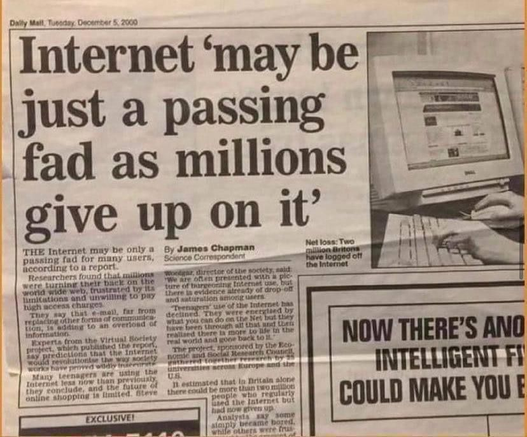
Happy 25th anniversary to this Daily Mail article from the year 2000, proclaiming that internet "may be just a passing fad as millions give up on it".
Lots of snark and negativity (understandably!), but I am for one thankful for the internet/the web, and all of you being here with me.
We can still turn things around, together!
@stefan The question is how.
We won't do it while everybody else is still trapped in shit places.
We won't do it either bringing so many people over, with all their bad habits, that this (or whatever other good place we may come up with along the way) becomes yet another shit place.
It's a bit of a catch-22.
@jorgecandeias Fair point!
Honestly, the fact that fediverse exists does give me some hope for the future, even if we don't have all the answers quite yet.
@stefan Sometimes I wish they'd been right...
I'm also convinced someone at BT genuinely believed this was the case, as they seemed to be very slow to get into the ISP game back in the days people were first getting online. Like they were waiting to be certain it wasn't going to be a flash in the pan.
@stefan The Daily Mail was not all that wrong. Most did give up on the Internet, choosing to lock themselves into abysmal megacorp siloes instead. The Internet’s breath has been very shallow for a very long time now.
We used to have open protocols, open standards, vendor- and platform independent communications. We now have gmail, SLOP instead of info, whatever Microsoft and Meta inflict upon mankind, and a handful of other nazi propaganda channels.
@Rastal Fascinating question to ponder!
I'd like to believe that we can still turn things around, have the internet and a better world.
@Rastal @stefan Instead of having sets of open standards for routing and communication we'd all be locked in to only what say AOL provides and nothing else.
That was the competing force that lost.
Open Source would have been murdered at infancy. Tech would be way behind but way more monopolistic and controlled. Think where we are headed, but back in the 90's.
Pretty sure the psychological abuse and experimentation would still be going on.
@stefan Interesting this quote: "e-mail [...] is adding to an overload of information".
So nothing has changed, really, we're just continually adjusting to overload.
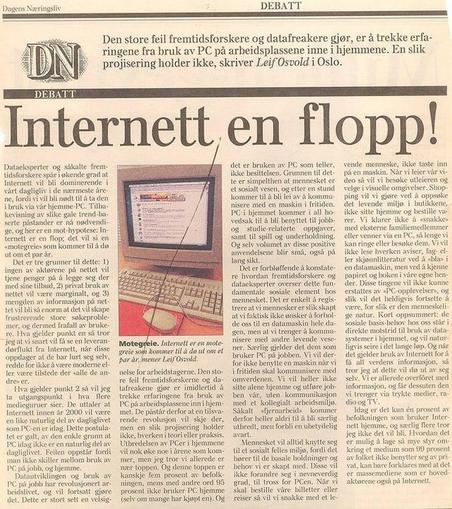
Satellite what? Internet through satellite connection? Or something else?
@NinjaDebugger , so a bit like online banking in the 1980's?
I remember my parents used a DOS program called Telix for directly phoning the bank's server and then using the bank pretty precisely the same way online banking works with browsers these days, except for the UI being basically ASCII art.
So, using satellite to connect to what essentially amounts to diverse intranets? Like a BBS?
@Tuuktuuk Like that but the other direction. They were pushing weather, crop, stock market etc data out to farmers.
It was a one way connection.
Ah, so, a very expensive device that does the same as teletext? Makes sense, obviously :D
YUP. And he bet everything on that instead of the internet.
Even then, vested interests were funding malign influence campaigns because they always fear the new.
Even then, the rich feared the disruption of unfettered access to information.
@dedicto @stefan no but it looks like research being quoted is here: "they came, they surfed, they went back to the beach"
https://academic.oup.com/book/52617/chapter-abstract/421806907?redirectedFrom=fulltext&login=false
and here is the entire ESRC "virtual society?" project book
https://books.google.co.uk/books/about/Virtual_Society.html?id=OEgVDAAAQBAJ&redir_esc=y
@stefan @dedicto yeah and the points being made by the researchers seem reasonable: access costs to the internet are high so out of reach of teenagers, the dot com bust slashed ad budgets of dot coms leading to downgraded growth forecasts, lack of digital money combined with the fact teens dont have credit cards limits growth of online shopping...
The issue here is just typically bad science reporting and bombastic headlines...
How dare you.
»James Chapman has unrivalled experience at the top of both journalism and government.«
In all fairness, he also said:
»Some 25 years ago, as a gauche young science reporter, I wrote an article for the Daily Mail about a think tank report highlighting the fact that two million former internet users had given up on the technology, frustrated by high costs and slow dial-up speeds. The piece itself was fairly nuanced, but a Mail sub-editor, perhaps reflecting corporate unease about what the impact of the internet might be on print titles, christened it with what has since become an infamous headline: ‘Internet “may be just a passing fad as millions give up on it”.
After someone dug out the cutting, this has gone viral to such an extent that barely a day goes by on social media without someone sending it to me with understandable amusement to ask for an update on my prediction. I used to point out that the research was not my own, having been sponsored by the Economic and Social Research Council, was based on then verifiable facts and widely reported by other outlets, including the Guardian. Now I roll with it and embrace the infamy.«
https://www.cityam.com/the-notebook-james-chapman-on-getting-big-money-out-of-politics/
"the young internet expanded my worldview in every dimension and made me the person I am today"
Love the way you put this!
Definitely feel the same way about the past decade or so, but I am hopeful we're still going to see better days.
Something like the fediverse was hard to imagine taking off just a few years ago, and here we are!

 Jorge Candeias
 BeeCycling
 Mrs.Malice 👾🍕
 barning
 Григорий Клюшников
 J$
J$ PaulaToThePeople 😷
 Andrew
 Rastal
 proedie
 derptron
 Anthropy
 さよなら皆さん
 thejikz
 Ronan
Ronan Je ne comprends pas
 Lett Osprey
 🍉
🍉 
 NinjaDebugger
 Tuukka R
 Thad
Thad Magnus Ahltorp
 Ria Price
 sentientsponge
 Nicole Parsons
 mahadevank
 Douglas Edwards
 소주한잔
소주한잔 lonely extrovert
 Zalasur 🐸🇺🇦
 Jim
Jim katzenberger
 Stumpy The Mutt
 四
四 Tim 🛥️🌈
 Talisyn Tailfeather
 Kerry Mitchell 🍁
 Kraftwerk-Das Model Collapse
 David Cohen
 That Eric
 My name is Gordo
 Morten Hilker-Skaaning