 Vinch
Vinch Lady Laura
 Hachiko
 Poul-Henning Kamp
Danish: Nine and half five twenty
 Ditol
Ditolnine plus halfway (from four) to five times twenty
twenty used to be a very common number in trade, it was called "en snes"
@bsdphk
You mean 9+4,5*20? Okay, this is hard to beat.
Weird, but 100% systematic from 50 to 99:
51 = 1 + 2.5*20
64 = 4 + 3*20
72 = 2 + 3.5*20
87 = 7 + 4 * 20
@bsdphk
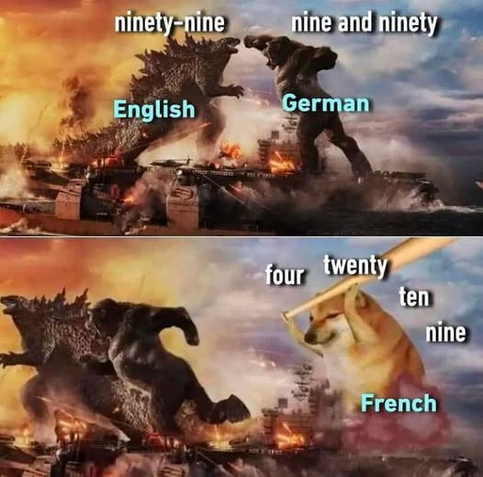
We need to update the meme: Danish comes in with a flamethrower.
 Sir Toootenstein
 proedie
 Bodhipaksa
@bsdphk @ditol @cmconseils The half thing is like the system of telling the time in Germany and some parts of rural Scotland, where “half five” for example means 4:30 rather than 5:30.
@bodhipaksa
Thanks, now it starts making sense at least. :)
@bodhipaksa
Btw., it's not only German and Scots: it's the same in Ukrainian and Russian (and probably other Slavic languages, but I don't speak them, so no way to tell certainly).
 Titia Schuurman
@bsdphk @ditol @cmconseils
I believe it is "score" in English, as in the Gettysburg Address:
"Four score and seven years ago our fathers brought forth on this continent, a new nation, conceived in Liberty, and dedicated to the proposition that all men are created equal."
Which would give us, in this case, "four-and-a-half-score and nine".
Yes, same thing.
 Sarah Peper 🏳️⚧️🇺🇦
@bsdphk @cmconseils I came here to say this
 rhempel
@bsdphk @cmconseils it's more like 9 and halfway from 80 to 100.
Halv fems is taken as half of the twenty that is 5 * 20.
Halv tres is half of the twenty that is 3 * 20.
It was confusing as hell until I got used to it :-)
 Elch
Elch@bsdphk @cmconseils Welsh (traditional): four on fifteen and fourtwenty
 onipa 🇬🇭📖
 HighlandLawyer
 JohnnieMac
@HighlandLawyer @cmconseils I never did get farther than fichead. 🙂
 jon crowcroft
@cmconseils french french - but belgians and swiss french has septante...nonante
 LiquorVicar
@tforcworc @cmconseils Though IIRC Belgian French still uses "quartre vingt" for 80 whereas Swiss French uses "octante" 🤷♂️
@LiquorVicar @cmconseils to be fair. we still say three score and ten, and fortnight, every once in a month of sundays
 Wildduck
@LiquorVicar @tforcworc @cmconseils common mistake but no single one says "octante" in Switzerland. I heard long ago that some people actualy do in Belgium but meeting more and more belgian and asking them about it, I think it's a myth as well 😁
In Switzerland a bunch say "huitante", like I do, but most of my compatriots still say "quatre-vingt", but "nonante" (they are wrong and inconsistent 😁).
@Wildduck @LiquorVicar @cmconseils thanks! from what i've now heard, it is variable across belgium too - and quebec....
 Tina Stormcaller
@cmconseils Isn’t the Danish one where you have to do fractions pretty much?
 Hilary
Yes, and to make it worse, French people always quote phone numbers as a string of two digit numbers, rather than single digits.
Absolutely does my head in, every time
 Dave
Dave@regordane @cmconseils Try german... strings of two or three numbers, depending on speech flow. And if it involves the area code of a telephone number, it can go up to 4 or even 5 digits in one string.
 Marcos Dione
@regordane @cmconseils it does everyone's head in. You can see French people pausing writing numbers down the moment you say 'quatre', which extends if you immediately say 'vingt'.
I imagine there's a pause after soixante as well
@regordane @cmconseils of course, but my phone contains '91', so I had plenty of time of seeing this play out :)
Mine contains 84, 95 and 79, not in that order
@mdione @regordane @cmconseils
Et le mien : 80 11 et je fais toujours une longue pause entre les deux pour éviter que mon correspondant note 91 😆
Et le mien : 80 11 et je fais toujours une longue pause entre les deux pour éviter que mon correspondant note 91 😆
@TYB @regordane @cmconseils ah, ça devrait être interdit! Je t'imagine en disant "quatre-vingt... (geste avec les mains comme si tu posait une boite sur une table) onze (même geste, mais tu mets la boite à coté de l'autre :)".
@mdione @regordane @cmconseils
Likewise in Gaelic, when saying X things, the thing is often in the middle of the number.
For example "aon chat deug" one cat ten (11), "dà chat deug" (12), "trì cait deug" three cats ten (13), "ceithir fichead cat 's a h-aon" four twenty cat and one (81).
Likewise in Gaelic, when saying X things, the thing is often in the middle of the number.
For example "aon chat deug" one cat ten (11), "dà chat deug" (12), "trì cait deug" three cats ten (13), "ceithir fichead cat 's a h-aon" four twenty cat and one (81).
@HighlandLawyer @mdione @cmconseils
Gosh, that's not even consistent about whether the tens or the units come first
@regordane @mdione @cmconseils
Twenties or half-hundreds come first, or units when there are no twenties. Also the noun is singular with one, two, twenties, or half-hundreds, and plural otherwise.
Oh, not forgetting that one & two lenite the noun, and two makes feminine nouns prepositional.
Twenties or half-hundreds come first, or units when there are no twenties. Also the noun is singular with one, two, twenties, or half-hundreds, and plural otherwise.
Oh, not forgetting that one & two lenite the noun, and two makes feminine nouns prepositional.
@HighlandLawyer @mdione @regordane @cmconseils
Idem en breton : triwec'h kazh ha pevar-ugent = tri x c'hwec'h kazh ha pevar x ugent (3 x 6 chats et 4 x 20 (98 chats)) noter, bien entendu, que chat est au singulier 🤪
Idem en breton : triwec'h kazh ha pevar-ugent = tri x c'hwec'h kazh ha pevar x ugent (3 x 6 chats et 4 x 20 (98 chats)) noter, bien entendu, que chat est au singulier 🤪
 SK53
SK53@mdione I've always liked this chunking for phone numbers. AFAIK the Swiss pattern is a chunk of three followed by two chunks of two.
There doesn't seem to be much pattern in how people convey phone numbers here in the UK. Partly, I suspect, because there's some kind of embedded memory of shorter numbers (my current landlines went from 5->6 in 1978 and from 6->7 20-odd years ago).
 InsertUser
@SK53
I tend to default to the chunking of where I grew up (4 3 4) rather than the UK version which with does 4 4 3, 4 3 4 or 5 3 3 depending on how much of it is area code and how much is actual number.
I don't think I'll ever get used to saying a mobile number one way and having it read back another.
Tom Scott did a rant about the confusing numbering a few years ago. Unlike him I don't think that there being history to it actually makes it good.

Tom Rants About Phone Numbers For Roughly Sixteen Minutes
@InsertUser @mdione Nice video. Only grouse is I would hold that mobile numbers are 3 4 4 although I know many people who do them 5 3 3. I was on the margins of the first consultation for the London phone number split (01->071,081), and remember thinking the chosen approach was rather short-term.
@InsertUser @SK53 similar thing happened in Argentina. The Big City -> prefix didn't happen that way (not sure there was a method; the 3rd city got 051).
Then came a Ma Bell type of split (+ privatization) and we added one digit to the exchange and one to the local. Cell phones are geographic, we also get long distance as a premium, like US; with a 9 there for reasons too.
And.
Let's not forget IPv6 and how well that's going...
@mdione @InsertUser Yeah, we're out of contract because they installed fibre along thestreet for VoIP in March. But, since then, nada. (Current connection is copper - if we're luvky, overhead wire)
 Eugene Alvin Villar 🇵🇭
@SK53 @mdione @InsertUser I saw this reply first before the OP and wondered how we got to network connections from 99. 😂
@regordane @cmconseils It’s easier to remember a string of numbers that way. Your working memory can generally only hold seven items at a time. If you double up the numbers you’re able to remember longer strings.
 Jos Dingjan
@regordane @cmconseils It does mean that, 20 years after moving away, I still remember my French mobile number.
In French.
 Simon Zerafa
Are we counting Luftballons? 🙂

NENA | 99 Luftballons (Live 2018) (HD)
Enjoy the videos and music you love, upload original content, and share it all with friends, family, and the world on YouTube.
 Je ne suis pas goth
@cmconseils technically in English it would be 4 scores and nineteen, and all of a sudden, it would only look like some kind of older English. :)
 Feyter
@cmconseils wouldn't it be more like "fore times twenty and tenty nine"?
 Thomas (le retour de la revanche)
@@feyter In French "ninety" is written "quatre-vingt-dix", which you can litterally translate as "four-twenty-ten".
But yeah, "quatre-vingts" stands for "quatre fois vingt" ("for times twenty"). Note that I did not misspell "quatre-vingts", vingt has an "s" for plural, but only when there’s nothing after. Marvelous language we have.
@@cmconseils
But yeah, "quatre-vingts" stands for "quatre fois vingt" ("for times twenty"). Note that I did not misspell "quatre-vingts", vingt has an "s" for plural, but only when there’s nothing after. Marvelous language we have.
@@cmconseils
 Daniel Gibert
@cmconseils Basque: "fourotwenty n'tenine" (Yes, the lack of spaces and the n' are intentional)
 Ariaflame
@danielgibert @cmconseils Ceithir fichead 's a naoi deug - four twenty and nine + ten. Scottish Gaelic.
@ariaflame @danielgibert @cmconseils Think Welsh does "naw deg naw" (nine ten nine) for 99 but it does do "un ar ddeg ar hugain" for 31 (one on ten on twenty).