 Lady Laura
 Hilary
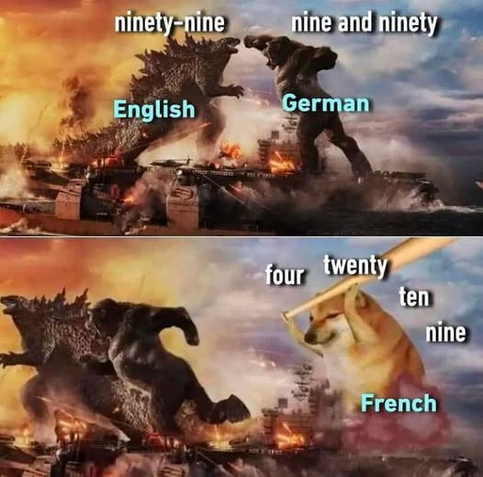
Yes, and to make it worse, French people always quote phone numbers as a string of two digit numbers, rather than single digits.
Absolutely does my head in, every time
Yes, and to make it worse, French people always quote phone numbers as a string of two digit numbers, rather than single digits.
Absolutely does my head in, every time
I imagine there's a pause after soixante as well
Mine contains 84, 95 and 79, not in that order
@HighlandLawyer @mdione @cmconseils
Gosh, that's not even consistent about whether the tens or the units come first
@mdione I've always liked this chunking for phone numbers. AFAIK the Swiss pattern is a chunk of three followed by two chunks of two.
There doesn't seem to be much pattern in how people convey phone numbers here in the UK. Partly, I suspect, because there's some kind of embedded memory of shorter numbers (my current landlines went from 5->6 in 1978 and from 6->7 20-odd years ago).
@SK53
I tend to default to the chunking of where I grew up (4 3 4) rather than the UK version which with does 4 4 3, 4 3 4 or 5 3 3 depending on how much of it is area code and how much is actual number.
I don't think I'll ever get used to saying a mobile number one way and having it read back another.
Tom Scott did a rant about the confusing numbering a few years ago. Unlike him I don't think that there being history to it actually makes it good.

@InsertUser @SK53 similar thing happened in Argentina. The Big City -> prefix didn't happen that way (not sure there was a method; the 3rd city got 051).
Then came a Ma Bell type of split (+ privatization) and we added one digit to the exchange and one to the local. Cell phones are geographic, we also get long distance as a premium, like US; with a 9 there for reasons too.
And.
Let's not forget IPv6 and how well that's going...
@regordane @cmconseils It does mean that, 20 years after moving away, I still remember my French mobile number.
In French.
 Dave
Dave Marcos Dione
 TYB
TYB HighlandLawyer
 SK53
SK53 InsertUser
 Eugene Alvin Villar 🇵🇭
 Bodhipaksa
 Jos Dingjan