@flxtr That's one available angle of consideration, but in this case of comparison, I must disagree. What is a bee or walking human's 'payload', compared to the whole system?
I get what you're saying, and I get the point of it, but in this case, I think that creates an inherently unfair basis of comparison, because we can discretely distinguish a machine's 'payload' from the machine itself, but we can't do that for animals.
@wesdym The bee or the human exist for themselves. The machine exists to transport stuff, humans, bees, whatever.
According to the graphic, you might think it's more energy efficient to drive by car than to walk. In fact, it is not because you are moving more than a ton, when your goal was to move only your body.
So yes you can calculate the efficiency by system mass, but what for? What insight would one gain from this?
@wesdym I’m pretty sure the datapoint on velo is based on a perfect pavement structure - not on off-road tracks.
Steve Jobs was well known for telling that story - also omitting the infra difference.
@lalonsander funny but not really correct. According to the graph, human are pretty damn efficient.
(And btw I think human in train, especially long distance fast train, would be more efficient)
@viq I made exactly the qualification you're offering here in the comment you responded to.
I don't understand why some people seem to feel a need to argue just for the sake of arguing. Especially when the point they raise was already made by the person they're raising it too.
@lis Yep! Even 'inefficient' locomotives end up with a very high overall efficiency compared to any other motorized surface transport bigger than a bike or trike. Rail trainsport is just inherently very efficient, for the energy needed to move mass along a rail.
If you want a high-density, high-efficiency MASS-transit system, always consider what role rail could have in it.
@lalonsander
I like the close placement between #velomobile and #salmon. Streamlined geometry hits everything :D
@kalbuth Depends very much on the bike. Any surface a human can walk across comfortably, a mountain bike will handle with no problem. A European racing bike with razor-sharp tires, not so much. This is also why armies don't use Minis, though a Mini will easily outrun any Jeep or Land Rover, and is far more efficient. The right tool for the job.
There are absolutely bicycles out there that can handle forest terrain; they're just not commonly seen on city streets.
@lalonsander Something else is that the vertical axis is per km, so absolute distances. It would be interesting to see this worked out not for absolute distances, but for relative ones with respect to the animal's body length. That way smaller animals will most likely not end up plotted as a lot less efficient compared to larger ones that do travel kilometers instead of just meters or even cm at a time.
For context: I remember reading somewhere that the fastest land mammals are cheetas in absolute speed terms. But with respect to body size, cats are in fact faster. And the fastest mammal on land in terms of body size turns out to be a hare. (A bat wins the fastest mammal battles if you include flying.)
The record fastest land animal in terms of body size displacements per unit of time is in fact a tiny mite:
https://www.ibtimes.com/worlds-fastest-land-animal-has-new-name-meet-paratarsotomus-macropalpis-mite-made-speed-1577349
@lalonsander *on a well-paved level road
this is comparing an all-terrain vehicle (legs) to something that only works on a road or path. apples and oranges
@wesdym ah but only if the human on top of the bike has proper experience. almost anyone can walk. not much fewer can ride a bicycle on level streets. but give me a mountain bike to climb a foresty mountain and I’d definitely end up hurting myself.
not to mention that legs will still be more efficient. after all, it’s a lot easier to run up a hill than to cycle up a hill, even at the same speed (assuming you don’t have enough momentum to clear the entire thing)
@_r Nearly anyone can learn to ride a bike. I'm not sure what point you're hoping to make here. I mean, I could also point out that any toddler can out-run a baby, on any surface, because babies can't walk. It's true, but what point does it make?
What point are you hoping to make here, that advances this discussion in any useful direction, instead of just arguing for argument's sake?
@wesdym you’re the one who keeps arguing. and I see no point when you misread what I wrote.
since you don’t wanna do the 15s of work requried to reread, here’s what you missed: I said “not much fewer can ride a bicycle” - I assume you misread this as “much fewer can ride a bicycle” or something. easy mistake to make, but maybe admit that much at least. my entire point is that almost everyone can ride a city bike on even ground, but being a mountain biker requires training (and a certain physique too, now that I think of it)
and you just entirely ignored the second paragraph about it being harder to ride a bike up a hill than to push it.
all I did was explain my stance, and now you insult me? get your emotions under control please.

Came here to say that, more or less
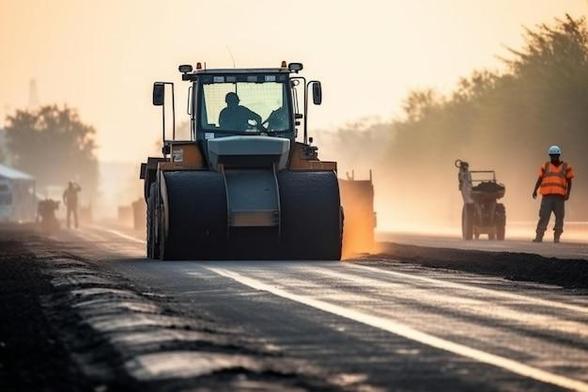
How about the energetic cost of creating the road for this "human on bicycle" ?
Serious and real question.
I don't think a MTB needs significantly more energy to drive on dirt than a normal bike on asphalt/concrete
1) It looks like your image is showing the construction process for an automobile road, not a bicycle trail
2) When it comes to bike lanes, which I think is what you're talking about, we only need those because of cars having seized and earmarked that space
3) In many places, the natural terrain is fine for riding without being modified. And when modifications do become needed, a dedicated bike trail requires far less effort to construct than a road for vehicles.
@lalonsander
A human on a bicycle is not that much more efficient than a human on foot.
Compare that to a mouse on a motorcycle. 🤔 😉