
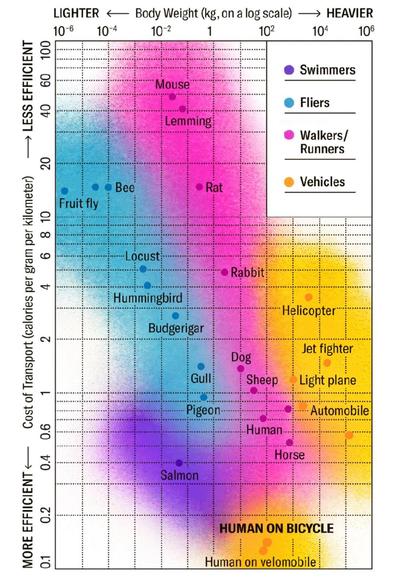
"Humans aren’t very efficient movers—until you put us on a bicycle, when we become some of the most energy-efficient land travelers in the animal kingdom.": https://www.scientificamerican.com/article/a-human-on-a-bicycle-is-among-the-most-efficient-forms-of-travel-in-the/
@lalonsander IMO it’s tricky to compare modes of locomotion that need infra with modes that don’t
@cypherhippie @lalonsander Furthermore, if I interpret this correctly, the weight of vehicles seems to contribute to their calculated efficiency. Since the main purpose of vehicles is transportation, I believe that energy consumption should be divided by payload rather than mass.

@flxtr That's one available angle of consideration, but in this case of comparison, I must disagree. What is a bee or walking human's 'payload', compared to the whole system?

I get what you're saying, and I get the point of it, but in this case, I think that creates an inherently unfair basis of comparison, because we can discretely distinguish a machine's 'payload' from the machine itself, but we can't do that for animals.

@wesdym The bee or the human exist for themselves. The machine exists to transport stuff, humans, bees, whatever.

According to the graphic, you might think it's more energy efficient to drive by car than to walk. In fact, it is not because you are moving more than a ton, when your goal was to move only your body.

So yes you can calculate the efficiency by system mass, but what for? What insight would one gain from this?