have them reliable and plentiful and people use them.
@pikesley @Thebratdragon @anon_opin Yes, I have considered it and agreed the heck out of it.
The real question is whether the companies running these routes have considered it. I doubt it.
@jon @pikesley @Thebratdragon @anon_opin "The right people just have to want it. After that it’s quite simple." This is true, but not really useful, It's lile saying "To prepare a cheetah casserole, you just have to catch a cheetah. after that it's quite simple."
How can we make the right people want it? I don't see a straightforward route to this.
@hicksy2 @jon @mike @Thebratdragon @anon_opin
BETTER THINGS AREN'T POSSIBLE well done you
@hicksy2 @mike @pikesley @jon @Thebratdragon @anon_opin and the right to spend that on providing a public service
(whilst one might be inclined to expect that local councils, bodies elected to provide local services, are allowed to provide services, the reality is …thatcher'd)
@jon @mike @purple @Thebratdragon @anon_opin @hicksy2
we have to keep The Money happy at all costs, Jon
Thatcher casts a very long shadow
@Thebratdragon @jon @pikesley @mike @anon_opin @hicksy2 ^ this exactly.
Over the last 40 odd years local authorities have been intentionally, somewhat explicitly, repeatedly undermined to the point they largely can't do ‘anything’.
Even things you wouldn't think of as privatised, like education, have largely been put out of reach of education authorities. Yes really.
(and we wonder why local elections get such little turn out)
But it very much doesn't have to be this way, we can, should, must, return power to our local bodies, and then we might start to get somewhere.
@jon @pikesley @purple @Thebratdragon @anon_opin @hicksy2 Isn't there a word for governments that just take stuff from people?
It's all fun and games while they're taking things we like from people we don't like and giving them others who we trust.
How confident are we that it would stop there?
@jon @pikesley @mike @Thebratdragon @anon_opin @hicksy2 Parliament certainly can pass laws, indeed there is a Bus Services Bill in progress at the moment which seems broadly positive, we also have a centuries long history of compulsory purchase and nationalisation, forgotten in more recent times, and I for one would welcome renewed use of such measures — I'd also really like our democratically elected local bodies to be allowed to carry out local wishes!
Locals want a public pool? The council should be allowed to do that. A development is against peoples wishes? The council should have real power to block it!
The point I beleive @hicksy2 and I were making is: Councils, as-is, can't simply go out and become a bus operator, largely no matter how much they or local people wish it.
Laws would in fact need to be changed, not to mention councils returned to a semblance of financial viability.
This isn't any kind of ‘oh it can't be done’ or ‘think of the markets’, it's a statement of realities to be overcome.
@mike @hicksy2 @jon @Thebratdragon @anon_opin
To speak in terms of "alignment of incentives" is to accept the Capitalist framing which has led us to our present hellscape where the only thing that matters is that The Money is comfortable
@mike @hicksy2 @jon @Thebratdragon @anon_opin
WHAT DO WE WANT?
Centrist tinkering
WHEN CAN WE EXPECT RESULTS?
We have to work within the constraints of the existing, obviously-rigged systems
@pikesley @hicksy2 @jon @Thebratdragon @anon_opin
You say you want a revolution?
Well, you know.
We'd all love to see the plan.
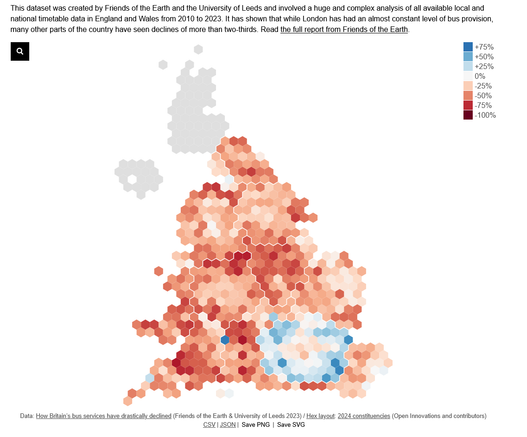
@slowe @pikesley @Thebratdragon @anon_opin Interesting! Also, shameful that the rest of the country PUT TOGETHER apparently makes less than half the bus journeys made in London.
(I wonder what that one blue dot west of London means?)
@mike In the past few years I should note that London gets to have a £1.75 single fare cap whilst the rest of the country was raised (from £2) to £3 by the Chancellor https://www.gov.uk/guidance/3-national-bus-fare-cap (although a few areas have tried to keep it at £2.50).
I'm also reminded of this post by Caroline Lucas https://mastodon.me.uk/deck/@CarolineL[email protected]/113435208228696027 pointing out how the Chancellor extended the 5p fuel duty cut to protect drivers whilst making buses (outside London) more expensive by lifting the fare cap.
@mike I will force myself to hope that the 2025 Bus Services Bill might help outside of London.
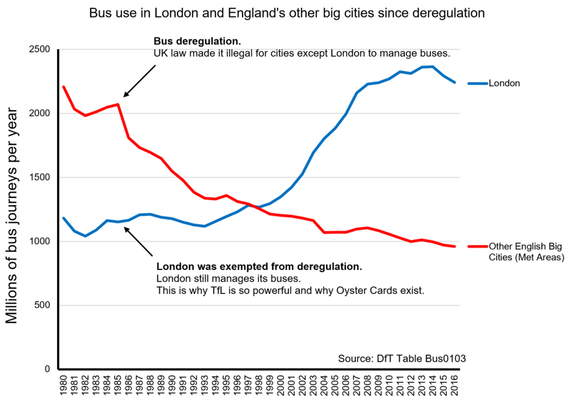
This old 2016 report https://assets.publishing.service.gov.uk/media/5a80769a40f0b62302693a81/the-bus-services-bill-an-overview.pdf downplays mention of how London was privileged for decades and picks a year range for outside-of-London to avoid it looking as bad as it has been.
@slowe @mike @pikesley @Thebratdragon @anon_opin Reading presents another exception, walk around the town centre and there are colourful town-owned buses everywhere, people using them too.
I'm sure the locals have their complaints, but it's about the one ‘deregulated’ place where buses still ‘work’ — specifically because the council worked against the ‘spirit’ of deregulation 🫣
(and whilst London retained powers over bus services, the buses were still, and are, privatised, unlike Reading)
@purple @slowe @pikesley @Thebratdragon @anon_opin That's brilliant!
Are they free in Reading, or just cheap?
@mike @slowe @pikesley @Thebratdragon @anon_opin I think the description would be ‘cheap-er’.
Certainly not free, but still, less than most places I think.
Really the key though is that the service is actually usable, naturally cheaper would be better, and then even more people would use it, but it goes to show people will pay when the service is frequent and varied enough to reliably get people where they need to be.
@mike @slowe @pikesley @Thebratdragon @anon_opin ah but see that's half the fun, frequent can lead to cheaper!
You both start to unlock economies of scale, reducing the running cost of the fleet itself, and increase overall utilisation, which reduces those costs per passenger.
More people paying fares means increase income as well, even with lowered fares.
15,000 trips at £1.50 produces more revenue than 10,000 at £2.10.
This is without even considering, shock horror, the idea of using public funds to support a public service.
Really the problem is having the initial rush of capital to get things started, private entities really have no incentive to do so and public ones, for one reason or another, largely can't.

@purple @slowe @pikesley @Thebratdragon @anon_opin Yes indeed. Once the ball starts rolling, virtuous circles are available. But in any given moment, when a council gets a 20% funding boost for public transport, say, it can EITHER run services 20% more often OR reduce fares by 20%. It can't do both.
One important question would be: which of these measures would most quickly lead to further revenue increase?