
"I'm puzzled when people say the Swiss have good transportation because they're rich. It has nothing to do with that. They're still using trams from 1970. They restore them every 7 years. Making do is part of the culture. If you're using trams for 50 years, that's a hell of a savings."

—Norman Garrick

🇨🇭 🧵
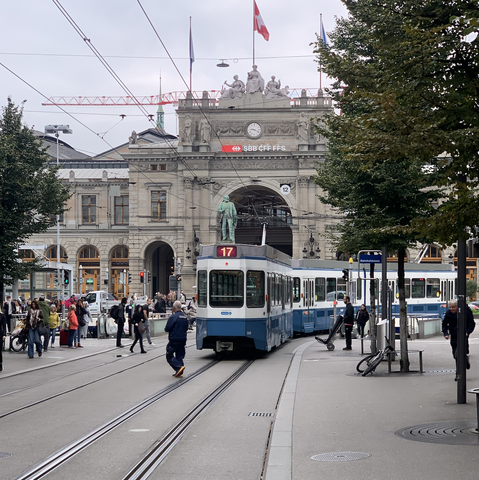
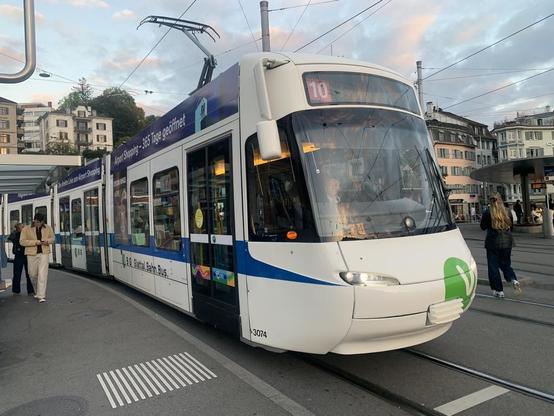
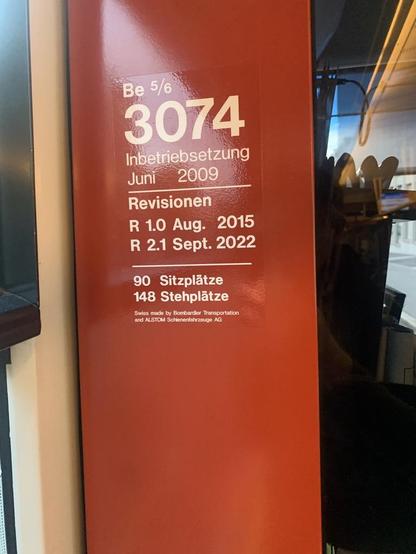
Garrick, who lives in #Zürich, is right. Here's what you see inside the #10 tram I rode to Central: this tram was introduced in 2009, then refitted in 2015 and 2022.

The point is, in #Switzerland, novelty for its own sake isn't a virtue...

They invest in quality, and make it last. That's something the rest of the world could learn from.

I take a look at how #Switzerland revolutionized its transport system, and how that benefits all citizens, in this HIGH SPEED dispatch:

https://www.highspeed.blog/anatomy-of-a-revolution/

@straphanger And the other notable part: much of the rail infrastructure was created before the country became prosperous (small private Bahnen that were later consolidated into what we have today). The whole it’s-because-they-are-rich, small, and homogenous myth needs to die.

(I live here for 13 years.)

@matt @straphanger ah yes the famously homogeneous Switzerland, with four languages divided by impassable mountain ranges
@PavelASamsonov @straphanger Just was channeling the historically, culturally, and geographically illiterate perspective of my birth-country — not something I remotely believe.
@matt @straphanger yeah I got that, I'm making fun of the people who would believe such a thing

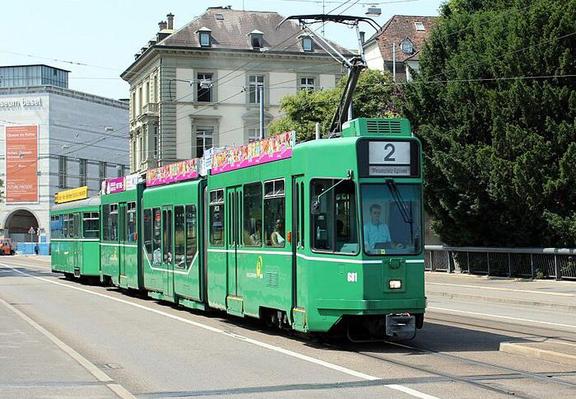
@straphanger Sustainability isn’t such good news here for people with strollers or wheelchairs — you still have to climb three steps. #Basel solved this decades ago by adding low-floor segments to their old trams. In #Zurich, that’s still often not the case, as with line 17 #tram in the photo.

📷 Kurt Rasmussen

#Guggummere #sänfte #bvbbasel

@oa: I beg to differ: Except for the very short and only auxilliary line 15, all currently used trams in Zurich have a least one low floor entrance/section, also the line 7 (not 17) in that photo: Actually these trams were AFAIK the first ones in Zurich to offer a lower floor for wheelchairs and strollers: That's why they were called "Sänfte": Because they added a low floor middle part the non-low-floor "Tram 2000".

You can actually see the lowered window line in that picture.

Cc @straphanger

Wie Zürcher Trams in der Ukraine weiterfahren - VBZ Online

In der grossen Halle der Zentralwerkstätte ist der Lärm allgegenwärtig: das metallische Kreischen einer Säge, das dumpfe Klopfen eines Hammers, das Summen der Maschinen. Doch Dmytro Tiutiunyk, Systemingenieur für Strassenbahnen, und Maksim Shalamay, Spezialist für Elektromechanik, sind davon nicht abzulenken. Mit konzentriertem Blick stehen sie neben Peter Regli, folgen aufmerksam seinen Erklärungen und notieren sich…

VBZ Online
@straphanger If anything, they are rich because they have good transportation 😸
@clement @straphanger
I was going to say something similar. Maybe they became rich because they didn't waste money building freeways. Building freeways in existing cities is tremendously wasteful. First, you have to destroy existing buildings to make space. Then you spend even more money building them, and they're expensive to maintain. Finally, they make the areas around them awful, destroying even more of the city.
@straphanger
the tram is only a small part ... most money/cost is in the infrastructure
@anduril @straphanger Correct. But mainly the willingness to actually invest in shared infrastructure and that political will so far enables that is a deciding factor. After that, the financial means to do it does matter. Even refurb costs. But it’s not beyond the means of many cities, only beyond the political will.
@hardingar @anduril @straphanger the urbanists and transportation nerds know this but cities go broke trying to fund expensive road infrastructure upgrades which wouldn't be necessary if there were fewer cars and more dense zoning, paving/repairing subdivision streets is expensive just to serve a handful of houses and upgrades to highways, interchanges and overpasses are not cheap, they cost hundreds of millions to billions of dollars, but so many people can't seem to imagine what a system looks like that isn't centered around private cars shuttling around private enclaves.
@straphanger BART was until recently using rolling stock from about 1970. It was beat up, grungy, and loud, but it got the job done. I wish Seattle hadn’t voted against rail back then.

@straphanger In Melbourne too we still have trams on regular routes which were built in the 1970s. :)

#tram #trams

@timrichards @straphanger In Poland, we buy decades-old German trams to replace Polish trams from the same era (although that is becoming rather less common as import supplies are dropping and Modertrans has established itself as a domestic budget option)
@straphanger "A nation is not rich when nobody has to use public transit. A nation is rich when it has public transit so good that EVERYBODY is happy to use the public transit."
@zakalwe @straphanger I think that's a quote by Enrique Peñalosa, former mayor of Bogotá, and the way I've heard it is slightly different (well, first of all, it's in Spanish, of course, but here's my literal translation): "A developed country isn't one in which the poor have cars, but one where the rich use public transit."
@straphanger I'm from Mexico City but lived for 5 years in Boston, USA and one of the things I missed there was efficient and cheap public transit. Mexico City isn't what most people would call rich (it isn't really poor either, of course).
@straphanger ALT: A picture of an old tram, painted in blue and white, running through a bustling city center. It is designated “17”.
@straphanger @tinker I rode those trams when I lived in Zürich 30 years ago. Happy to see a picture of them and the Bahnhofstrasse again.

@straphanger

Indeed. Their mechanical and electrical systems are probably fairly straightforward to maintain with basic tools.

No need to update the firmware on the Engine Management System to fix a bug introduced by Russian or Chinese hackers, as a totally random example 🙄

@straphanger Visited Geneva with the scouts, longer ago that I'd like to admit to. We were impressed that we could look at the clocks on the platform as the train came to a stop. It would slow and come to a compete stop the moment the second hand swept past the 12. The second hand went round for one minute and as it passed the 12 again, the train started moving. Every single train. Every single platform. Every single time. Sure made a change from British Rail.

@straphanger For what it's worth, San Francisco has a line of "heritage" cars which were originally deployed by then-mayor Dianne Feinstein as a tourist attraction (while the even older cable-car system was being renovated), but now used at least as much by locals. Most of these are American PCC variants from the 1930s and '40s, but some are even older.

(There are a few PCCs in service elsewhere -- Philadelphia and a spur line in Boston -- but those are rebuilds with more modern innards.)

@straphanger
But that's what being rich is. The accumulation of capital over time.
@straphanger people say the same about Luxembourg and it's free public transport. "oh, it is because it is a rich country".
It should maybe more like "transport is not for profit but a common good for everyone"
@straphanger @asymco Lived 5 years in Basel, Switzerland in 1980’s, trams were old but new trams joined the fleet periodically. Looked & operated same as older ones, so just a matter of appearance. But the Swiss do keep their trams a long time, though they don’t have to. But wife & I drove everywhere, used trams only periodically. Americans are programmed to commute by car & it’s difficult to change that 🙁