 Pav
Pav Felicitas Pojtinger 🌅
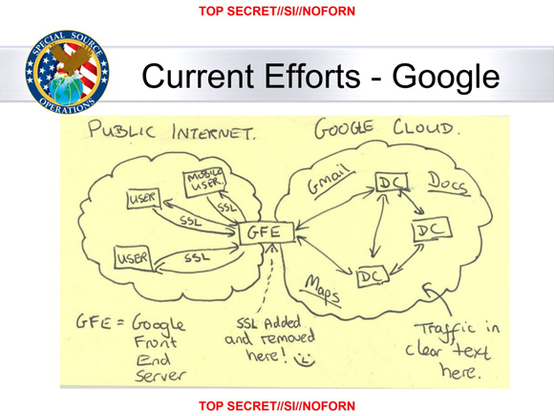
Whenever you see someone recommend Cloudflare or something else that decrypts and re-encrypts TLS for something, esp. for something related to open social media or media storage etc., reply with this picture from the Snowden leaks
I'm begging you. Please tell me what else to do.
I run copy-paste-quality pfsense with a single personal domain.
@dnavinci I've had good luck using yggdrasil (https://yggdrasil-network.github.io/) rather than DNS to access media remotely. it does require the client machine to also be on yggdrasil, but that's doable even without root if you can run your own software or apps
DNS is renting because you have to keep paying for domains or you lose them, just like renting anything else. the "buying" terminology is just marketing
@dnavinci @migratory One edge server running Wireguard & nginx. One LAN computer running same, connecting via Wireguard to edge server. DNS entries that resolve publicly to edge IP, resolve on LAN to internal IP.
Configuration and automation ensues; not too intense.
@dnavinci @migratory Sorry if I made it sound trivial, I was trying to quickly regurgitate my approach 😅 But depending on what you host there are some docker-based workflows that simplify some parts e.g. certificates. My Wireguard and nginx setup was mostly hand-built though, and it wasn't too complicated to configure those. There are a few moving parts, but I didn't find it too overwhelming.
I'm in the middle of switching to a Pangolin based approach. I had previously only allowed clients on the Wireguard network into the services but only allowing IPs from Wireguard, but to allow for sharing content with external (to my home) users I think Pangolin will give more flexibility. This mostly affects the edge server configuration, not much has to change internally.
If you do go with a certbot approach to certificates, I'd recommend using DNS validation from the start, as I think it offers more flexibility for the rest of the setup.
@migratory
Segmentation is a feature.
I'd like to minimize my attack surface. My read of yggdrasil seems like it would be fairly exposed.
You've opened my mind to the possibilities. I was looking at l3 switches and thinking about yggdrasil and thinking, "who even needs a router?!"
But... Just not ready to free my mind. Also my spouse and kid aren't either :P
@nickspacek
Thanks for turning me on to pangolin. That will make this really easy!
By DNS validation you mean DCV? Not something I've given much thought. I assume this is easy in pangolin?
I've been waffling between what you said and just tailscale.
My threat model doesn't really include the NSA.
Mostly I want to host my music server, but also give my friends my minecraft.myhostname.com for when we play.
@migratory
@dnavinci @migratory Most (all?) Of my current use-cases are HTTP-based. Pangolin supports TCP proxying too but I have no experience so I can't speak to it.
By DNS validation with ACME/LetsEncrypt the common approaches to validate that you "own" the domain are HTTP, where the handshake asks you to create a specific file/contents on a web server, vs the ACME DNS handshake that asks you to create a TXT record with specific contents. When the ACME confirms one of the above approaches, it issues you the SSL certificate for the domain! Then you can serve your site over HTTPS.
That's not important for Minecraft servers though. In that case, Pangolin would probably do the trick (maybe a bit heavy), or Tailscale (still heavy), or Hamachi (is that still around??), or for a long while I just used a reverse SSH tunnel which is dead simple.
@dnavinci @migratory Right, I couldn't remember before but there's a app built on SSH for maintaining the reverse proxy connection called AutoSSH. I think it is in most Linux Distro package managers now.
I found this post about setting it up to start automatically with systemd. Could be handy!
https://pesin.space/posts/2020-10-16-autossh-systemd/
It runs inside the LAN and connects over SSH to your jumpbox, which has some convenient DNS entry pointing at it. When it establishes the SSH connection it also opens a port on the jumpbox where packets are tunneled over the SSH connection to a target port inside your LAN, which can be on the server initiating the SSH connection, or on some other host if you want!
@pojntfx I think Google has since fixed the cleartext-in-the-DC issue but that alone doesn't earn them trust.
I'm old enough to remember when even the front-end of webmail services was cleartext.
@stuartl @pojntfx if you use a modern browser (especially Firefox or Chrome, but I think Safari might as well these days), the traffic is even protected against someone storing the ciphertexts, developing a quantum computer, and breaking the elliptic curves used.
I talk about the effort of making this true internally here, using that very slide 😏.

 i was just trying to add more forward secrecy
@stuartl @pojntfx I’m old enough to remember when TCI/IP was invented, and anyone smartcenougb to have deployed it could be trusted by default. And you tell these young folk nowadays, etc., etc. (stumbles off, mumbling and stroking into beard).
I miss those days. The UK Internet Consortium was influential (even though nobody even remembers it). It achieved its goal, and the UK uses the same (more efficient) standards as the rest of the world.
@stuartl @pojntfx well yes, but thanks to the old guard who actually made this shit work, users don’t really need to understand the details anymore. I have only skimmed the surface myself!
I taught TCPIP classes for approximately 20 years, and throughout that period, the uptake of IPv6 was consistently felt by the industry to be “10 years away“. 🤣
@holdenweb @pojntfx It's been reduced to magic numbers at this point.
"Look, put 255.255.255.0 in that field there and the other one must start with 192.168… don't worry about the rest!"
(ugh!)
Not much use for knowledge of things like 802.1Q in "the cloud".
@stuartl @pojntfx yes, but there’s no use bemoaning the fact that broadening the market for a technology necessarily means making it accessible to the (literally, not pejoratively) ignorant.
Back in 1995, when the Python world was a delight, I knew it would inevitably devolve into the same shit-show I’d already seen in the MS world. You either work with niche tech or welcome the world and all its warts!🤷
@pojntfx that's why this sticker exists :)
SVG: https://github.com/justjanne/stickers/blob/main/designs/ssl%20added%20and%20removed%20here.svg

Great, thanks. Saved, maybe I find it useful sometime.
@justjanne That sticker would perfectly fit my workplace's laptop
@sashin @pojntfx The padlock in your browser promising your data is securely protected ends at Google's servers, and is only restored on the other side, exposing your data to Google. The slide Snowden posted is from an NSA presentation where the author drew a smiley face at that point, because it gave the NSA full access to the data flowing through Google's servers.
Cloudflare has the same vulnerability. And the NSA's capabilities have only improved since the slide was released 12 years ago.
@sashin @pojntfx That Cloudflare (and everyone that manages to snoop on them) can read, store, and modify any requests and content that is transmitted.
Basically, the promise of TLS is that everything you do on a website is unreadable by anyone except the web browser and the provider of the website. Cloudflare inserts itself into the transaction and breaks that promise.
@pojntfx Yes, end-to-end encryption is all very well as long as the other end isn’t everyone in a corporation that decided being evil was OK, actually.
But as a technologist I’m firmly of the opinion that knowing this stuff should not be a precondition of safe internet communications. Ethics and technical standards should (but currently don’t) keep us all safe.
 codl
codl
 zaire arcana
 medium rare bird
 Gianmarco Gargiulo
 DNAvinci
 Nick Spacek
 Haelwenn /элвэн/
 Piko Starsider
 Stuart Longland (VK4MSL)
 Wilfried Klaebe
 Sophie Schmieg
 Violet
 Steve Holden
 Sigma
Sigma justJanne
 Didek
Didek HTTP 1.1/418 Old Teapot Typewriter Font
 🐧DaveNull🐧 ☣️pResident Evil☣
 M.O.M.O.
 Kris Hardy
 Phil
Phil Wolf480pl
 Mike Taylor 🦕
 Sashin
 John Deters
 Magnus Ahltorp