This should have been big news!

Ten funding agencies from eight European countries have pledged to support a public infrastructure that is poised to replace academic journals:
FWF 🇦🇹
RCN 🇳🇴
Forte 🇸🇪
ARIS 🇸🇮
SRC 🇸🇪
FCT 🇵🇹
CSIC 🇪🇸
DFG 🇩🇪
Formas 🇸🇪
ANR 🇫🇷
Only two of them issued press releases in English:
https://www.fwf.ac.at/en/news/detail/joint-commitment-to-strengthening-open-research-europe
https://www.fccn.pt/en/atualidade/fct-assina-declaracao-fortalecimento-open-research-europe-ore/
and one more, NWO from 🇳🇱 considers joining:
https://www.nwo.nl/en/news/nwo-endorses-joining-open-access-platform-open-research-europe-ore
Why is this BIG? 1/4
#openscience #openaccess

Joint Commitment to Strengthening Open Research Europe

In December 2024, ten leading European research funding organizations, including the Austrian Science Fund (FWF), signed a Statement of Intent to jointly support and further develop the Open Research Europe (ORE) publication platform.


Austrian Science Fund (FWF)

1. This development essentially entails that all authors in the participating countries now have a venue where they can publish #openaccess without any fees.
2. The vision is to develop Open Research Europe (ORE) "as a collective non-profit open access publishing service for the public good".
https://op.europa.eu/en/publication-detail/-/publication/3603e219-6a65-11ef-a8ba-01aa75ed71a1/language-en

2/4

Open research Europe - Publications Office of the EU

Publications Office of the EU

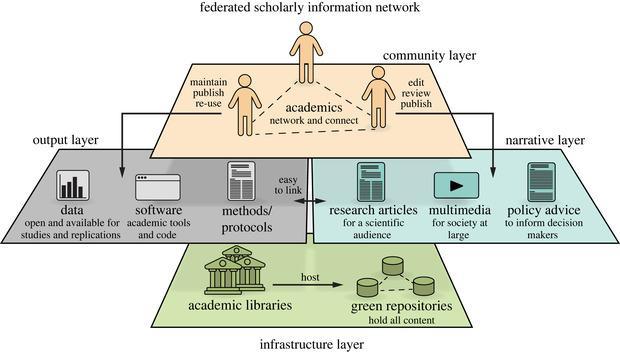
3. As we outline in our article, such a decentralized public infrastructure can be highly resilient against not only natural or political disasters, but also "against corporate capture and surveillance technologies":
https://royalsocietypublishing.org/doi/10.1098/rsos.230206
4. If/when funding agencies realize that maintaining funding for legacy journals directly counteracts the goals they signed onto with their support of ORE, the legacy journals stand to suffer massive drops in revenue.

What can YOU do?

3/4

#academicchatter

Here are two easy things YOU can do:

#1 Every academic supporting #openscience and #openaccess should consider ORE as their primary publishing venue and ask colleague/co-authors to do the same.

#2 Point your librarian, institutional leaders, funding agencies towards the documents linked above and ask them to support ORE, too.

#3 Make *everyone* and every institution aware that they now have a choice: support parasitic corporations or the public good. By their actions you shall know them!

@brembs This is great news, but from your thread I don't see that ORE actually exists yet... Or does it? If so, can you please include in the thread the link?

(If it doesn't exist yet, I can't make it my primary publishing venue...)

@brembs I found it: https://open-research-europe.ec.europa.eu/

But I'd suggest you edit the posts above to prominently link to it!

@skyglowberlin @brembs Oof, that needs a better URL that doesn't say "Europe" four times.

@skyglowberlin

Oh, sorry, it's been around for a few years, so I thought everyone on here knows it already:

https://open-research-europe.ec.europa.eu/

https://www.ore.eu/

As the press releases say, the transition is scheduled to happen in January 2026.

@brembs I'm not sure I had seen it.

But I'm afraid after looking at several pages, I'm still confused as to what "the transition" is. I mean, I guess from ORE to ORE 2.0, but what does that mean?

Does it mean that soon any researchers in Europe can publish there, instead of only people reporting results from Horizon (etc) grants?

Looking everything over, I don't particularly like the "you can go back and edit the paper at any time in the future" aspect. And I think there are some serious structural issues with open review (yes, anonymous review also has problems, but they are different problems). Before I knew about those two aspects, I thought "ok, in the future, I'll send nearly everything there!" Now I'm less excited, but I'm still interested to try it out.

@skyglowberlin @brembs Like citations in wikipedia which have the access date added. Or posts here in Mastodon, which are editable, but a boost is for a specific version. Better enable live papers with incorporated but tracked erratums, than virtually invisible erratums or retractions.
#ScientificPublishing

@albertcardona I understand the idea, but I think research articles are different from social media and Wikipedia and that there is some value in them becoming frozen when they are published.

I definitely don't want to be prodded to go back and edit something I wrote 5 or 10 years ago, and I see a serious trap here for the kinds of people who have trouble letting things be. I have known several people who would I can imagine would have gotten stuck constantly editing an already published article if that had been possible.

I would be fine the with the possibility of releasing a new version if a serious error comes to light. But allowing minor revisions at any time after publication? I don't see any need for that, and I see a lot of possible downside.

@albertcardona @skyglowberlin

Yes!
As long as there is a clear record of all the versions, it is easy to see which version was cited and one can even set up alerts for when a version gets changed, e.g. for the most important publications in the field, or particularly contentious ones.
Probably like Wikipedia, the number of scholarly publications with many version will be really low?

@brembs @albertcardona I am open to seeing how it goes.

@skyglowberlin in addition to things like arxiv, Zenodo has versioning - you can get a DOI for the deposit in general or a specific version. If you land on an old version of the deposit, a banner appears pointing you to the new version.

In terms of research outputs that are peer reviewed, there are journals like Living Reviews in [X] which do a decent job of allowing authors to update their work when appropriate, so this doesn’t seem too terrible on the face of it. I’d be happy if there were publicly-owned gold OA alternatives to those journals.
@brembs @albertcardona

@skyglowberlin

It is my understanding that every author in the listed countries should be able to publish in ORE without fees starting 2026. At least this bis what I'm going to assume and try out come January.

@brembs Ok, that's great. Once it's clear that that's the case, I'll try to spread it through my email networks. From my side, I will have DFG funding for the next 5 years, so it should definitely be possible for me to try submitting there.
@brembs That’s all nice and sweet, but how can we make sure this abomination of “typesetting” employed on the platform does not become the new norm for how we publish and read all our scholarship? (I know that there are bigger concerns and that his should probably not be the decisive factor. But I also honestly believe that there is an aesthetic aspect driving scholar’s decisions about where to publish.)
@felwert I’d guess a start would be to ask to join them.
@brembs

@felwert

I think their blurb on their new URL gives it away:

"ORE 2.0 is the vision to expand ORE to a European Diamond Open Access platform with open peer-review and operated by the academic community."

If the academic community operates it, we decide it:

https://www.ore.eu/

Home Page

ORE 2.0

@felwert @brembs

The platform is the one developed for/by F1000, where features, layout and PDF files look similar. But I am sure the PDF and HTML templates can be tweaked and improved.

(I agree that this is definitely a factor for acceptance of a journal... silly as it might seem.)

@christof @felwert

The back-end itself is in the process of being migrated from F1000 to OJS...

@brembs @felwert

Oh, that's good news. I feel more comfortable with #OJS than with #F1000.

@brembs

The real blocker: ourselves.

Will we, as members of a grant panel or search committee, or grant reviewers, and as authors:

1. stop judging a paper by its publication venue;
2. stop providing subsidised labour to for-profit journals;
3. review only for non-profit journals;
4. send our manuscripts to journals aligned with our values of openness, data sharing, democratised access, diamond open access.

It’s really on us to stop this game of chicken.

#academia #ScientificPublishing

@brembs

This sounds exactly the type of project and cultural shift we need!

@brembs This is the platform that Open Journal Systems got a contract for, is that right? I heard that so far it's only about $1million and I'm not sure how far that goes, so that's great they're pledging more money...

@alexh

Yes, they'll migrate it to OJS. The funding they have now agreed on should expand coverage to all authors in those countries that are represented by the funders.

If they do it right, this could be huge.

@brembs is it decentralised?

@neuralreckoning

Not yet, I think, but from what I hear and read, it is on their mind - and if it isn't, everybody talking about it will bring it to their attention 😇 😆

@brembs decentralised is not really the MO of the EU though... 😉

@neuralreckoning @brembs

I can't think of a better word than decentralzed. Europeans are trying to work together. That is the most decentralised thing to say. Centralised systems dont have to try.

Look at it this way. Unity is about diversity. Its the part of the word unity that makes it it different from the word uniformity.

@kevinrns @brembs centralised is not the same thing as authoritarian. If there's a single point of failure, then it's centralised. That's the case here regardless of decision making that led to it.

@neuralreckoning @brembs

I dont see authoritarian, except in the threats to Europe.

@neuralreckoning @brembs Kinda maybe. DOI and/or ORCID "tables" could be hosted at any domain it looks like. They can refer to each other sort of like web links. So a document with a DOI record at doi.derp.org could have a bibliography refering to a document pointed at by a DOI record hosted at doi.herp.org.

But this isn't really "networking" so it's not "decentralized". It's kinda like an ISBN for a book or whatever.

@neuralreckoning @brembs I think to be "decentralized" something like this would need to allow you to generate you own, guaranteed unique ID. That doesn't look like the protocol here. You ask an authority for an ID and they host the record for you.

@crazyeddie @neuralreckoning

A very useful project would be, in my mind, to try and implement a technology like COAR Notify in ORE:

https://coar-repositories.org/what-we-do/notify/

Not only would that bring a huge fraction of the scholarly literature to ORE, done intelligently, it would also bring true decentralization.

COAR Notify

The COAR Notify Initiative is developing and accelerating community adoption of a standard, interoperable, and decentralised approach to linking research outputs hosted in the distributed network o…

COAR
@brembs @crazyeddie @neuralreckoning Why would we want to “bring a huge fraction of the scholarly literature to ORE”..? It is not an aggregator or an archive, it is a platform for publishing original work.

@mostlyphysics @crazyeddie @neuralreckoning

I'm not sure I follow? Is the scholarly literature not "original work"? When should an article move into an "archive" and how long should an article remain on "the platform"? Because I don't see the difference between older and brand new articles, I don't weant to see them in separated silos. It feels to me, the scholarly literature should be in one silo and this is also what we envisage here:

https://royalsocietypublishing.org/doi/10.1098/rsos.230206

Can you explain?

@brembs @crazyeddie @neuralreckoning I think you and others are wish-projecting things on it that it was never meant to do. The idea is for ORE to host research that has been published on ORE, nothing else.
@brembs @crazyeddie @neuralreckoning The upcoming changes are meant to vastly broaden the scope of who can publish there, but they are not about making it into some gigantic panopticon of all research published anywhere.

@mostlyphysics

No, no, of course not!
My men tion of COAR Notify was due to @neuralreckoning asking about decentralization and @crazyeddie commenting on decentralizing "something like this" in what appeared to me a hypothetical way.

In the same, hypothetical way, I mentioned how cool it would be if one could one day fuse the two to get closer to what we envisaged in our paper, see Fig. 3, "infrastructure layer":

@brembs @neuralreckoning @crazyeddie okay I see, sorry for misunderstanding!

@brembs @mostlyphysics @neuralreckoning What about research data? Like in neuroscience they generate and share HUGE files and there's metadata you want to be able to index and search.

There are some file formats like NWB, but is there an open standard or project for pushing this data into something like this where other scientists can search it maybe in a "data lake"? Not reports or studies, but the real, raw data?

From what I can tell it's pretty much just handed around but they want better

@mostlyphysics @brembs @crazyeddie I don't think he's "wish-projecting", he's suggesting a way it could be something more than it is.
@neuralreckoning @brembs @crazyeddie Knowing a bit about how relatively tricky it has been to build consensus over the expansion (case in point, missing UK participation, for example), and how large the technical and governance challenges will be to implement it, I think it is not realistic to expect for it to evolve into something so much beyond it’s intended purpose for the funders who foot the bill – at least not for the near-to-mid-term future. Sorry to pour some cold water on this but I think this discussion is confusing what these changes are about and what they are not.
@neuralreckoning @brembs @crazyeddie Nothing I have seen or heard suggests there is any motivation for ORE to host anything that hasn’t been submitted there. Maybe the open infrastructure that is being built will enable that in the future, and maaaaaybe the funders will come to see their duty as providing a universal infrastructure for publicly funded research along the lines of Björn’s vision, but that is not what we are (or should be) discussing with the coming changes.
@mostlyphysics @neuralreckoning @brembs @crazyeddie Sorry if this has been announced already somewhere but will F1000 keep running the platform, how long? Based on my experience, a great barrier of the platform currently is the quality of F1000 service (of course a very natural stage in development for any new platform).
La Commissione Europea e Open Journal System: una infrastruttura open source per Open Research Europe – Open Science @Unimi

@brembs @mostlyphysics @neuralreckoning @crazyeddie It's great that this was confirmed; curious still how they're going to run it all, as it's a lot of editorial and desk work to process everything! Having hired topic editors would be a core priority from a user's perspective.

@MKarhulahti @mostlyphysics @neuralreckoning @crazyeddie

Yes, it will be interesting to see how they set it all up.

@mostlyphysics @neuralreckoning @brembs It looks to me like it chose a lot of the right technologies to implement on. It'll play well with others that do similar things and serve as a nice host to these 'federated' protocols. It's good to see because as far as I know the current method is to get a doi and then point it at some random url where your document will be. That's got all kinds of weaknesses for things that should stick around.
@brembs ANY authors? Or (as with Wellcome's and Gates's systems) only those in receipt of grants?

edit: this restriction is about to change.

@mike @brembs
It seems you are right. The how-it-works page of open-research-europe states:
"Each publication must have at least one author who has been, or still is, a recipient of a Horizon 2020 and/or Horizon Europe grant."

@Jochgem @brembs I just HATE this kind of pointless discrimination. "We want to advance since, but not ALL science, just our own science". You'd think self-funding would be welcome, but quite the opposite.
@mike @Jochgem @brembs maybe we can argue with ukri to do the same. Nihr already has it's own platform.

@Jochgem @mike

This is precisely what is changing come 2026! That's what the news is!