This should have been big news!

Ten funding agencies from eight European countries have pledged to support a public infrastructure that is poised to replace academic journals:
FWF 🇦🇹
RCN 🇳🇴
Forte 🇸🇪
ARIS 🇸🇮
SRC 🇸🇪
FCT 🇵🇹
CSIC 🇪🇸
DFG 🇩🇪
Formas 🇸🇪
ANR 🇫🇷
Only two of them issued press releases in English:
https://www.fwf.ac.at/en/news/detail/joint-commitment-to-strengthening-open-research-europe
https://www.fccn.pt/en/atualidade/fct-assina-declaracao-fortalecimento-open-research-europe-ore/
and one more, NWO from 🇳🇱 considers joining:
https://www.nwo.nl/en/news/nwo-endorses-joining-open-access-platform-open-research-europe-ore
Why is this BIG? 1/4
#openscience #openaccess

Joint Commitment to Strengthening Open Research Europe

In December 2024, ten leading European research funding organizations, including the Austrian Science Fund (FWF), signed a Statement of Intent to jointly support and further develop the Open Research Europe (ORE) publication platform.


Austrian Science Fund (FWF)

1. This development essentially entails that all authors in the participating countries now have a venue where they can publish #openaccess without any fees.
2. The vision is to develop Open Research Europe (ORE) "as a collective non-profit open access publishing service for the public good".
https://op.europa.eu/en/publication-detail/-/publication/3603e219-6a65-11ef-a8ba-01aa75ed71a1/language-en

2/4

Open research Europe - Publications Office of the EU

Publications Office of the EU

3. As we outline in our article, such a decentralized public infrastructure can be highly resilient against not only natural or political disasters, but also "against corporate capture and surveillance technologies":
https://royalsocietypublishing.org/doi/10.1098/rsos.230206
4. If/when funding agencies realize that maintaining funding for legacy journals directly counteracts the goals they signed onto with their support of ORE, the legacy journals stand to suffer massive drops in revenue.

What can YOU do?

3/4

#academicchatter

@brembs is it decentralised?

@neuralreckoning @brembs Kinda maybe. DOI and/or ORCID "tables" could be hosted at any domain it looks like. They can refer to each other sort of like web links. So a document with a DOI record at doi.derp.org could have a bibliography refering to a document pointed at by a DOI record hosted at doi.herp.org.

But this isn't really "networking" so it's not "decentralized". It's kinda like an ISBN for a book or whatever.

@neuralreckoning @brembs I think to be "decentralized" something like this would need to allow you to generate you own, guaranteed unique ID. That doesn't look like the protocol here. You ask an authority for an ID and they host the record for you.

@crazyeddie @neuralreckoning

A very useful project would be, in my mind, to try and implement a technology like COAR Notify in ORE:

https://coar-repositories.org/what-we-do/notify/

Not only would that bring a huge fraction of the scholarly literature to ORE, done intelligently, it would also bring true decentralization.

COAR Notify

The COAR Notify Initiative is developing and accelerating community adoption of a standard, interoperable, and decentralised approach to linking research outputs hosted in the distributed network o…

COAR
@brembs @crazyeddie @neuralreckoning Why would we want to “bring a huge fraction of the scholarly literature to ORE”..? It is not an aggregator or an archive, it is a platform for publishing original work.

@mostlyphysics @crazyeddie @neuralreckoning

I'm not sure I follow? Is the scholarly literature not "original work"? When should an article move into an "archive" and how long should an article remain on "the platform"? Because I don't see the difference between older and brand new articles, I don't weant to see them in separated silos. It feels to me, the scholarly literature should be in one silo and this is also what we envisage here:

https://royalsocietypublishing.org/doi/10.1098/rsos.230206

Can you explain?

@brembs @crazyeddie @neuralreckoning I think you and others are wish-projecting things on it that it was never meant to do. The idea is for ORE to host research that has been published on ORE, nothing else.
@brembs @crazyeddie @neuralreckoning The upcoming changes are meant to vastly broaden the scope of who can publish there, but they are not about making it into some gigantic panopticon of all research published anywhere.

@mostlyphysics

No, no, of course not!
My men tion of COAR Notify was due to @neuralreckoning asking about decentralization and @crazyeddie commenting on decentralizing "something like this" in what appeared to me a hypothetical way.

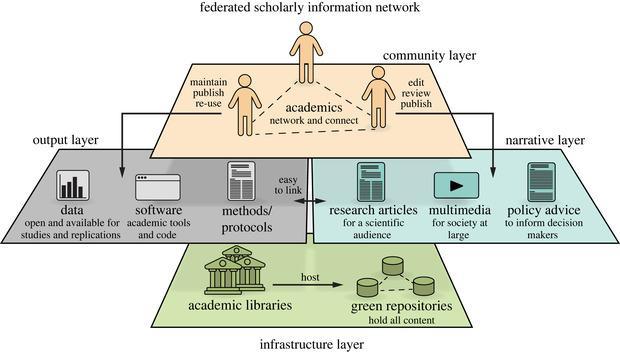
In the same, hypothetical way, I mentioned how cool it would be if one could one day fuse the two to get closer to what we envisaged in our paper, see Fig. 3, "infrastructure layer":

@brembs @neuralreckoning @crazyeddie okay I see, sorry for misunderstanding!

@brembs @mostlyphysics @neuralreckoning What about research data? Like in neuroscience they generate and share HUGE files and there's metadata you want to be able to index and search.

There are some file formats like NWB, but is there an open standard or project for pushing this data into something like this where other scientists can search it maybe in a "data lake"? Not reports or studies, but the real, raw data?

From what I can tell it's pretty much just handed around but they want better