 LIGO
LIGOResults from the first part of our fourth observing run are out today!
We are pleased to share the largest ever catalog of gravitational-wave observations with more discoveries of black holes and neutron stars
Results from the first part of our fourth observing run are out today!
We are pleased to share the largest ever catalog of gravitational-wave observations with more discoveries of black holes and neutron stars
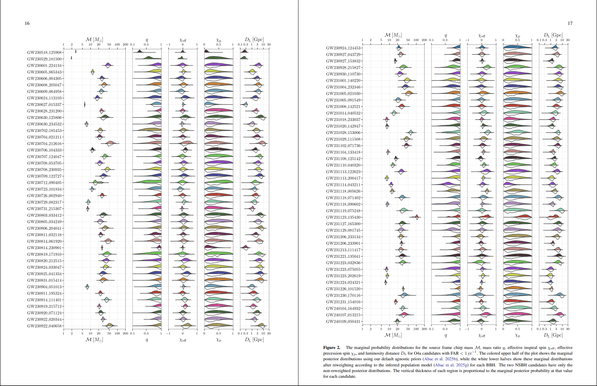
You know you have a good set of results when your plot fills 2 whole pages
Here are the measured properties for our most significant new detections. We have a wide range of binary black holes and a couple of neutron star black hole binaries
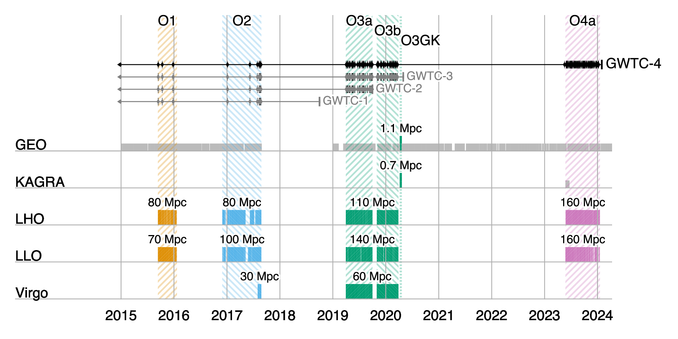
Our fourth observing run has seen some of best detector performance. This allows us to see gravitational-wave signals from more distant sources and make more detection. We are making more discoveries than ever before.
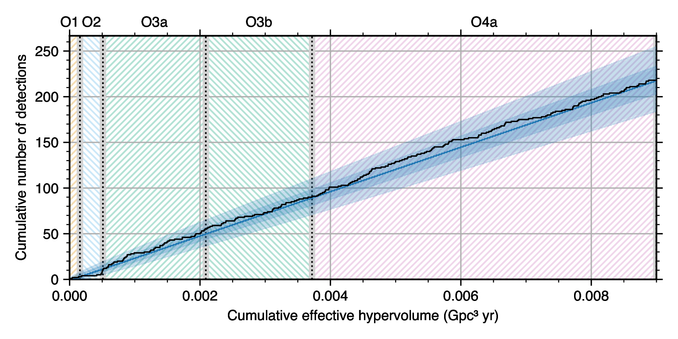
The timeline shows probable detections so far. Each observing run has a greater rate of detection than the one before.
In our first 3 observing runs, we found 90 probable gravitational-wave signals. Analysis of the first part of our 4th observing run add 128 new probably signals, more than doubling our catalog! Analysis of the later parts of the run is underway
A spacetime waltz. Simulations consistent with our 86 most confident new detections, each showing the orbiting components and their emitted gravitational waves. Each is speed up by a different amount, because we have a wide range of sources.
https://www.youtube.com/watch?v=3B6WKSWDJRE
🎬I Markin/T Dietrich/H Pfeiffer/SXS Collaboration

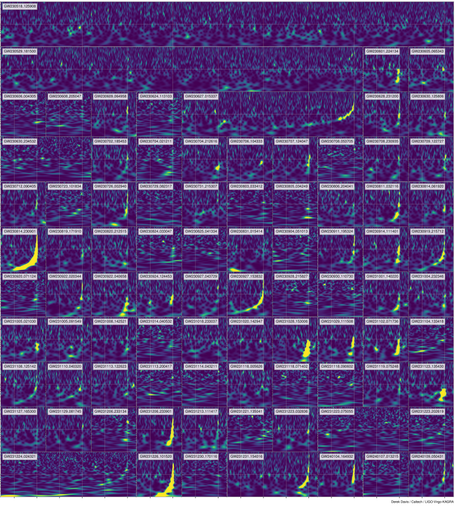
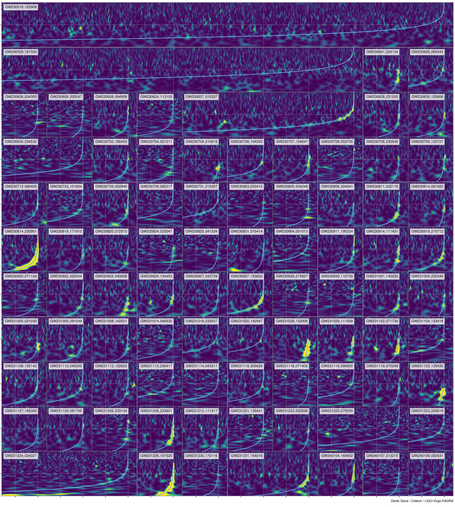
Visualisations of the data from our most significant new detections. These show time vs frequency: a binary signal sweeps up from low frequency to high making a chirp. The frequency evolution tells us about the masses.
Can you spot the signals? (The second version shows a track for each)
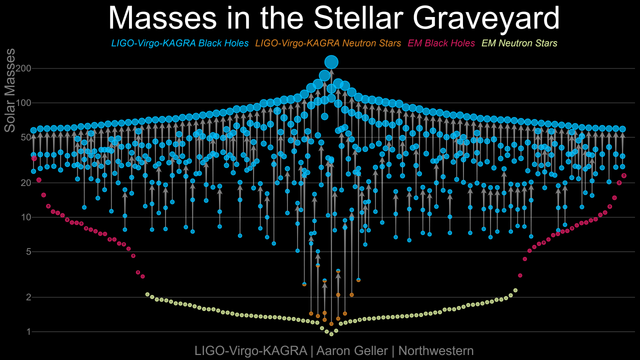
Our new discoveries in blue and our past ones in grey (point size indicates loudness)
We've a diverse range of sources. GW230518's source is a new neutron star black hole (like GW230529), GW231114's is two unequal black holes, GW231028's is BIG, but GW231123's is BIGGER. The more we observe, the more surprises we find

Data from our fourth observing run, and links to data releases to accompany our latest results are available from
You can read more about using our data in https://arxiv.org/abs/2508.18079
We have doubled the number of gravitational-wave detections. Catch up with the new discoveries with our Science Summary
Having more gravitational-wave observations helps us unlock the astrophysical secrets of our sources
What have we learned about the family of black holes and neutron stars from our latest observations?
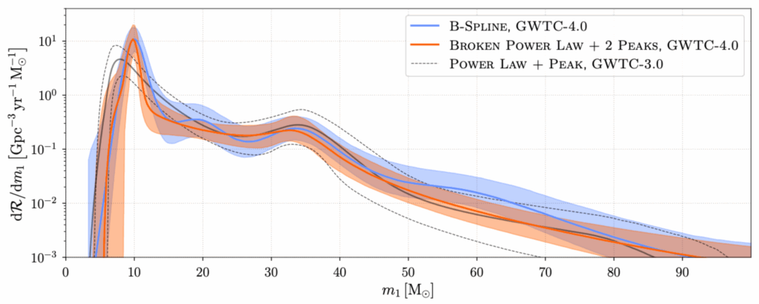
"10 years ago, LIGO saw its first gravitational wave. After 218 detections, our view of black holes has changed forever."
https://bigthink.com/starts-with-a-bang/ligo-doubles-black-hole-haul/ by @startswithabang
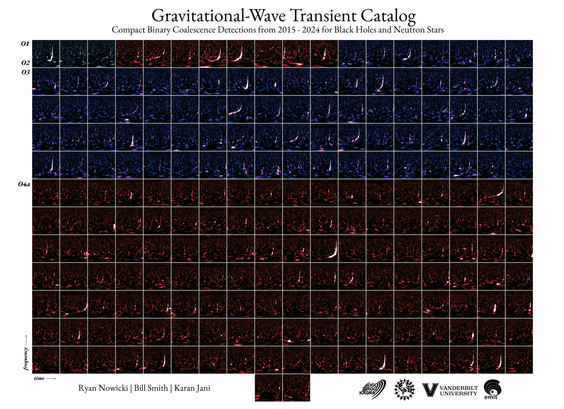
A family portrait of 218 gravitational-wave signal! Each observing run has its own color palette, tracing the journey from our very first detection to the latest #GWTC4
The loudest #GravitationalWave in #GWTC4 is #GW230814
Detected with only Livingston, it was still about twice as loud as GW150914!
Being loud should enable precision tests of general relativity, but with only one detector, you need to be careful with the analysis
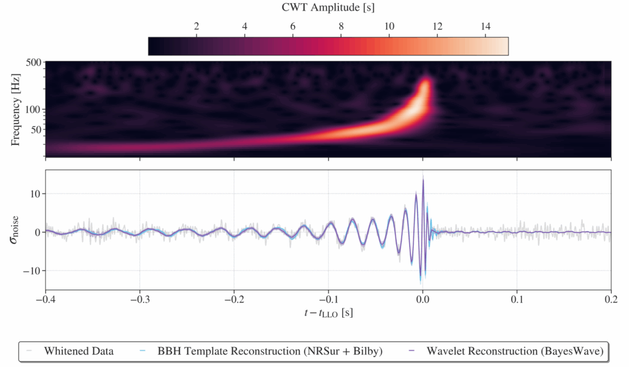
Our detailed study of #GW230814 is out today
https://arxiv.org/abs/2509.07348
We are able to precisely test general relativity with this loud signal. Most tests show agreement with Einstein's theory, but some…
The deviations can be explained by detector noise. This is why having multiple detectors is important!


 Level 98 🇺🇦
 Whiskers 🇦🇺