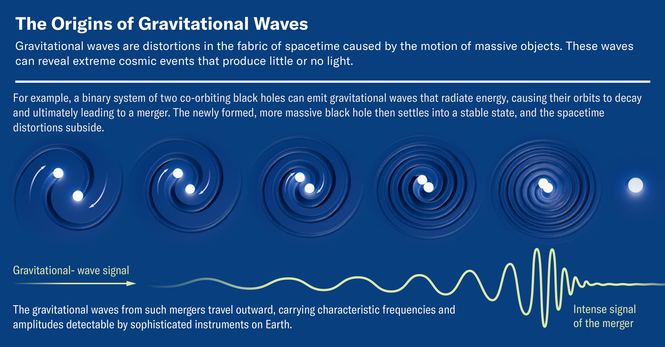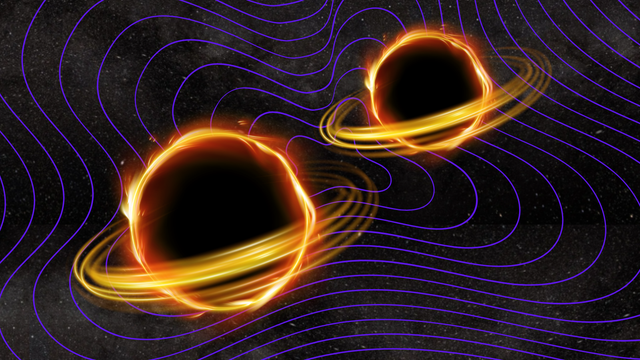
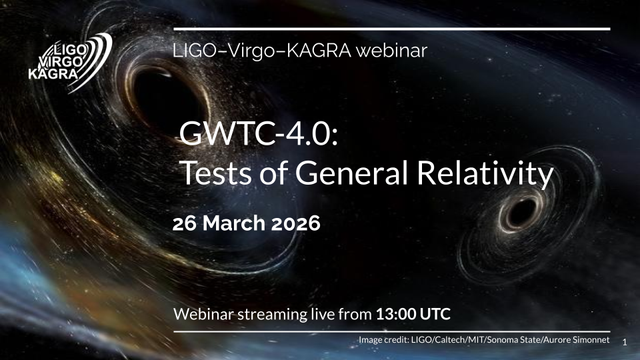
Our next LIGO Virgo KAGRA webinar will discuss tests of general relativity with #GWTC4 (papers https://arxiv.org/abs/2603.19019 https://arxiv.org/abs/2603.19020 https://arxiv.org/abs/2603.19021).

If you you are curious about understanding gravity and the nature of black holes please join!

26 March at 13:00 UTC, with the recording on YouTube after

Register for free https://wisconsin-edu.zoom.us/webinar/register/WN_G2EyvI8rTzqRRJ6nfe51BA

To convert UTC to your timezone you can use https://www.timeanddate.com/worldclock/converter.html?iso=20260325T130000&p1=137&p2=64&p3=179&p4=213&p5=90&p6=215&p7=111&p8=44&p9=33&p10=248&p11=152

[Updated to correct time]
#Astrodon #GravitationalWaves

A boom in gravitational waves leaves scientists with more questions than answers: Scientific American reports how we still have much to discover after #GWTC4

https://www.scientificamerican.com/article/what-do-hundreds-of-gravitational-wave-events-reveal-about-the-universe/ by K. R. Callaway

#Astrodon #Science

The universe is humming with ripples in spacetime: Scientists just doubled our catalog of black hole and neutron star collisions

"We are really pushing the edges, and are seeing things that are more massive, spinning faster, and are more astrophysically interesting and unusual."

Space

📣 New gravitational-wave catalog doubles number of detections 📈

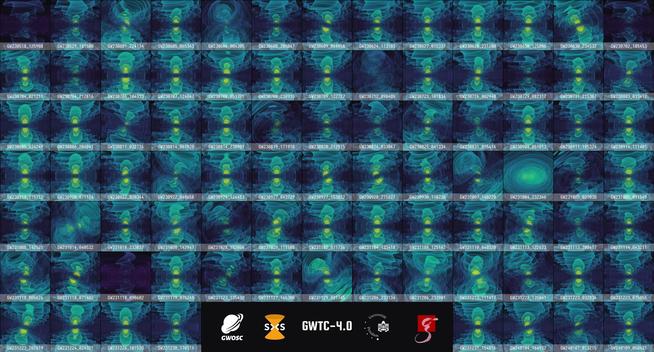
The latest catalog of LIGO-Virgo-KAGRA gravitational-wave detections, GWTC-4, has been published. It presents 128 new candidates from the fourth observing run, more than doubling the previous total.

This catalog update results from a nine-month observing period (May 2023 to January 2024) of the gravitational-wave observatories.

Researchers at the @mpi_grav and at @unihannover have made significant contributions to this milestone, presented in several publications in a special issue of Astrophysical Journal Letters.

ℹ️ https://www.aei.mpg.de/1415736/new-catalog-of-ligo-virgo-kagra-observations-published

📄 https://iopscience.iop.org/article/10.3847/2041-8213/ae0c06 (OpenAccess)

#GravitationalWaves #GWTC4 #BlackHoles #Astrophysics #Astronomy #Science #Research

📣 Neuer Katalog verdoppelt Anzahl der beobachteten Gravitationswellen 📈

Der neueste Katalog der von der LIGO-Virgo-KAGRA-Kollaboration nachgewiesenen Gravitationswellen, GWTC-4, ist nun veröffentlicht. Er enthält 128 neue Kandidaten aus dem vierten Beobachtungslauf. Damit hat sich die bisherige Gesamtzahl mehr als verdoppelt.

Die Aktualisierung des Katalogs beruht auf Daten aus einer neunmonatigen Phase wissenschaftlicher Datenerfassung der Gravitationswellen-Observatorien, die von Mai 2023 bis Januar 2024 dauerte.

Forschende des @mpi_grav und des @unihannover haben einen wesentlichen Beitrag zu diesem Meilenstein geleistet, der in mehreren Veröffentlichungen in einer Sonderausgabe des Astrophysical Journal Letters vorgestellt wird.

ℹ️ https://www.aei.mpg.de/1416445/new-catalog-of-ligo-virgo-kagra-observations-published

📄 https://iopscience.iop.org/article/10.3847/2041-8213/ae0c06 (Open Access)

#Gravitationswellen #GWTC4 #SchwarzeLöcher #Astrophysik #Astronomie #Wissenschaft #Forschung

Our next LIGO Virgo KAGRA webinar will introduce the analysis methods used for our #GWTC4 results (paper https://arxiv.org/abs/2508.18081). If you you are curious about the techniques used for our discoveries please join!

19 February at 15:00 UTC, with the recording on YouTube after

Register for free https://wisconsin-edu.zoom.us/webinar/register/WN_ey7T8h4hQzyagXE7kqsk2g#/registration

To convert UTC to your timezone you can use https://www.timeanddate.com/worldclock/converter.html?iso=20211206T150000&p1=137&p2=64&p3=179&p4=213&p5=90&p6=215&p7=111&p8=44&p9=33&p10=248&p11=152

#Astrodon #GravitationalWaves

Our previous webinar introduced #GWTC4 and the data from our fourth observing run. You can catch up on YouTube if you would like some background before hearing about our latest results

https://scicomm.xyz/@LIGO/115610387427483902

#Astrodon

Our next LIGO Virgo KAGRA webinar will introduce our latest #GWTC4 detections and discoveries (paper https://arxiv.org/abs/2508.18082)

12 February at 15:00 UTC, with the recording on YouTube after

Register for free https://wisconsin-edu.zoom.us/webinar/register/WN_ey7T8h4hQzyagXE7kqsk2g#/registration

To convert UTC to your timezone you can use https://www.timeanddate.com/worldclock/converter.html?iso=20211206T150000&p1=137&p2=64&p3=179&p4=213&p5=90&p6=215&p7=111&p8=44&p9=33&p10=248&p11=152

#Astrodon

Catch up on our #GWTC4 results with the recording of our webinar introducing our latest gravitational-wave catalog release and the associated data (papers arxiv.org/abs/2508.18080 and arxiv.org/abs/2508.18079)

https://youtu.be/fFKD-6parxY?si=VzpsxNYQfG4UE9RH

#Astrodon #OpenData #GravitationalWaves

GWTC 4.0 Introduction and Data Release

YouTube