ok it's less sensational than stuffing an easter egg in here, but I realized I can simply have it refuse to tell you the answer if you try to divide by zero
I'm thinking of adding a tile type that could be used to construct sequences. It would take an input for its reset value, a clock input, and an input for its update value. It outputs the reset value until the clock goes from low to high, at which point it copies the current update value to its output. This would let you build stuff like repeating note sequences with two tiles per note + a shared clock source, and you could use flipflops to switch out sections.
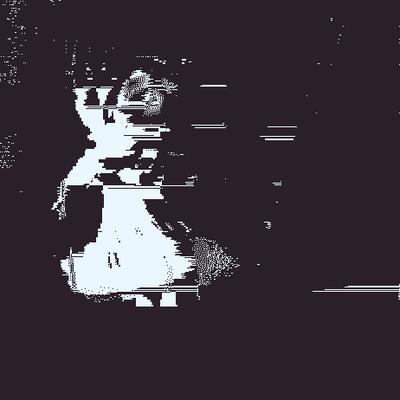
I made a crappy oscilloscope for debugging. Every frame it draws a new line for the magnitude of the sample corresponding to that frame. This does not show the wave form accurately because it's just whatever the main thread happens to get when it polls for the latest sample. This is mostly meant to help check the magnitude to verify that it matches expectations. A red line indicates clipping happened. #mollytime
And here's what an eccentric patch looks like in scope view. I'm using the RNG node as if it were an oscillator, but I didn't try to correct the range, so the samples are all positive. Also it clips like crazy. Anyways here's 3 minutes and 29 seconds of hard static to relax and study to. #mollytime
personally, I highly recommend the 3 minutes and 29 seconds of hard static
I reworked the oscilloscope so that it now shows the range of samples in the time frame between refreshes. Here's a short video fo me playing around with inaudible low frequency oscillators. Also, I added a "scope" tile which you can use to snoop on specific tile outputs in place of the final output. I'm planing on eventually having it show the output over the regular background when connected so you don't have to switch modes to see it.

The scope line is sometimes a bit chonky because it's time synced, and recording causes it to lag a bit. It generally looks a bit better than in the video normally.

You can also make it worse by taking successive screenshots :3

mym tells me this is ghost house music #mollytime
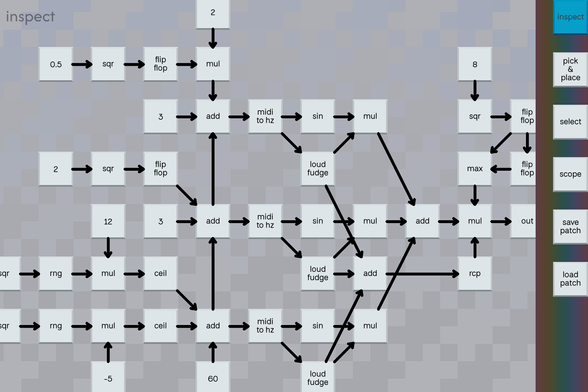
and here's most of that patch
one of the things I think is neat about programming is the way fundamental design decisions of the programming languages you use inevitably express themselves in the software you write. for javasscript it's NaN poisoning bugs. for c++, it's "bonus data". unreal blueprints have excessive horizontal scrolling on a good day. blender geometry nodes evolve into beautiful deep sea creatures. as I've experimented with mollytime, I've noticed it has a wonderful tendency to summon friendly demons
I have all these big plans for using procgen to do wire management ( https://mastodon.gamedev.place/@aeva/114617952229916105 ) that I still intend on implementing eventually, but I'm finding their absence unexpectedly charming at the moment
aeva (@[email protected])

Attached: 1 image I put it to the test by translating my test patch from my python fronted to a hypothetical equivalent node based representation without regard for wire placement and then stepped through my wire placement rules by hand. I'm very pleased with the results, it's a lot clearer to me what it does than the python version is at a glance.

Gamedev Mastodon
anyone up for some doof and boop music #mollytime
a good test to see if your speakers can emit 55 hz or not
I whipped up a version of the doof-and-boop patch that automates the alternating connections with a pile of flip flops and I've been grooving out to it for the last two hours 😎
I tried doing a live jam for some friends tonight where I had the drum machine patch going along with a simple synth voice on top of that which I intended to drive with the midi touch screen keyboard I made back in January, but I quickly found that to be unplayable due to latency in the system. I'm not sure exactly where as I haven't attempted to measure yet.

I figure if I move the touch screen keyboard into the synth and cut out the trip through the midi subsystem that might make the situation a little better (again, depending on where the real problem is)

Anyways, it got me thinking, I think processing input events synchronously with rendering might be a mistake, and it would be better if I could process input events on the thread where I'm generating the audio.

I added an instruction called "boop" that implements a momentary switch, and built a small piano out of it, and also built a metronome in the patch. That is very playable, so the latency must have been something to do with having one program implement the midi controller and the other implement the synth. I think I had this same problem with timidity a while back, so maybe it's just linux not being designed for this sort of thing.
with one program being the midi controller and the synthesizer it's pretty playable, but sometimes touch events seem to get dropped or delayed. that is probably my fault though, there's a lot of quick and dirty python code in that path, though I'm not sure why it's only occasional hitches
k, I've got tracy partially hooked up to mollytime (my synthesizer), and with mollytime running stand-alone playing the drum machine patch (low-ish program complexity), the audio thread (which repeatedly evaluates the patch directly when buffering), the audio thread wakes up every 3 milliseconds, and the repeated patch invocations take about ~0.5 milliseconds to run, with most patch evals taking about 3 microseconds each.
almost a third of each patch invocation is asking the also if there's any new midi events despite there being no midi devices connected to mollytime, but that's a smidge under a microsecond of time wasted per eval, and it's not yet adding up enough for me to care so whatever
anyways, everything so far is pointing toward the problem being in the UI frontend I wrote, which is great, because that can be solved by simply writing better code probably unless the problem is like a pygame limitation or something
I switched pygame from initializing everything by default like they recommend to just initializing the two modules I actually need (display and font) and the audio thread time dropped, probably because now it's not contending with the unused pulse audio worker thread pygame spun up. The typical patch sample eval is about 1.5 microseconds now, and a full batch is now under a millisecond.
tracy is a good tool for profiling C++, but the python and C support feels completely unserious :/
making building with cmake a requirement to use the python bindings and then only providing vague instructions for how to do so is an odd choice.
using cmake is a bridge too far, so I figure I'll just mimic what the bindings do, but it turns out they're a bit over engineered as they're meant to adapt C++ RAII semantics to python decorators and I don't want to pay for the overhead for that when I could just have a begin and end function call to bind instead. that probably will have to be wrapping new and delete like they do though because there is no straight forward C call for this.
The relevant C APIs are provided as a pile of macros that declare static variables that track the context information for the begin and end regions. This seems to be on the theory that you would never ever ever want to wrap these in a function for the sake of letting another language use them in a general purpose way. The inner functions they call are all prefixed with three underscores, which is basically the programmer way of saying "trespassers will be shot without hesitation or question"
also there's this cute note in the docs saying that if use the C API it'll enable some kind of expensive validation step unless you go out of your way to disable it, which you shouldn't do but here's how 🙄
C++ RAII semantics are so universally applicable to all programs (sarcasm) that even the C++ standard library provides alternatives to scope guard objects if you don't want to use them. come on man

tragic. pygame.display.flip seems to always imply a vsync stall if you aren't using it to create an opengl context, and so solving the input events merging problem is going to be a pain in the ass. it is, however, an ass pain for another night: it is now time to "donkey kong"

EDIT: pygame.display.flip does not imply vsync! I just messed up my throttling logic :D huzzah!

😎
ideally the ordering of those events would be represented in the patch evals but they just happen as they happen. It's plenty responsive with a mouse though. I'll have to try out the touch screen later and see if the problem is basically solved now or not.
ok I can go ape shit with a mouse and it works perfectly and like I mean double kick ape shit, but the dropped events problem still persists with the touch screen ;_;
it's possible that I'm doing something wrong with the handling of touch events and it's something i can fix still, but now i'm wondering if there's a faster way to confirm if "going ape shit" playing virtual instruments is a normal intended use case for touch screen monitors by their manufacturers and the people who wrote the linux infrastructure for them, or if they all were going for more of a "tapping apps" vibe
and by "going ape shit" i just mean gently flutter tapping two fingers rapidly to generate touch events faster than i could with just one finger, such as to trill between two notes or repeatedly play one very quickly. doing that on one mouse button to generate one note repeatedly very fast feels a lot more aggressive
if i do the same on my laptop's touch pad (which linux sees as a mouse) the same thing happens, but if I really go ham on it such that it engages a click with the literal button under the touch pad, then the events all go through just fine. this is why i'm starting to think there's some filtering happening elsewhere
i wonder if there's a normal way to ask linux to let me raw dog the touch screen event stream without any gesture stuff or other filtering, or if this sort of thing isn't allowed for security and brand integrity reasons

someone brought up a really good point, which is that depending on how the touch screen works, it may be fundamentally ambiguous whether or not rapidly alternating adjacent taps can be interpreted as one touch event wiggling vs two separate touch events

easy to verify if that is the case, but damn, that might put the kibosh on one of my diabolical plans

ok great news, that seems to not be the case here. I made little touch indicators draw colors for what they correspond to, and rapid adjacent taps don't share a color.

bad news; when a touch or sometimes a long string of rapid touches is seemingly dropped without explanation, nothing for them shows up in evtest either D: does that mean my touch screen is just not registering them?

side note: if you try to use gnome's F11 shortcut to take a screen recording, it doesn't give you the option to pick which screen, and it just defaults to recording the main screen. i assume this too is security

I want to add a pair of instructions for switching between (0, 1) range and (-1, 1) range. so

u = s * .5 + .5

and

s = u * 2 - 1

what are good short names for these operations?

EDIT: can be up to three words, less than 7 letters each preferably closer to 4 each
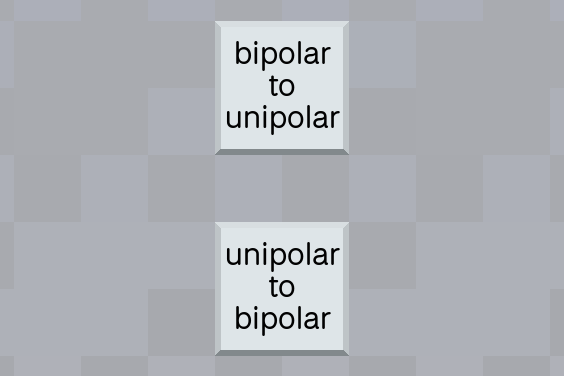
ok thanks to the magic of variable width font technology, "unipolar" squeaks in under the limit despite being 8 letters
I've got my undulating noise wall mollytime patch piped into a rings clone running in vcvrack and ho boy that is a nice combo
I gotta figure out how to build some good filter effects

why the hell am i outputting 48 khz

i'm pretty sure i can't even hear 10 khz

i'm using doubles for samples which feels excessive except that std::sinf sounds moldy so that has a reason at least, but i do not know why i picked 48 khz for the sampling rate i probably just copied the number from somewhere but seriously why is 48 khz even a thing what is this audiophile nonsense
look at me im just gonna fill up all my ram with gold plated cables
well, ok I'd have to buffer roughly two days of audio to run out of ram but still it just feels obscene
i'm going to have words with this nyquist guy >:(

i love how a bunch of people were like it's because of nyquist duh and then the two smart people were like these two specific numbers are because of video tape and film

EDIT: honorable mention to the 3rd smart person whose text wall came in after I posted this

I'm going to end up with something vaguely resembling a type system in this language because I'm looking to add reading and writing to buffers so I can do stuff like tape loops and sampling, and having different connection types keeps the operator from accidentally using a sine wave as a file handle.

I've got a sneaking suspicion this is also going to end up tracking metadata about how often code should execute, which is kinda a cool idea.

oOoOoh your favorite language's type system doesn't have a notion of time? how dull and pedestrian

oh, so I was thinking about the sampling rate stuff because I want to make tape loops and such, and I figured ok three new tiles: blank tape, tape read, tape write. the blank tape tile provides a handle for the memory buffer to be used with the other two tiles along with the buffer itself.

I thought it would be cute to just provide tiles for different kinds of blank media instead of making you specify the exact buffer size, but I've since abandoned this idea.

bytes per second is 48000 * sizeof(double)

wikipedia says a cassette typically has either 30 minutes or an hour worth of tape, so

48000 * sizeof(double) * 60 * 30

is about half a GiB, which is way too much to allocate by default for a tile you can casually throw down without thinking about.

I thought ok, well, maybe something smaller. Floppy? 1.44 MiB gets you a few seconds of audio lol.

I have since abandoned this idea, you're just going to have to specify how long the blank tape is.

i made a tape loop #mollytime
i just realized i probably can't afford polyphony unless i really juice the perf of the vm
@aeva I played this video, like I almost always do, with audio muted. I kept waiting for the action to start 😛
@aeva saw the code :)
@lritter the stuff I pushed tonight?
@aeva the stub from earlier ;) i was browsing the repo looking for where the time delta was sent from but couldnt find it. but i noticed the tape related bits
@lritter it's pretty gnarly. I ended up with some dirty hax to make it work
mollytime/src/pipewire.cpp at e2a89e72778fc64dc8c39ee8baee820a5da04a71 · Aeva/mollytime

A system for creating ad hoc virutal MIDI controllers in python. - Aeva/mollytime

GitHub
@aeva but where is sampleinterval built?
@lritter StreamRealTimeThread::SetupPorts same file
@aeva sounds like the Mini Metro soundtrack at the start

@aeva time to pretend windows doesn‘t exist and just overcommit memory, it‘s Literally Free(*)

*: may cause mysterious oom death at some point

@aeva you forgot to multiply by 2 for stereo ;)
@nina_kali_nina I'm starting with just mono for now
@aeva by not using electron, your users can use up to four casette tapes and will still think your software is acceptable 

@aeva doubles! *spit take* :)

FWIW your usual compact cassette has the equivalent of less than 6 bits/sample, professional reel-to-reel tape under ideal conditions maybe 13

@rygorous the doubles sound better lol
@aeva @rygorous but... how/why?
aeva (@[email protected])

i'm using doubles for samples which feels excessive except that std::sinf sounds moldy so that has a reason at least, but i do not know why i picked 48 khz for the sampling rate i probably just copied the number from somewhere but seriously why is 48 khz even a thing what is this audiophile nonsense

Gamedev Mastodon
@rygorous @aeva now that you're mentioning it... i never paid much attention to the noise floor of my cassettes... but a sudden drop from 1/64 to 0 amplitude should have been noticeable? unless it was very well dithered, perhaps... and they did some postprocessing to smoothen the curve...
@lritter @aeva that's not how either analog tape or proper digital 6-bit recording works

@lritter @aeva in analog you get it for free (because it's all stochastic processes anyhow), in digital when decimating down to 6 bits you want dither (tape hiss would be Gaussian dither), and then you don't get a sudden drop-out, you get a nice uniform noise floor.

For cassette tape you get maybe 58, 60 dB SNR. 6 bits dithered gives you ~64dB SNR.

@rygorous @lritter @aeva How does the calculation work for that? I always thought the rule of thumb was 6dB per bit. (As calculated 20*log10(2) )

I know you can exceed the digital noise floor with noise shaping, where the analog lowpass post-DAC removes the noise, but Gaussian noise is in the audible range.

@jkaniarz @lritter @aeva eh, the calculation for that works like "Fabian was not awake yet and somehow decided that 6*6 = 64"
@jkaniarz @rygorous @aeva aha! so there is postprocessing (sometimes)
@rygorous @aeva *looks down at the floor in shame*

@aeva i would go with 100Mb Zip disks - that would be suitable capacity for three-minute pop songs

And you could add a click of death simulation

@aeva confused audio people: "_temporal_ antialiasing? is there any other kind?"

@aeva Sounds like a fun rabbit hole for someone interested in reversible computing to go down, temporal type systems.

I shouldn't be surprised this is already a thing, but I am.

https://arxiv.org/abs/1710.10258

Temporal Type Theory: A topos-theoretic approach to systems and behavior

This book introduces a temporal type theory, the first of its kind as far as we know. It is based on a standard core, and as such it can be formalized in a proof assistant such as Coq or Lean by adding a number of axioms. Well-known temporal logics---such as Linear and Metric Temporal Logic (LTL and MTL)---embed within the logic of temporal type theory. The types in this theory represent "behavior types". The language is rich enough to allow one to define arbitrary hybrid dynamical systems, which are mixtures of continuous dynamics---e.g. as described by a differential equation---and discrete jumps. In particular, the derivative of a continuous real-valued function is internally defined. We construct a semantics for the temporal type theory in the topos of sheaves on a translation-invariant quotient of the standard interval domain. In fact, domain theory plays a recurring role in both the semantics and the type theory.

arXiv.org
@Mayabotics I understood maybe about half of the words in that blurb. What's the gist?

@aeva That's what I'd like to know.  

The summary somewhat made sense up until the last sentence, when it veered off into the weeds of category theory and algebraic geometry.

But what I gather from my skimming is that behavior types are types that describe the set of all possible trajectories of a dynamic system.

And I think the last sentence just means that the rules of the theory is derivable from a partially ordered set of intervals.

@aeva If that was a question about my earlier comment, what I was thinking was that since a temporal type system could describe sets of trajectories through a state space, it might be a useful thing to explore for someone interested in reversible computing, since reversible computing concerns itself with the question of given the output state of a calculation, can you find a single unique input state that maps to it, and vice versa.
@aeva @Mayabotics I haven't read the book, but it seems it is trying to define some kind of logic on "things that change with time". It supports both discrete, continuous, and mixed systems. It employs some heavy math machinery, and it has clearly been written with type theorists as target readers. I thus cannot say how practical it is.

@aeva meanwhile, my favourite language: https://opensource.ieee.org/vasg/Packages/-/blob/release/std/standard.vhdl#L296

(also cool: "boolean" is an enumerated type, and so is "character")

std/standard.vhdl · release · vasg / Packages · GitLab

The following project contains open source materials that will be referenced by the IEEE 1076 standard.

GitLab
@aeva i think it is really neat that there's a clear mathematical limit for how many samples you need
@aeva i remember seeing jack pick 48k instead of 44.1k automatically, i can't imagine there being an audible difference
@milo oh I might have picked it because that's what pipewire likes
@milo @aeva Yeah 44.1KHz is CD quality. And so I have not done research to learn if this is true, but my pet theory is the reason 48KHz started becoming commonplace in computer audio is because USB requires a 48MHz clock involved. If you have a clock that can be used for USB communications, it is trivial to divide it to 48KHz for your audio sample clock.
@artemis @milo consider that 48 khz / 24 hz = whole number
@artemis @milo @aeva iirc DAT was the first with 48khz
AxWax (@[email protected])

Attached: 1 image Needs moar bass! #TinaTheCat #Caturday #SynthCat #StudioCat

chaos.social