TOPIC>
Milkyway From Earth

2025 July 2

Milky Way Through Otago Spires
* Image Credit & Copyright: Kavan Chay
https://www.instagram.com/kchayphotos/;
* Text: Ogetay Kayali (Michigan Tech U.)
https://www.ogetay.com/
https://www.mtu.edu/physics/

Explanation:
Does the Milky Way always rise between these two rocks? No. Capturing this stunning alignment took careful planning: being in the right place at the right time. In the featured image taken in June 2024 from Otago, New Zealand, the bright central core of our Milky Way Galaxy, home to the many of our Galaxy's 400 billion stars, can be seen between two picturesque rocks spires. For observers in Earth's Northern Hemisphere, the core is only visible throughout the summer. As Earth orbits the Sun, different parts of the Milky Way become visible at different angles at different times of the night. As Earth rotates, the orientation of the Milky Way in the sky also shifts -- sometimes standing vertically as seen in the featured image, and other times stretching parallel to the horizon, making it harder to see. In early June, observers can watch it emerge low on the horizon after sunset and gradually arc upward to reveal its full grandeur.
https://www.instagram.com/p/C8qW2gMJcaF/

https://apod.nasa.gov/apod/ap250702.html

#space #milkyway #astrophotography #photography #nature #NewZealand #NASA

A Milky Road to the Rubin Observatory
* Image Credit: NSF, DOE, Rubin Obs., Paulo Assunção Lago (Rubin Obs.)
https://www.instagram.com/passuncao.ph/
https://rubinobservatory.org/
https://www.energy.gov/
https://www.nsf.gov/

Explanation:
Is the sky the same every night? No -- the night sky changes every night in many ways. To better explore how the night sky changes, the USA's NSF and DOE commissioned the Vera C. Rubin Observatory in Cerro Pachón, Chile. In final testing before routine operations, Rubin will begin to explore these nightly changes -- slight differences that can tell us much about our amazing universe and its surprising zoo of objects. With a mirror over 8 meters across, Rubin will continually reimage the entire visible sky every few nights to discover new supernovas, potentially dangerous asteroids, faint comets, and variable stars -- as well as mapping out the visible universe's large-scale structure. Pictured, the distant central band of our Milky Way Galaxy appears to flow out from the newly operational observatory. Taken last month, the featured picture is a composite of 21 images across the night sky, capturing airglow on the horizon and the Small Magellanic Cloud galaxy on the lower left.
https://www.nsf.gov/
https://ui.adsabs.harvard.edu/abs/1999PASP..111..886N/abstract
https://ui.adsabs.harvard.edu/abs/2003AJ....125.2740N/abstract

https://apod.nasa.gov/apod/ap250604.html

#space #earth #observatory #milkyway #astrophotography #photography #science #nature #NASA

2011 September 24

Mangaia's Milky Way
* Image Credit & Copyright: Tunç Tezel (TWAN)
https://twanight.org/profile/tunc-tezel/

Explanation:
From Sagittarius to Carina, the Milky Way Galaxy shines in this dark night sky above planet Earth's lush island paradise of Mangaia. Familiar to denizens of the southern hemisphere, the gorgeous skyscape includes the bulging galactic center at the upper left and bright stars Alpha and Beta Centauri just right of center. About 10 kilometers wide, volcanic Mangaia is the southernmost of the Cook Islands. Geologists estimate that at 18 million years old it is the oldest island in the Pacific Ocean. Of course, the Milky Way is somewhat older, with the galaxy's oldest stars estimated to be over 13 billion years old. (Editor's note: This image holds the distinction of being selected as winner in the Royal Observatory, Greenwich, Astronomy Photographer of the Year competition in the Earth and Space category.)

https://apod.nasa.gov/apod/ap110924.html

#space #milkyway #astrophotography #photography #nature #science #astronomy #NASA

2025 May 20

Milky Way over Maunakea
* Image Credit & Copyright: Marzena Rogozinska
https://www.instagram.com/marzena_astrophotography/

Explanation:
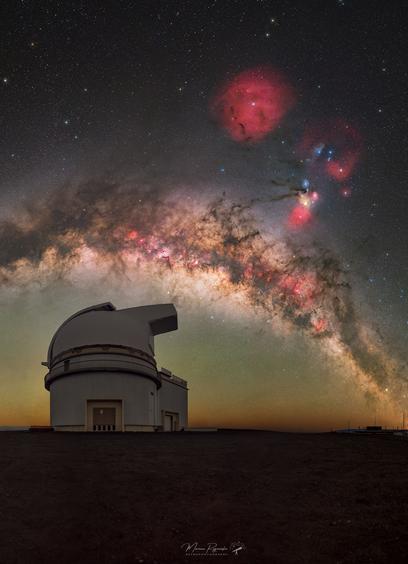
Have you ever seen the band of our Milky Way Galaxy? In a clear sky from a dark location at the right time, a faint band of light becomes visible across the sky. Soon after your eyes become dark adapted, you might spot the band for the first time. It may then become obvious. Then spectacular. One reason for your growing astonishment might be the realization that this fuzzy swath, the Milky Way, contains billions of stars. Visible in the featured image, high above in the night sky, the band of the Milky Way Galaxy arcs. Also visible are the colorful clouds of Rho Ophiuchi on the right, and the red and circular Zeta Ophiuchi nebula near the top center. Taken in late February from Maunakea, Hawaii, USA, the foreground telescope is the University of Hawaii's 2.2-Meter Telescope. Fortunately, you don’t need to be near the top of a Hawaiian volcano to see the Milky Way.

https://apod.nasa.gov/apod/ap250520.html

#space #milkyway #astrophotography #photography #science #astronomy #nature #NASA

2025 February 9

Milky Way over the Australian Pinnacles
* Image Credit & Copyright: Michael Goh
https://astrophotobear.com/about/

Explanation:
What strange world is this? Earth. In the foreground of the featured image are the Pinnacles, unusual rock spires in Nambung National Park in Western Australia. Made of ancient sea shells (limestone), how these human-sized picturesque spires formed remains unknown. In the background, just past the end of the central Pinnacle, is a bright crescent Moon. The eerie glow around the Moon is mostly zodiacal light, sunlight reflected by dust grains orbiting between the planets in the Solar System. Arching across the top is the central band of our Milky Way Galaxy. Many famous stars and nebulas are also visible in the background night sky. The featured 29-panel panorama was taken and composed in 2015 September after detailed planning that involved the Moon, the rock spires, and their corresponding shadows. Even so, the strong zodiacal light was a pleasant surprise.

https://apod.nasa.gov/apod/ap250209.html

#space #milkyway #astrophotography #photography #science #astronomy #nature #NASA

2024 November 5

Milky Way over Easter Island
* Credit & Copyright: Josh Dury
https://www.instagram.com/josh_dury_photomedia/

Explanation:
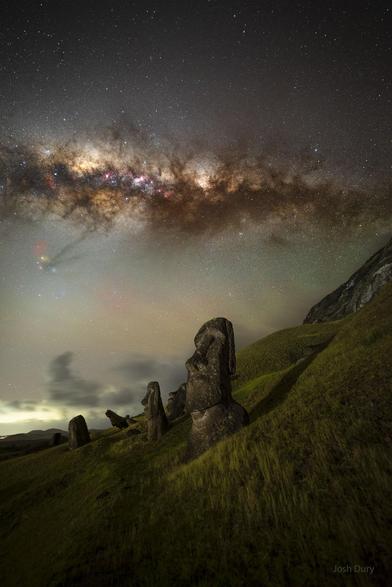
Why were the statues on Easter Island built? No one is sure. What is sure is that over 900 large stone statues called moais exist there. The Rapa Nui (Easter Island) moais stand, on average, over twice as tall as a person and have over 200 times as much mass. It is thought that the unusual statues were created about 600 years ago in the images of local leaders of a vibrant and ancient civilization. Rapa Nui has been declared by UNESCO to a World Heritage Site. Pictured here, some of the stone giants were imaged last month under the central band of our Milky Way galaxy. Previously unknown moais are still being discovered.
https://www.theguardian.com/world/2023/mar/02/new-easter-island-moai-statue-discovered-in-volcano-crater

https://apod.nasa.gov/apod/ap241105.html

#space #milkyway #astrophotography #photography #science #astronomy #nature #NASA

2024 August 7

Milky Way Behind Three Merlons
* Image Credit & Copyright: Donato Lioce; Text: Natalia Lewandowska (SUNY Oswego)
https://www.instagram.com/donamour_photography/
https://ww1.oswego.edu/physics/profile/natalia-lewandowska

Explanation:
To some, they look like battlements, here protecting us against the center of the Milky Way. The Three Merlons, also called the Three Peaks of Lavaredo, stand tall today because they are made of dense dolomite rock which has better resisted erosion than surrounding softer rock. They formed about 250 million years ago and so are comparable in age with one of the great extinctions of life on Earth. A leading hypothesis is that this great extinction was triggered by an asteroid about 10-km across, larger in size than Mount Everest, impacting the Earth. Humans have gazed up at the stars in the Milky Way and beyond for centuries, making these battlefield-like formations, based in the Sexten Dolomites, a popular place for current and ancient astronomers.

https://apod.nasa.gov/apod/ap240807.html

#space #milkyway #astrophotography #photography #science #astronomy #nature #NASA

2024 August 5

Milky Way Over Tunisia
* Image Credit & Copyright: Makrem Larnaout
https://app.astrobin.com/u/Makrem_Larnaout#gallery

Explanation:
That's no moon. On the ground, that's the Lars Homestead in Tunisia. And that's not just any galaxy. That's the central band of our own Milky Way galaxy. Last, that's not just any meteor. It is a bright fireball likely from last year's Perseids meteor shower. The featured image composite combines consecutive exposures taken by the same camera from the same location. This year's Perseids peak during the coming weekend is expected to show the most meteors after the first quarter moon sets, near midnight. To best experience a meteor shower, you should have clear and dark skies, a comfortable seat, and patience.
https://www.atlasobscura.com/places/lars-homestead

https://apod.nasa.gov/apod/ap240805.html

#space #milkyway #astrophotography #photography #science #astronomy #nature #NASA #starwars

2010 August 12

Perseid Prelude
* Credit & Copyright: Tamas Ladanyi (TWAN)
https://twanight.org/profile/tamas-ladanyi/

Explanation:
Each August, as planet Earth swings through dust trailing along the orbit of periodic comet Swift-Tuttle, skygazers can enjoy the Perseid Meteor Shower. The shower should build to its peak now, best seen from later tonight after moonset, until dawn tomorrow morning when Earth moves through the denser part of the wide dust trail. But shower meteors have been spotted for many days, like this bright Perseid streaking through skies near Lake Balaton, Hungary on August 8. In the foreground is the region's Church of St. Andrew ruin, with bright Jupiter dominating the sky to its right. Two galaxies lie in the background of the wide-angle, 3 frame panorama; our own Milky Way's luminous arc, and the faint smudge of the more distant Andromeda Galaxy just above the ruin's leftmost wall. If you watch for Perseid meteors tonight, be sure and check out the early evening sky show too, featuring bright planets and a young crescent Moon near the western horizon after sunset.

https://apod.nasa.gov/apod/ap100812.html

#space #milkyway #astrophotography #photography #science #astronomy #nature #NASA

2010 June 25

The Starry Night of Alamut
* Image Credit & Copyright: Babak Tafreshi (TWAN)
https://twanight.org/profile/babak-a-tafreshi/

Explanation:
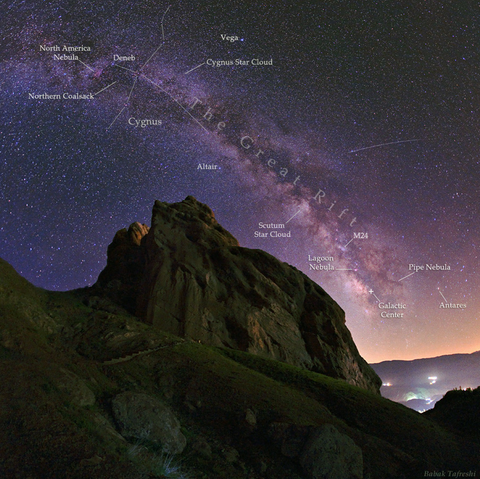
A meteor's streak and the arc of the Milky Way hang over the imposing mountain fortress of Alamut in this starry scene. Found in the central Alborz Mountains of Iran, Alamut Castle was built into the rock in the 9th century. The name means Eagle's Nest. Home of the legendary Assassins featured in the adventure movie Prince of Persia, Alamut was also historically a center for libraries and education. For a time, it was the residence of important 13th century Persian scholar and astronomer Nasir al-Din al-Tusi. To identify the stars in a night sky Tusi certainly pondered, just slide your cursor over the image. Highlights include bright white stars Deneb (in Cygnus), Vega, and Altair, nebulae near the Galactic Center, and the dark obscuring dust clouds of the Milky Way also known as the Great Rift. Lights at the lower right are from small villages and the capital Tehran, over 100 kilometers away to the southwest.

https://apod.nasa.gov/apod/ap100625.html

2024 July 29

Milky Way over Uluru
* Image Credit & Copyright: Max Inwood
https://www.instagram.com/max.nti/

Explanation:
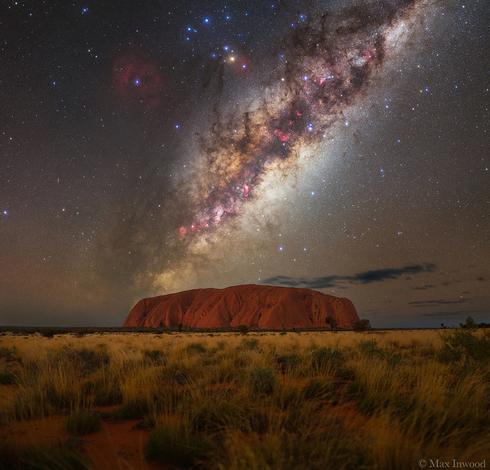
What's happening above Uluru? A United Nations World Heritage Site, Uluru is an extraordinary 350-meter high mountain in central Australia that rises sharply from nearly flat surroundings. Composed of sandstone, Uluru has slowly formed over the past 300 million years as softer rock eroded away. The Uluru region has been a home to humans for over 22,000 years. Recorded last month, the starry sky above Uluru includes the central band of our Milky Way galaxy, complete with complex dark filaments of dust, bright red emission nebulas, and billions of stars.

https://apod.nasa.gov/apod/ap240729.html

#space #galaxy #milkyway #astrophotography #photography #science #astronomy #NASA

Annotations for previous post

2024 July 21

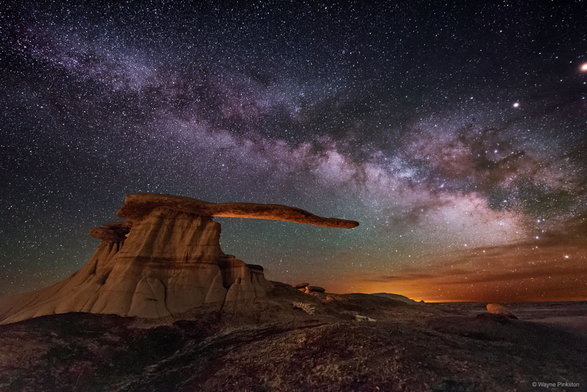
King of Wings Hoodoo under the Milky Way
* Image Credit & Copyright: Wayne Pinkston (LightCrafter Photography)
https://waynepinkstonphoto.com/

Explanation:
This rock structure is not only surreal -- it's real. Perhaps the reason it's not more famous is that it is smaller than one might guess: the capstone rock overhangs only a few meters. Even so, the King of Wings outcrop, located in New Mexico, USA, is a fascinating example of an unusual type of rock structure called a hoodoo. Hoodoos may form when a layer of hard rock overlays a layer of eroding softer rock. Figuring out the details of incorporating this hoodoo into a night-sky photoshoot took over a year. Besides waiting for a suitably picturesque night behind a sky with few clouds, the foreground had to be artificially lit just right relative to the natural glow of the background. After much planning and waiting, the final shot, featured here, was taken in May 2016. Mimicking the horizontal bar, the background sky features the band of our Milky Way Galaxy stretching overhead.

https://apod.nasa.gov/apod/ap240721.html

#space #galaxy #milkyway #astrophotography #photography #science #astronomy #nature #NASA

2024 July 5

Mount Etna Milky Way
* Image Credit & Copyright: Gianni Tumino
https://www.facebook.com/giovanni.tumino.58

Explanation:
A glow from the summit of Mount Etna, famous active stratovolcano of planet Earth, stands out along the horizon in this mountain and night skyscape. Bands of diffuse light from congeries of innumerable stars along the Milky Way galaxy stretch across the sky above. In silhouette, the Milky Way's massive dust clouds are clumped along the galactic plane. Also familiar to northern skygazers are bright stars Deneb, Vega, and Altair, the Summer Triangle straddling dark nebulae and luminous star clouds poised over the volcanic peak. The deep combined exposures reveal the light of active star forming regions along the Milky Way, echoing Etna's ruddy hue in the northern hemisphere summer's night.

https://apod.nasa.gov/apod/ap240705.html

#space #galaxy #milkyway #astrophotography #photography #science #astronomy #nature #NASA

2024 May 29

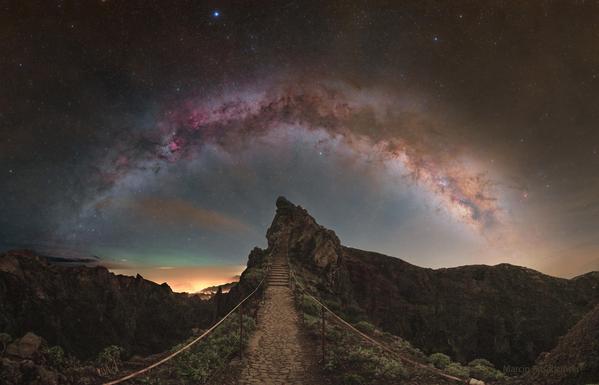
Stairway to the Milky Way
* Image Credit & Copyright: Marcin Rosadziński
https://researchinpoland.org/news/polish-astrophotographer-selected-milky-way-photographer-of-the-year-2025/

Explanation:
What happens if you ascend this stairway to the Milky Way? Before answering that, let's understand the beautiful sky you will see. Most eye-catching is the grand arch of the Milky Way Galaxy, the band that is the central disk of our galaxy which is straight but distorted by the wide-angle nature of this composite image. Many stars well in front of the Milk Way will be visible, with the bright white star just below the stellar arch being Altair, and the bright blue star above it being Vega. The air glows green on the left, just above the yellow cloud deck. The featured image was taken last month on Portugal's Madeira Island in the North Atlantic Ocean. Oh, and what happens after you reach the top of these stairs and admire the amazing sky is, quite probably, that you then descend down the stairs on the other side.

https://apod.nasa.gov/apod/ap240529.html

#space #galaxy #milkyway #astrophotography #photography #science #astronomy #nature #NASA

Annotations for previous post

2023 December 1

Milky Way Rising
* Image Credit & Copyright: José Rodrigues
https://joserodrigues.space/

Explanation:
The core of the Milky Way is rising beyond the Chilean mountain-top La Silla Observatory in this deep night skyscape. Seen toward the constellation Sagittarius, our home galaxy's center is flanked on the left, by the European Southern Observatory's New Technology Telescope which pioneered the use of active optics to accurately control the shape of large telescope mirrors. To the right stands the ESO 3.6-meter Telescope, home of the exoplanet hunting HARPS and NIRPS spectrographs. Between them, the galaxy's central bulge is filled with obscuring clouds of interstellar dust, bright stars, clusters, and nebulae. Prominent reddish hydrogen emission from the star-forming Lagoon Nebula, M8, is near center. The Trifid Nebula, M20, combines blue light of a dusty reflection nebula with reddish emission just left of the cosmic Lagoon. Both are popular stops on telescopic tours of the galactic center. The composited image is a stack of separate exposures for ground and sky made in April 2023, all captured consecutively with the same framing and camera equipment.

https://apod.nasa.gov/apod/ap231201.html

#space #galaxy #milkyway #astrophotography #photography #science #astronomy #nature #NASA

2023 September 27

STEVE and Milky Way Cross over Rural Road
* Image Credit & Copyright: Theresa Clarke

Explanation:
Not every road ends in a STEVE. A week ago, a sky enthusiast's journey began with a goal: to photograph an aurora over Lake Huron. Driving through rural Ontario, Canada, the forecasted sky show started unexpectedly early, causing the photographer to stop before arriving at the scenic Great Lake. Aurora images were taken toward the north -- but over land, not sea. While waiting for a second round of auroras, a peculiar band of light was noticed to the west. Slowly, the photographer and friends realized that this western band was likely an unusual type of aurora: a Strong Thermal Emission Velocity Enhancement (STEVE). Moreover, this STEVE was putting on quite a show: appearing intertwined with the central band of our Milky Way Galaxy while intersecting the horizon just near the end of the country road. After capturing this cosmic X on camera, the photographer paused to appreciate the unexpected awesomeness of finding extraordinary beauty in an ordinary setting.

https://apod.nasa.gov/apod/ap230927.html

#space #galaxy #milkyway #astrophotography #photography #science #astronomy #nature #NASA

2023 July 16

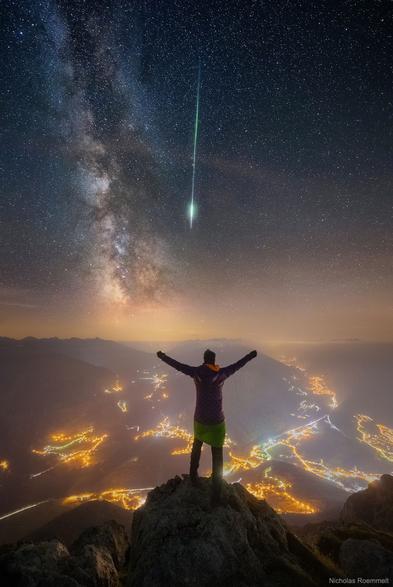
Meteor and Milky Way over the Alps
* Image Credit & Copyright: Nicholas Roemmelt (Venture Photography)
https://www.facebook.com/DrNicholasRoemmeltPhotography/
https://www.venture.photography/bio

Explanation:
Now this was a view with a thrill. From Mount Tschirgant in the Alps, you can see not only nearby towns and distant Tyrolean peaks, but also, weather permitting, stars, nebulas, and the band of the Milky Way Galaxy. What made the arduous climb worthwhile this night, though, was another peak -- the peak of the 2018 Perseids Meteor Shower. As hoped, dispersing clouds allowed a picturesque sky-gazing session that included many faint meteors, all while a carefully positioned camera took a series of exposures. Suddenly, a thrilling meteor -- bright and colorful -- slashed down right next to the nearly vertical band of the Milky Way. As luck would have it, the camera caught it too. Therefore, a new image in the series was quickly taken with one of the sky-gazers posing on the nearby peak. Later, all of the images were digitally combined.

https://apod.nasa.gov/apod/ap230716.html

#space #galaxy #milkyway #astrophotography #photography #science #astronomy #nature #NASA

2025 July 23

Fireball over Cape San Blas
* Image Credit & Copyright: Jason Rice
https://www.instagram.com/p/DLa5D4sxVag/

Explanation:
Have you ever seen a fireball? In astronomy, a fireball is a very bright meteor -- one at least as bright as Venus and possibly brighter than even a full Moon. Fireballs are rare -- if you see one you are likely to remember it for your whole life. Physically, a fireball is a small rock that originated from an asteroid or comet that typically leaves a fading smoke trail of gas and dust as it shoots through the Earth's atmosphere. It is unlikely that any single large ground strike occurred -- much of the rock likely vaporized as it broke up into many small pieces. The featured picture was captured last week from a deadwood beach in Cape San Blas, Florida, USA.

https://www.amsmeteors.org/fireballs/faqf/
https://science.nasa.gov/solar-system/meteors-meteorites/
https://science.nasa.gov/solar-system/asteroids/
https://apod.nasa.gov/apod/ap231126.html
https://en.wikipedia.org/wiki/Comet_nucleus
https://apod.nasa.gov/apod/ap190430.html
https://www.instagram.com/p/DLa5D4sxVag/?img_index=2

https://apod.nasa.gov/apod/ap250723.html

#space #galaxy #milkyway #astrophotography #photography #science #astronomy #nature #NASA

@grobi Why are so many #astronomy pictures so hard photoshopped.

@samurro

Don't Panic!
If you don't like them you don't need to see them at all ..