TOPIC> Clouds

"Dear dev-ops and admins, who are mostly overworked and close to burnout: DON'T PANIC!
These clouds have nothing to do with your work, but quite the opposite, they are supposed to lead you back to the original meaning of the word. So scroll calmly through this thread and let yourself fall into deep relaxation until your state of mind corresponds to a small pink fluffy cloud and breathe serenely in and out again .. in and out .. and now let the clouds in your mind just come and go .. come and go .. just wach these clouds passing by scrolling deeper down down down .."

2021 August 11

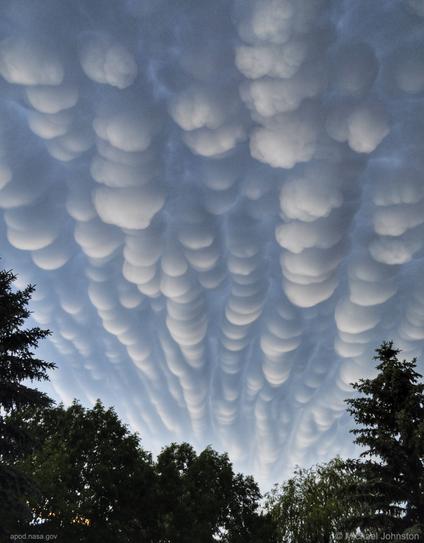
Mammatus Clouds over Saskatchewan
* Image Credit & Copyright: Michael F Johnston
https://www.instagram.com/beautyandruin/

Explanation:
When do cloud bottoms appear like bubbles? Normally, cloud bottoms are flat. This is because moist warm air that rises and cools will condense into water droplets at a specific temperature, which usually corresponds to a very specific height. As water droplets grow, an opaque cloud forms. Under some conditions, however, cloud pockets can develop that contain large droplets of water or ice that fall into clear air as they evaporate. Such pockets may occur in turbulent air near a thunderstorm. Resulting mammatus clouds can appear especially dramatic if sunlit from the side. The mammatus clouds pictured here, lasting only a few minutes, were photographed over Regina, Saskatchewan, Canada, just after a storm in 2012.

https://apod.nasa.gov/apod/ap210811.html

#space #earth #atmophere #clouds #weather #photography #science #physics #meteorology #nature
2022 January 16

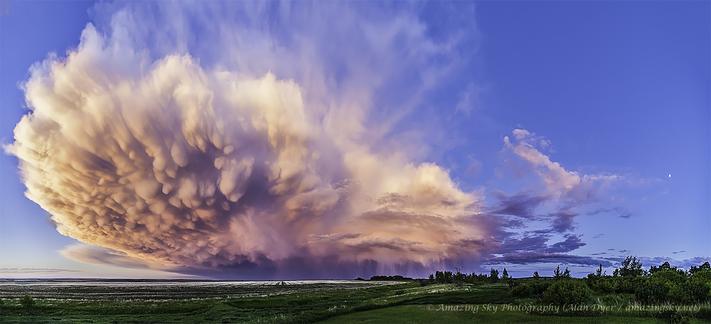
A Retreating Thunderstorm at Sunset
* Image Credit & Copyright: Alan Dyer (The Amazing Sky)
https://amazingsky.net/about/
https://amazingsky.net/

Explanation:
What type of cloud is that? This retreating cumulonimbus cloud, more commonly called a thundercloud, is somewhat unusual as it contains the unusual bumpiness of a mammatus cloud on the near end, while simultaneously producing falling rain on the far end. Taken in mid-2013 in southern Alberta, Canada, the cloud is moving to the east, into the distance, as the sun sets in the west, behind the camera. In the featured image, graphic sunset colors cross the sky to give the already photogenic cloud striking orange and pink hues. A darkening blue sky covers the background. Further in the distance, a rising, waxing, gibbous moon is visible on the far right.

https://apod.nasa.gov/apod/ap220116.html

#space #earth #atmophere #clouds #weather #photography #science #physics #meteorology #nature
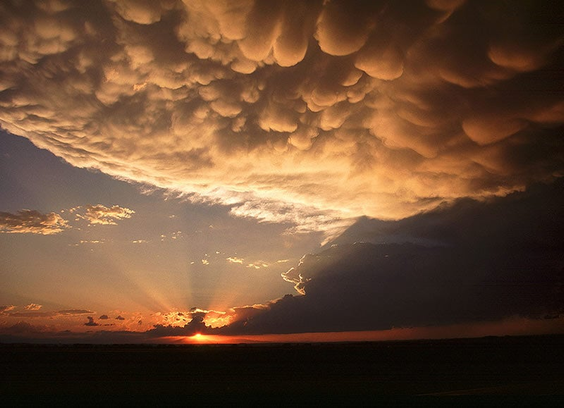
Mammatus Clouds
* UCAR Center for Science Education

Mammatus clouds are pouches of clouds that hang underneath the base of a cloud. They are most often associated with cumulonimbus clouds that produce very strong storms. These clouds usually form during warm months, and are formed by descending air in the cloud. Mammatus clouds are sometimes described as looking like a field of tennis balls or melons, or like female human breasts. In fact, the name "mammatus" comes from the Latin word mamma, or breast.

CREDIT
Gregory Thompson

https://scied.ucar.edu/image/mammatus-clouds

#space #earth #atmophere #clouds #weather #photography #science #physics #meteorology #nature #education

2018 August 19

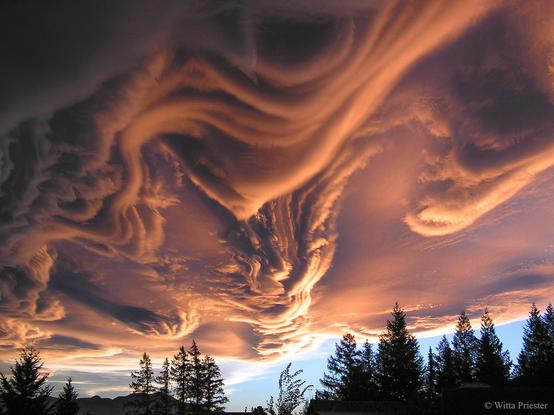
Asperitas Clouds Over New Zealand
* Image Credit & Copyright: Witta Priester
https://www.flickr.com/people/wittap/

Explanation:
What kind of clouds are these? Although their cause is presently unknown, such unusual atmospheric structures, as menacing as they might seem, do not appear to be harbingers of meteorological doom. Formally recognized as a distinct cloud type only last year, Asperitas clouds can be stunning in appearance, unusual in occurrence, and are relatively unstudied. Whereas most low cloud decks are flat bottomed, asperitas clouds appear to have significant vertical structure underneath. Speculation therefore holds that asperitas clouds might be related to lenticular clouds that form near mountains, or mammatus clouds associated with thunderstorms, or perhaps a foehn wind -- a type of dry downward wind that flows off mountains. Such a wind called the Canterbury arch streams toward the east coast of New Zealand's South Island. The featured image, taken above Hanmer Springs in Canterbury, New Zealand, in 2005, shows great detail partly because sunlight illuminates the undulating clouds from the side.

https://apod.nasa.gov/apod/ap180819.html

#space #earth #atmophere #clouds #weather #photography #science #physics #meteorology #nature #education
2009 January 21

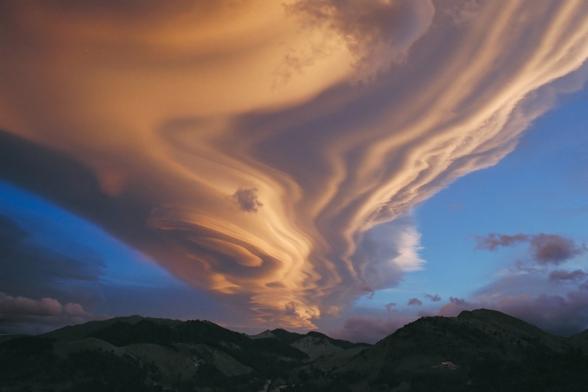
A Lenticular Cloud Over New Zealand
* Credit & Copyright: Chris Picking (Starry Night Skies Photography)
http://www.starrynightphotos.com/about_me.html

Explanation:
What's happening above those mountains? Several clouds are stacked up into one striking lenticular cloud. Normally, air moves much more horizontally than it does vertically. Sometimes, however, such as when wind comes off of a mountain or a hill, relatively strong vertical oscillations take place as the air stabilizes. The dry air at the top of an oscillation may be quite stratified in moisture content, and hence forms clouds at each layer where the air saturates with moisture. The result can be a lenticular cloud with a strongly layered appearance. The above picture was taken in 2002 looking southwest over the Tararua Range mountains from North Island, New Zealand.

https://apod.nasa.gov/apod/ap090121.html

#space #earth #atmophere #clouds #weather #photography #science #physics #meteorology #nature #education
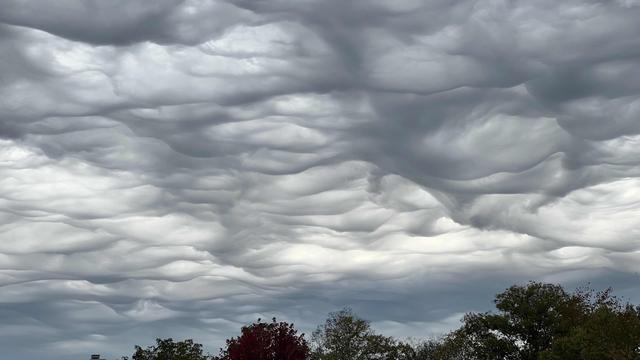
From Wikipedia, the free encyclopedia

Asperitas (cloud)

Asperitas (formerly known as Undulatus asperatus) is a cloud formation first popularized and proposed as a type of cloud in 2009 by Gavin Pretor-Pinney of the Cloud Appreciation Society. Added to the International Cloud Atlas as a supplementary feature in March 2017, it is the first cloud formation added since cirrus intortus in 1951. The name translates approximately as "roughness".

The clouds are closely related to undulatus clouds. Although they appear dark and storm-like, they almost always dissipate without a storm forming. The ominous-looking clouds have been widespread in the Plains states of the United States, often during the morning or midday hours following convective thunderstorm activity.

According to International Cloud Atlas, Asperitas are defined as

Well-defined, wave-like structures in the underside of the cloud; more chaotic and with less horizontal organization than the variety undulatus. Asperitas is characterized by localized waves in the cloud base, either smooth or dappled with smaller features, sometimes descending into sharp points as if viewing a roughened sea surface from below.
Varying illumination levels and cloud thickness can lead to dramatic visual effects.
Occurs mostly with Stratocumulus and Altocumulus.
[...]
For more Information see ALT-Text and:
https://en.wikipedia.org/wiki/Asperitas_(cloud)

#space #earth #atmophere #clouds #weather #photography #science #physics #meteorology #nature #education

2016 February 14 (*)

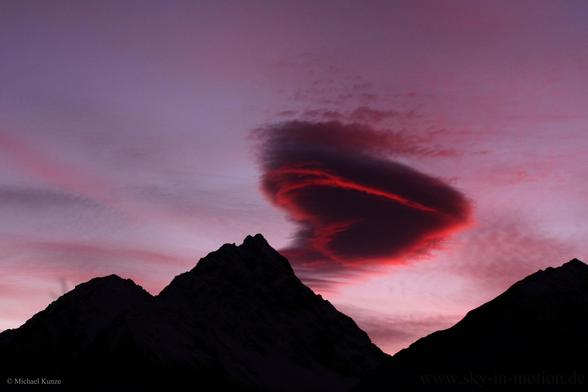
A Heart Shaped Lenticular Cloud
* Image Credit & Copyright: Michael Kunze
https://www.sky-in-motion.de/de/
https://www.sky-in-motion.de/en/index.php

Explanation:
Can a cloud love a mountain? Perhaps not, but on a Valentine's Day like today (*), one might be prone to seeing heart-shaped symbols where they don't actually exist. A fleeting pareidolia, the featured heart was really a lenticular cloud that appeared one morning last July above Mount Cook National Park in New Zealand. A companion video shows the lenticular cloud was mostly stationary in the sky but shifted and vibrated with surrounding winds. The cloud's red color was caused by the Sun rising off the frame to the right. Lenticular clouds are somewhat rare but can form in air that passes over a mountain. Then, vertical eddies may form where rising air cools past the dew point causing water carried by the air to condense into droplets. Unfortunately, this amazing sight made the fascinated videographer late for breakfast.

https://apod.nasa.gov/apod/ap160214.html

#space #earth #atmophere #clouds #weather #photography #science #physics #meteorology #nature #education
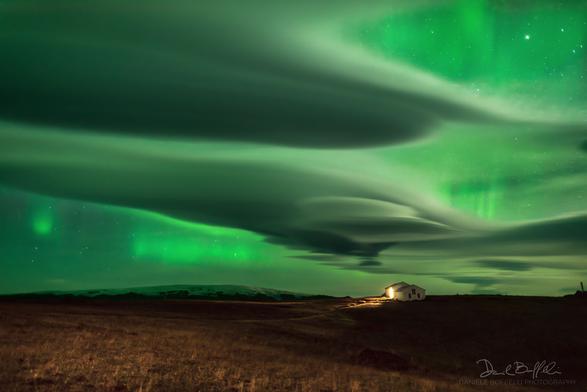
"A green aurora through odd lenticular clouds!"

2021 May 30

Aurora over Clouds
* Image Credit & Copyright: Daniele Boffelli
https://www.facebook.com/danieleboffellifotografia/

Explanation:
Auroras usually occur high above the clouds. The auroral glow is created when fast-moving particles ejected from the Sun impact the Earth's magnetosphere, from which charged particles spiral along the Earth's magnetic field to strike atoms and molecules high in the Earth's atmosphere. An oxygen atom, for example, will glow in the green light commonly emitted by an aurora after being energized by such a collision. The lowest part of an aurora will typically occur about 100 kilometers up, while most clouds exist only below about 10 kilometers. The relative heights of clouds and auroras are shown clearly in the featured picture in 2015 from Dyrholaey, Iceland. There, a determined astrophotographer withstood high winds and initially overcast skies in an attempt to capture aurora over a picturesque lighthouse, only to take, by chance, the featured picture including elongated lenticular clouds, along the way.

https://apod.nasa.gov/apod/ap210530.html

#space #earth #atmophere #clouds #weather #photography #science #physics #meteorology #nature #education
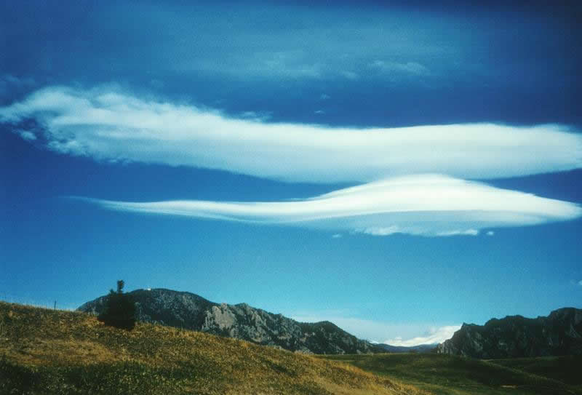
Lenticular Clouds
-- UCAR Center for Science Education

Lenticular, or lee wave, clouds form downwind of an obstacle in the path of a strong air current. In the Boulder, Colorado area, the obstacle is the Front Range of the Rocky Mountains, seen at the bottom of the picture. Wind blows most types of clouds across the sky, but lenticular clouds seem to stay in one place. Air moves up and over a mountain, with the lenticular cloud forming just past the mountaintop. The cloud evaporates on the downwind side, so it appears stationary even though air is moving through the cloud. Lenticular clouds are lens-shaped and often look like flying saucers.

CREDIT
UCAR

https://scied.ucar.edu/image/lenticular-clouds

#space #earth #atmophere #clouds #weather #photography #science #physics #meteorology #nature #education
2016 March 2

Unusual Clouds over Hong Kong
* Image Credit & Copyright: Alfred Lee

Explanation:
What's that in the sky? Earlier this month, in the sky high above Hong Kong, China, not just one unusual type of cloud appeared -- but two. In the foreground was a long lenticular cloud, a cloud that forms near mountains from uprising air and might appear to some as an alien spaceship. Higher in the sky, and further in the background, was a colorful iridescent cloud. Iridescent clouds are composed of water droplets of similar size that diffract different colors of sunlight by different amounts. Furthest in the background is the Sun, blocked from direct view by the opaque lenticular, but providing the light for the colors of the iridescent. Either type of cloud is unusual to see in Hong Kong, and unfortunately, after only a few minutes, both were gone.

https://apod.nasa.gov/apod/ap160302.html

#space #earth #atmophere #clouds #weather #photography #science #physics #meteorology #nature #education
2005 August 21

A Lenticular Cloud Over Hawai'i
* Credit & Copyright: Peter Michaud (Gemini Obs.)
https://www.gemini.edu/

Explanation:
Can a cloud do that? Actually, pictured above are several clouds all stacked up into one striking lenticular cloud. Normally, air moves much more horizontally than it does vertically. Sometimes, however, such as when wind comes off of a mountain or a hill, relatively strong vertical oscillations take place as the air stabilizes. The dry air at the top of an oscillation may be quite stratified in moisture content, and hence forms clouds at each layer where the air saturates with moisture. The result can be a lenticular cloud with a strongly layered appearance. The above picture was taken near Mauna Kea, Hawaii, USA.

https://apod.nasa.gov/apod/ap050821.html

#space #earth #atmophere #clouds #weather #photography #science #physics #meteorology #nature #education
CSICOP's Young Skeptics Program

CSICOP's Young Skeptics Program

@grobi Do they take passengers? I'm looking for a ride...

@Satiah

.. sure, you only need that towel!

https://en.wikipedia.org/wiki/Towel_Day

"A towel, it says, is about the most massively useful thing an interstellar hitchhiker can have. Partly it has great practical value. You can wrap it around you for warmth as you bound across the cold moons of Jaglan Beta; you can lie on it on the brilliant marble-sanded beaches of Santraginus V, inhaling the heady sea vapours; you can sleep under it beneath the stars which shine so redly on the desert world of Kakrafoon; use it to sail a miniraft down the slow heavy River Moth; wet it for use in hand-to-hand-combat; wrap it round your head to ward off noxious fumes or avoid the gaze of the Ravenous Bugblatter Beast of Traal (such a mind-bogglingly stupid animal, it assumes that if you can't see it, it can't see you β€” daft as a brush, but very very ravenous); you can wave your towel in emergencies as a distress signal, and of course dry yourself off with it if it still seems to be clean enough. "

β€”β€ŠDouglas Adams, The Hitchhiker's Guide to the Galaxy

Towel Day - Wikipedia

@grobi I have just the right towel for all possible applications. πŸ‘