3,013 neurons, half a million synapses: the complete #connectome of the whole #Drosophila larval brain!

Winding, Pedigo et al. 2022. "The connectome of an insect brain" https://www.biorxiv.org/content/10.1101/2022.11.28.516756v1

We’ve mapped and analysed its circuit architecture, from sensory neurons to brain output neurons, as reconstructed from volume electron microscopy, and here is what we found. 1/

#neuroscience #connectomics #vEM #volumeEM

Our map of the #Drosophila larval brain #connectome is complete, with all inputs and all outputs, and everything in between: all polysynaptic pathways from sensory neurons all the way to brain output neurons, across both brain hemispheres. 2/

#neuroscience #connectomics

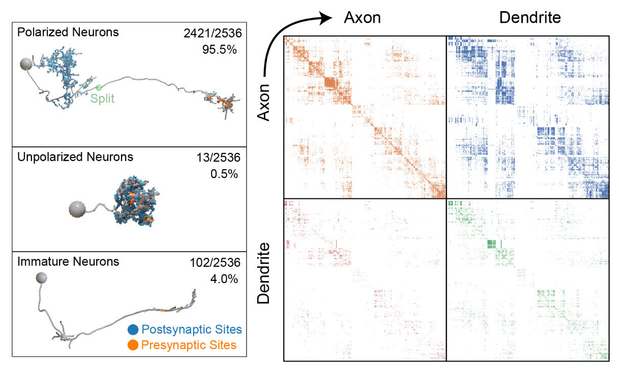
Our analysis of the #Drosophila larval brain starts by recognizing that neurons are polarized: 95.5% of all brain neurons present clearly segregated axons and dendrites.

In the #connectome, we found 66% axo-dendritic synapses, 26% axo-axonic, 6% dendro-dendritic and 2% dendro-axonic.

This matters because inputs onto dendrites contribute to the integration function of a neuron; inputs onto an axon modulate its output. Analysing them separately makes sense.

#neuroscience #connectomics 3/

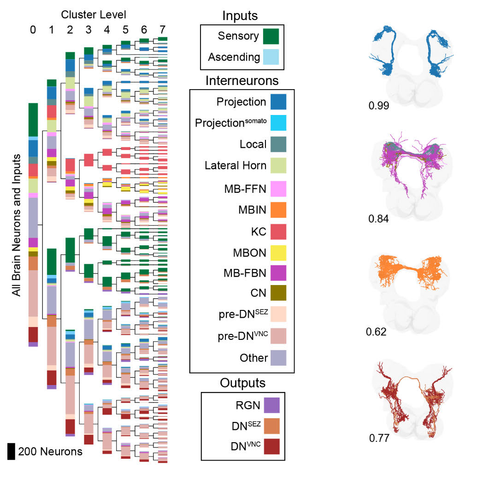
Having split the #Drosophila larval brain #connectome into 4 types of edges, hierarchical spectral clustering defined about 90 groups of neurons.

Remarkably, clusters defined by connectivity alone were internally consistent for other features, such as neuron morphology or function.

Clusters were sorted from sensory neurons (SNs) to descending neurons (DNs) using the Walk-Sort algorithm. To the right, example clusters with intracluster morphological similarity score using NBLAST.

4/

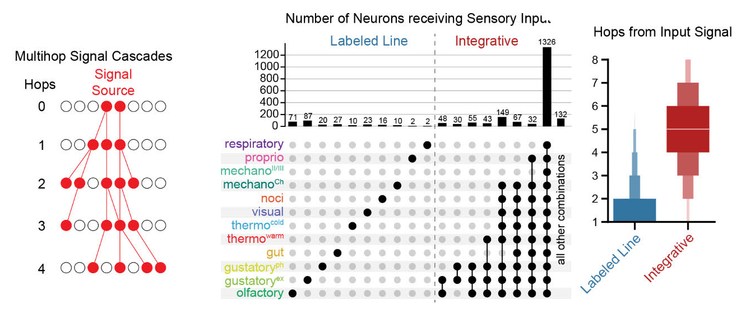
Next, we explored the #Drosophila larval #connectome with multi-hop signal cascades (left) that extended across synapses up to a depth of 5. We sorted neurons into labelled lines and multisensory (right).

Neurons were considered to receive sensory input when visited in most cascade iterations.

The majority of brain neurons integrate from all sensory types, but a few neurons integrated from only one sensory modality (labelled line) or from a combination.

#neuroscience #connectomics

5/

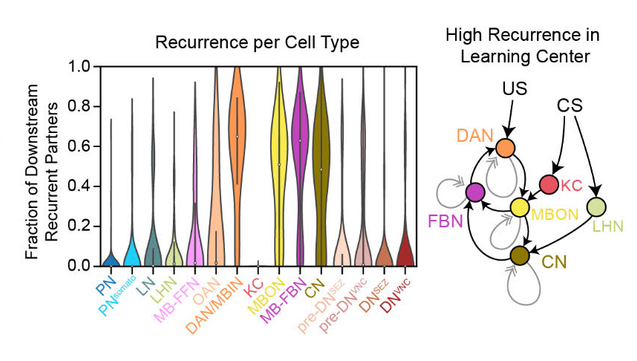
Then we studied recurrent circuits in the #Drosophila larval brain.

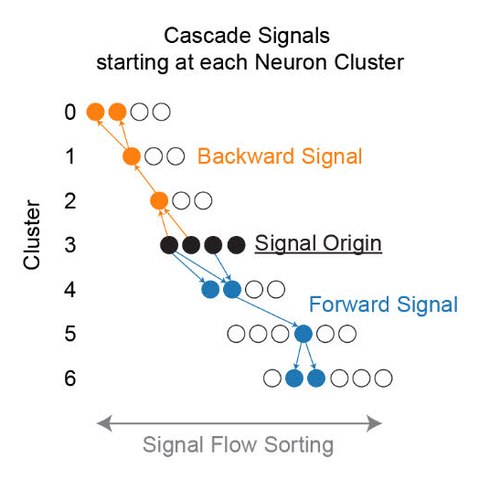
By starting bi-directional multi-hop signal cascades at any one cluster, we found that the cluster containing the dopaminergic neurons (DANs) of the centre for associative learning and memory, the insect mushroom body (MB), present the most cascades where the beginning and the end of the cascade is itself!

In other words DANs, which mediate learning, are the most recurrent neurons in the brain.

#neuroscience #connectomics 6/

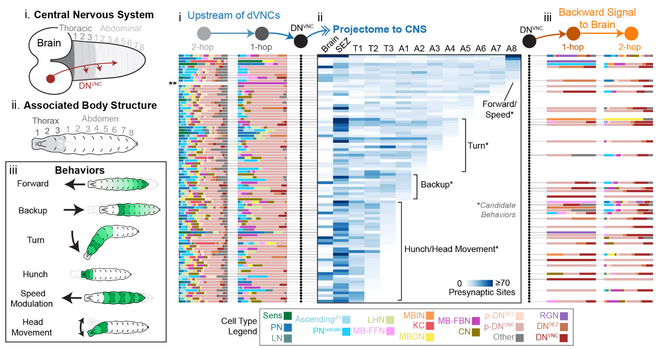
With all descending neurons (DNs) mapped, we could have a look at how the #Drosophila larval brain drives locomotion.

By determining the spatial projection pattern of all axons of DNs, and the known contribution of each body segment to locomotion, we inferred which behaviours can be controlled by which DNs, and then, which brain neurons control those DNs.

#neuroscience #connectomics 7/

@albertcardona As far as you know, do the neural networks at the heart of machine (and deep?) learning attempt to mimic, or end up mimicking, dopaminergic neurons DANs? - which appear to be linked to the ability to learn. I imagine emulating sensory/multisensory neurons (SNs) would be useful in the field of robotics.

@alex_p_roe

Artificial neural networks work in a very different way to biological ones. For one, it takes a deep neural network to emulate the capabilities of a single pyramidal neuron in the mammalian cortex. And ANNs lack axo-axonic synapses, active dendritic spikes, redundant inputs across different dendritic branches, and more. All of which matter a lot and are the subject of a number of scientific publications. The differences are huge. Not at all comparable beyond: both are networks.

@albertcardona Thanks. Very interesting to hear that ANNs are not close to mammalian neural networks - which may mean they are unable to become sentient - could this be the cause of hallucination? I imagine we will need to build a copy of a brain and then “teach” it, although without sensory organs, this won’t be easy unless we create a replica of a living organism. Is that where your insect studies are heading?

@alex_p_roe For the time being I am content with mapping brain circuits and making sense of them through a combination of genetics, functional imaging, observation of behavioural perturbations, and computational modeling. All of this is possible in a tiny organism, and not at all on a large one, at least, not if one has the ambition of studying the complete brain at nanometre resolution.

As per the "hallucinations", large language models don't hallucinate. Instead, they are simply statistical models of language, and therefore what they generate is what is plausible, given a corpus of texts it was trained on. It does not reason. They also fall prey to the curse of dimensionality, where the higher the number dimensions, the more "empty space" – regions of the activation space where nothing makes sense – there is.

@albertcardona An interesting and clear reply. Thanks. Mapping brain circuits does sound interesting and is a way of understanding what brains do. Starting with insects sounds wise - it helps understand the basics and this knowledge can be applied to more complex brains in time and, one day, to human brains. I thought we were closer to understanding how brains work - seems not…in which case we can’t really create an artificial brain yet. This begs questions about artificial general intelligence.

@alex_p_roe

Artificial general intelligence would require at the very least explicitly modeling the world and predicting future trajectories for objects in it. At the very least. Indeed, not understanding yet how specific functions such as wayfinding/navigation, learning in its many forms, and perception of the own body work in the brain, there's little hope so far for a constructed system to do so, beyond very limited use cases in highly controlled and constrained environments.

@albertcardona Thanks for confirming what I’d suspected for a while - that this technology is very much in its infancy. I still find it fascinating and future iterations will no doubt be very powerful especially when combined with the kind of research being carried out by yourself and others until one day the ability to emulate human brains arrives - unlikely in my lifetime (am 60), I suspect…but quantum computing may help.