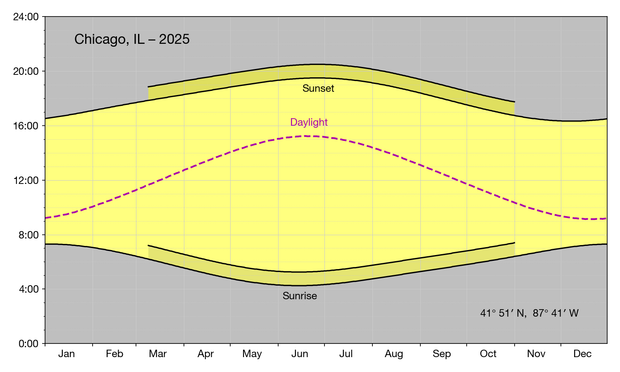
As we approach Daylight Saving Time, I will show this graph again, which I hope explains why I like DST. Call me crazy, but 4 am sunrises just don’t appeal to me. Should I advocate for something that might harm others just because it benefits me? Well, that’s the way the US works now, right?
By the way, this may be my favorite among all the graphs I’ve built. Might be more self-explanatory if I change the “Daylight” label to “Hours of daylight,” but the shorter label has its advantages.
@drdrang Nice graph, and indeed I did not know what Daylight meant until I read this post.
@atlds I know it might be too late for this, but do you think “Daylight Hours” would have triggered recognition? It’s less explicit than “Hours of Daylight” but a little more compact.
@drdrang I like that!
@atlds @drdrang May I humbly suggest a right-side Y access with purple labels called “Hours“? I also assumed the Daylight line had some relation to the other lines.
@atlds @drdrang OK, looking at this again I see that the left axis is cleverly *already* correctly showing units of hours for the purple line. However, this was not clear to me on first viewing as I saw it and mentally assigned it the category “time” not “time or duration”.
@drdrang it makes me wonder though - wouldn't it work if everyone wakes up at 4am and goes to sleep at 8pm all year, enjoying the full extent of daylight in summer and dark mornings and evenings in winter?
@drdrang maybe you just need to move further south?
@idbjorh Again, the world should adjust to me, not vice versa.

@drdrang

I’m not certain what the red dotted line is supposed to represent.

I would not assume astronomical noon, when the sun is highest and furthest from the horizon.

I might be able to think middle of day perhaps, but astronomical noon should be the middle of the day regardless.

@drdrang That’s why I’d like DST all the time.

@drdrang If you have 16 hours of daylight, 8 of those hours should be before noon and 8 of them should be after noon.

Otherwise what’s even the point of having noon and midnight?

Might as well live on UTC if we don’t care about local solar maximums anymore.

Having said that, by this point it’s the switching twice a year that does the real harm. Let’s just go permanent DST and stop the twice a year arguments and health issues.

And while we’re at it, put continental US on two timezones instead of four. If China and India can both make one timezone work, we can simplify there and just have two.

@HitokiriEric You’re absolutely right. In fact, we should go back to local time everywhere. Otherwise, there’s no way of having the same amount of daylight before and after noon.

@drdrang You could almost see it with things being coordinated online across distance with UTC and having automatic translation to local time. DST has been training people to realize how time is a social construct anyways.

In the end most people only really care about what time local businesses are open and then what time needs to be coordinated for travel or online meetings.

No reason for those things to be tied to the sky anymore.

@drdrang @HitokiriEric

It NEVER bothered me growing up whether it was dark in the morning, or dark in the afternoon, when going to school.

What DID bother me was the sleep disruption twice a year, expecially spring forward, as I was a lifetime night owl.

@Chancerubbage @drdrang yeah. Social engineering everyone into waking up an hour earlier by lying about the time was one hell of a political project. One of the more fascinating parts of the history of DST.
@drdrang I would like daylight savings always turned on/off to whichever way doesn't make it dark at almost 4pm. I would like to at least drive home from work and get some sunlight then. That is the most exhausting part of winter in the Midwest to me.
@drdrang Am I reading that graph correctly, in that the Y-Axis labels serve 2 meanings? Once as the hour of the day (for the sunrise/sunset graph), and then also as the number of hours (for the daylight line). If yes, then that’s pretty clever!
@leoncowle Yes, I was delighted when I realized the scale could be interpreted two ways and both are correct. It might be too clever, but I still like it.
@drdrang I'll admit, I didn't immediate grok it, but a little while later when the lightbulb went on (which happened before reading any of the other comments), I instantly *loved* the cleverness of the approach. Nice one, DrD!
@drdrang @leoncowle I have always liked this sort of graph, and really appreciated the extra work of adding the different daylight/twilight times they do at the weatherspark site. https://weatherspark.com/y/14091/Average-Weather-in-Chicago-Illinois-United-States-Year-Round#Sections-Sources
Chicago Climate, Weather By Month, Average Temperature (Illinois, United States) - Weather Spark

In Chicago, the summers are warm, humid, and wet; the winters are freezing, snowy, and windy; and it is partly cloudy year round. Over the course of the year, the temperature typically varies from 22°F to 83°F and is rarely below 5°F or above 91°F.

@drdrang PST is superior as well. I’m not sure there’s a use case for earlier sinrises.