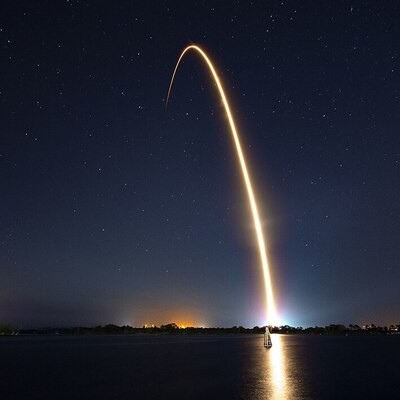
 Spaceflight 🚀
The #FireStar Drive begins a fusion process by adding #boron into the thruster exhaust. The base thruster generates high-speed protons through the ionization of water vapor. These protons collide with the nucleus of a boron atom, which starts the fusion reaction. The technique produced ionizing radiation and increased the base propulsion unit’s thrust by 50% 📈 https://interestingengineering.com/space/nuclear-fusion-powered-electric-propulsion-drive

#FusionPropulsion offers 1000 times the power of conventional #IonThrusters currently used in orbit. The vacuum environment and extremely cold ❄️ temperatures of space 🌌 provide an ideal setting for fusion propulsion * https://orbitaltoday.com/2023/07/14/interplanetary-travel-to-become-faster-through-nuclear-fusion/
Ultrananocrystalline diamond 💎 may be a promising approach to prolong service life. #Nanoscaled metamaterial could help to reduce the heat losses. #SelfHealing of Boron nitride nanotubes with very high tensile strength similar to that of carbon nanotubes, and excellent electrical characteristics https://www.nature.com/articles/s41467-017-02269-7

Recent progress and perspectives of space electric propulsion systems based on smart nanomaterials - Nature Communications
Miniaturized spacecraft built from advanced nanomaterials are poised for unmanned space exploration. In this review, the authors examine the integration of nanotechnology in electric propulsion systems and propose the concept of self-healing and adaptive thrusters.
#MIT #OpenLearning, topic #SpacePropulsion, excerpt :
• Fundamentals and Definitions
• Basic #Electromagnetic Theory and Plasma Physics
• #Electrostatic Thrusters
• Characterization of Space Propulsion Devices
• #Plasma Accelerators
...
https://ocw.mit.edu/courses/16-522-space-propulsion-spring-2015/pages/lecture-notes/

The #3Dprinted prototype was able to generate thrust more #efficiently than larger, more expensive #chemical rockets and outperformed existing droplet #electrospray engines. It can be produced rapidly and for a fraction of the #cost 💵 of traditional thrusters and even be fully made in #orbit 🌌 https://news.mit.edu/2025/mit-engineers-develop-fully-3d-printed-electrospray-engine-0212

MIT engineers develop a fully 3D-printed electrospray engine
MIT researchers demonstrated the first fully 3D-printed, droplet-emitting electrospray engine. The low-cost device can be fabricated more quickly than traditional thrusters, potentially from on board a spacecraft, and could enable CubeSats to perform precise, in-orbit maneuvers, aiding space research projects.
In an #electrospray thruster, charged particles are pulled directly out of a liquid propellant using a strong electric field and accelerated using charged #electrodes https://spacepropulsion.mit.edu/electric-propulsion
 Isaac Ji Kuo
@spaceflight It's worth noting that the estimated specific impulse ranges from 278s to 404s, which is on par with larger chemical rockets but much lower than larger electric thrusters (by an order of magnitude).
This performance is GREAT for tiny thrusters suitable for cubesats, but this is a whole different realm of applications compared to more familiar satellites, probes, and spacecraft.
@isaackuo seems there are a bunch of #MicroPropulsion systems in development (2024) https://www.mdpi.com/2226-4310/11/7/502

Propulsion Technologies for CubeSats: Review
This paper explores the wide-ranging topography of micro-propulsion systems that have been flown in different small satellite missions. CubeSats, known for their compact size and affordability, have gained popularity in the realm of space exploration. However, their limited propulsion capabilities have often been a constraint in achieving certain mission objectives. In response to this challenge, space propulsion experts have developed a wide spectrum of miniaturized propulsion systems tailored to CubeSats, each offering distinct advantages. This literature review provides a comprehensive analysis of these micro-propulsion systems, categorizing them into distinct families based on their primary energy sources. The review provides informative graphs illustrating propulsion performance metrics, serving as beneficial resources for mission planners and satellite designers when selecting the most suitable propulsion system for a particular mission requirement.
@isaackuo the wikipedia article says "#inefficiencies in small propulsion systems cause thrusters to run out of fuel rapidly" and IMHO that's what the prototype mentioned wants to change https://en.wikipedia.org/wiki/CubeSat#Attitude_control
