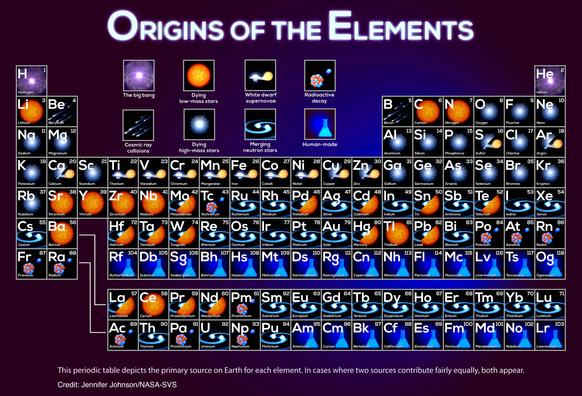
You've probably heard that "we are stardust," but this graphic breaks it down further & tells you what kind of stars your dust came from--and which elements didn't come from stars at all.
https://svs.gsfc.nasa.gov/13873/ #science #nature #space

NASA Scientific Visualization Studio | Periodic Table of the Elements: Origins of the Elements

The periodic table organizes all the known elements by atomic number, which is the number of protons in each atom of the element. This version of the table, which draws on data compiled by astronomer Jennifer Johnson from Ohio State University, shows our current understanding of how each element found on Earth was originally produced. Most of them ultimately have cosmic origins. Some elements were created with the birth of the universe, while others were made during the lives or deaths of stars. The Nancy Grace Roman Space Telescope will help us understand the cosmic era when stars first began forming. The mission will help scientists learn more about how elements were created and distributed throughout galaxies.The related Tumblr post is here. ||


NASA Scientific Visualization Studio

New findings from JWST bolster the case that a lot of the heavy elements in the universe (including most of the gold on Earth) formed during collisions between neutron stars.

https://bigthink.com/starts-with-a-bang/jwst-colliding-neutron-star/

JWST shocks the world with colliding neutron star discovery

From LIGO, there weren't enough neutron star-neutron star mergers to account for our heavy elements. With a JWST surprise, maybe they can.

Big Think
@coreyspowell I thought they discovered plutonium in New Hampshire pitchblende because of U238 getting the occasional neutron; did they see Pu in the spectrum of some astrophysical object? I can't see very much getting here from a neutron star collision

@UP8 @coreyspowell

Plutonium-244 has a long enough half-life that it has been found in cosmic dust, generally thought to be from supernova remnants. It's been used in attempts to determine the chronology of seabed sediment deposition. As far as practical chemistry is concerned, however, it's strictly a man-made element.

@coreyspowell So at least three stars died to give life to me...?
@coreyspowell Huh, I wonder how does “merging neutron stars" lead to further elements. Shouldn't it form a black hole?

@getajobmike

A neutron star merger produces a black hole, but also a significant amount of ejected matter. We know that a lot of stuff must be shot out because astronomers can see radiation from this material, which is observed as a kilonova.

See, eg: https://www.psu.edu/news/eberly-college-science/story/merging-neutron-stars-unfolding-story-kilonova-told-x-rays

Merging neutron stars: The unfolding story of a kilonova told in X-rays | Penn State University

Astronomers may have detected a kilonova — a powerful event that results when two neutron stars merge — in an event called GW170817. Several years after its first detection, the event has continued to emit X-rays that were detected with NASA’s Chandra X-ray Observatory and analyzed by an international team including Penn State scientists.

@coreyspowell never heard of “kilonova”, thank you! And what a fantastic image, almost looks like an artist’s conception.
@coreyspowell I'm adding this to my #Perl periodic table API list of element properties. :)

@coreyspowell
Stardust we are
Close to divine
Stardust we are
See how we shine

https://youtu.be/kbwU2gqPfjk?si=TLf6a5-U_u8dli_n

Stardust We Are

YouTube
@coreyspowell wow beautiful 🤩 thank you for sharing this one
@coreyspowell That's a great piece of work. Thanks for posting.
@coreyspowell With this graphic, I just realized that over half that atoms (by count, not by weight) that make you up are not star dust, but from the big bang (hydrogen). (~50% water by weight, 2/3rds of that is hydrogen, remaining 50% is unlikely to match the same number of oxygen atoms)
@coreyspowell how long till they're forced to remove this graphic
@coreyspowell Awesome information! This is a great complement to the documentary “Journey of the Universe.”

@coreyspowell Wait - isn’t Helium made in active stars? The result of Hydrogen fusion?

Or does this indicate that most of the universe’s helium came in the period after the Big Bang, and what is being produced now is less than that? (An equally mind boggling idea…)

@coreyspowell Beryllium and Boron: "don't mind us, we're just happy to be here".
@coreyspowell I'm torn about the Pu... ok, so it's being made there too, but the Pu on earth, not really?

@coreyspowell

"That we are not together.

That is the greatest lie ever told."
SearingTruth

@coreyspowell found it interesting that low mass stars make some heavier stuff. Apparently these are made by the s-process slow neutron capture over time. A little is also made by neutron star collisions.

Googles "AI" results jump to the conclusion most are made by neutron star collisions which is wrong and a showcase of how AI can give wrong answers based on bias in its data collection.

@coreyspowell cool. This is definitely one to put up in my office ...as a physicist in a chemistry department this is just perfect. 🥳

@coreyspowell I only recently learned about Hydrogen (by number of atoms, the majority of our bodies!) from Katie Mack's podcast on Crash Course.

It's kind of obvious when you think about it - H is the ingredient not the product of star reactions - but I'd never really stopped to think about that.

https://pod.link/1740594155

Crash Course Pods: The Universe

Dr. Katie Mack, a theoretical astrophysicist, walks #1 New York Times bestselling author John Green through the history of the entire universe - including the parts that haven’t been written yet.

@coreyspowell I wonder if this gives us any clue which elements might be rare on most planets but more common here, or vice versa.