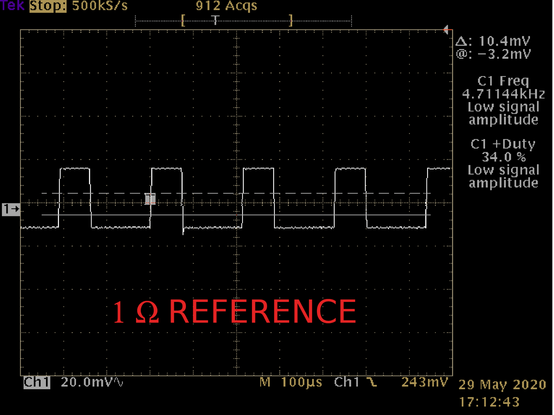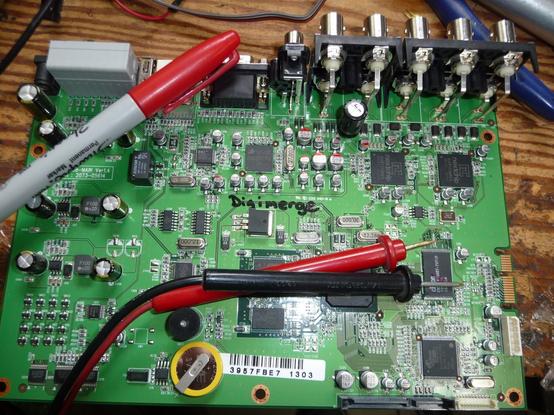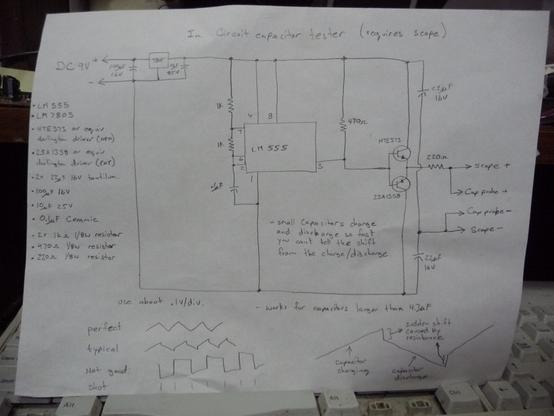
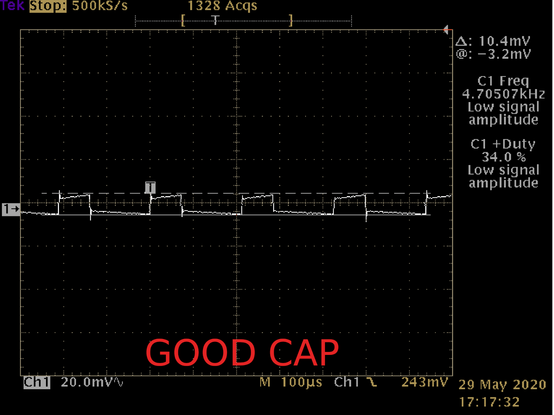
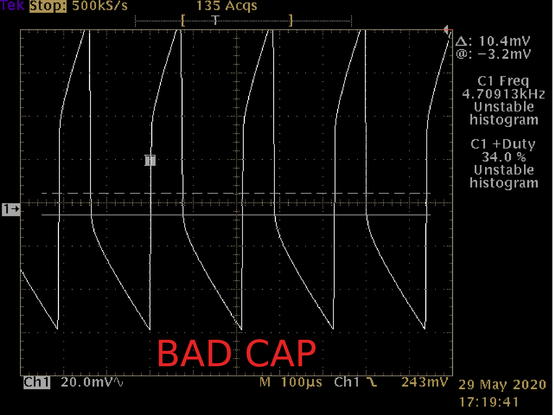
Do you life activities include diagnosing bad capacitors on circuit boards? Take the time to build an in-circuit capacitor tester and stop needlessly replacing caps that are fine! It takes just seconds to go thru a board and identify all the bad caps!
http://ruemohr.org/~ircjunk/circuits/captester.jpg

@RueNahcMohr Ah, yeah, I should do that. This will be definitely be cheaper and faster than recapping the whole board ^^

@RueNahcMohr

Most modern scopes have USB connectors so there's the 5V, bye bye regulator.

Most scopes also have a calibration square wave output so bye bye 555, perhaps even bye bye transistor output stage.

That might leave some wires, some connectors and a 220Ω resistor.

@SamantazFox

@RueNahcMohr do you have a theory of operation statement? It is not apparent to me how this can identify a bad cap in parallel with a bunch of good caps. Or is that not what "in circuit" means? Or am I missing something?
@poleguy The primary parasitic in a capacitor is plate resistance. As a capacitor gets worse, the resistance (ESR) gets MUCH worse. By applying a square wave current to the capacitor, you can see an instantaneous change in voltage thats proportionate to the ESR. The slope is irrelevant, look at the amount of instantaneous shift.

@RueNahcMohr Thank you for elaborating. I think I understand the expected waveform with good/bad ESR if we are looking at a _single_ capacitor.

However, if there are two capacitors in parallel and only one is bad, I would expect to see the same waveform irrespective of which capacitor I probed, right? So then I would still have to pull one out of the circuit to know which of the two was bad? Or am I still missing something?

@poleguy yes, it doesn't work well for large clusters of paralleled caps. but in that situation, you usually already know their bad.
Its that little 4.7uF 50V in the corner that the bootstrap supply relies on that you need to know about.
@RueNahcMohr Yes, but I generally just look at them or feel their heads to see if they're domed.
@botvolution I think your being blocked by something to do with security, the SSL certs need to get re-arranged on the server. Try an older browser.

@RueNahcMohr here's my in circuit ESR checker.
https://webshed.org/projects/in-circuit-esr-meter/

Works quite nicely.

An in-circuit Equivalent Series Resistance meter

An Equivalent Series Resistance Meter Some time ago I was trying to repair a switched mode power supply (SMPS) in my oscilloscope. I’d been quoted £800 for a new PSU, so trying to fix it first was well worth my while. It’s pretty common for electrolytic capacitors to develop faults in an SMPS; specifically they develop an higher than normal internal resistance. So while the capacitor may hold a charge and measure as the correct capacitance, it will not behave correctly in a filter or PSU circuit. The ESR of a large high voltage, high capacity electrolytic capacitor should be fractions of an Ohm, smaller capacitors have ESRs of a few Ohms typically. As the capacitor degrades in use the ESR can easily climb to several hundred times the normal value, while exhibiting no changes to voltage and capacitance ratings Suspecting the capacitors, and not having a way to measure their series resistance, I set out to design and build an ESR meter.

@dtl Nice website too!
we need to start a new search engine for all our funny non-mainstream websites.
@RueNahcMohr maybe go back to the old webring link things. I liked this site, so you might too.
@dtl It would be nice to have a 'non-corp' search engine for our little private sites tho.
@RueNahcMohr @dtl
I'm thinking about setting up a https://onpears.org/ instance specifically for electronics/tinkering/open source blogs.

I've spent the weekend writing a crawler, that will ingest RSS feeds and dump the URLs it found into the PeARS indexer. So it would even do stuff automatically instead of relaying on user interaction to add stuff to the index.
PeARS : Search

@RueNahcMohr @dtl
Finally got around to doing a thing: https://pears.zenerdio.de

It's by no means final. It's barely functional at this point.

The RSS-crawler as of now is a hot mess. I've stolen a lot of the code from my other search engine project and added a weird set of adapters to make it work with pears. Works as a prototype, but definitely not something I'd hand to somebody else. I'll do a big clean-up soonish and release it.

Also I ran into some bugs with pears (https://github.com/PeARSearch/PeARS-federated/issues/123)... A workaround on my end is in the works, that probably means that I have to nuke my index and start over.

PeARS : Search

@sebastian @dtl but wait, most of our non-corp sites, use really simple content, dont they?

@RueNahcMohr @dtl Depends on what you call simple. As soon as a CMS is involved there's a lot markup mixed in with the text.
Even on my site I have syntax highlighting for source code and mathjax to render latex style formulas. Combine that with the responsive theme I wrote and you get a lot of stuff.

That's one of the reasons why I use to RSS/Atom feeds to figure out if the contents changed.

@sebastian @RueNahcMohr I'm not sure if when I update my site it pushes out a rss update with everything included. I should check and fix that, else I could see that causing problems.

@dtl Most CMSs/static site generators do that out of the box. Some even bump the timestamp if there are new comments.

The reason why I focus on RSS is that I want my crawler to have minimal resource implications on the sites it visits. You should be able to host your stuff on a raspi and survive being indexed.

@RueNahcMohr

@RueNahcMohr @dtl

Try marginalia search. It’s pretty good.

@maxwainwright @dtl

seems to have a bunch of corp websites in it...

@RueNahcMohr @dtl yeah, dunno what changed. It was perfect before. :-(
@dtl @RueNahcMohr Oh, I like this, I wonder if you could delete the diodes, alter the amplfier to noninvering, add CMOS switch controlled by the oscillator and get synch demodulation to drive the meter with a passive RC filter to smooth dc. Might need a buffer. Using the switching "rectifier" would probably help linearise the meter scale at the lower end. Might be better still to switch to something that could deal with the "zero" signal and subtract it. Or not. I've not had enough tea so I could be spouting even more nonsense than usual
@synx508 @RueNahcMohr I did come up with a way to linearise the low end, and promptly forgot it. It's useful for a quick check rather than being a proper measurement device, there's always room to improve it.
@dtl @RueNahcMohr with a rail to rail op-amp could likely do linearising with a "precision rectifier" circuit, only one more op-amp and I tend to buy twin packages anyway. I might give that a go with a mcp6002. Now I'm thinking it would be nice to have multiple frequencies and some of what Rue's circuit offers. This is why I never end up building a capacitor tester…
@dtl @RueNahcMohr Well, I will start with the exact thing, except the 10μF coupling capacitor which I have inserted with what I reckon is the correct polarity.

@synx508 @dtl

I still like to be able to see the waveform so I can distinguish RC slope from the ESR shift... Aside from a DSP I'v not figured that one out.

@RueNahcMohr @dtl Yes, I can see it could tell you a little more than a scalar measurement. I like the idea of a small dedicated tester, though. I spent much of the day trying to find my box of panel meters and it still hasn't appeared, more updates when I find them.
@RueNahcMohr @dtl Found the largest and least appropriate meter first. Not far off 10 minus 1 division per 0.5Ω from 0 to 3Ω
@dtl @RueNahcMohr Nice!
I’m intrigued by the 3 stage oscillator.
Also: you should put your website in your Mastodon profile. It has exactly the kind of content I love to read but I never knew.

@tom_verbeure @RueNahcMohr It's already on there.

I designed and built this in 2011 so I'm not quite sure of the design choices now. I remember breadboading it and 1 stage wouldn't reliably start.