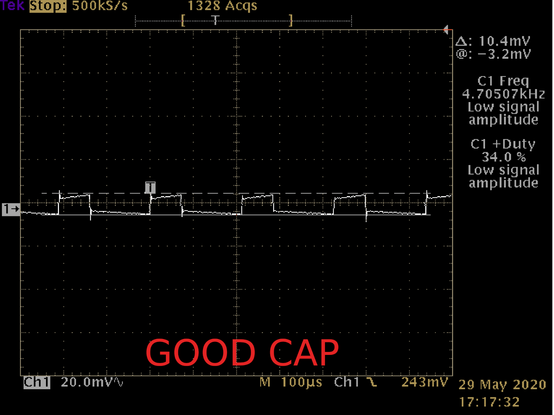
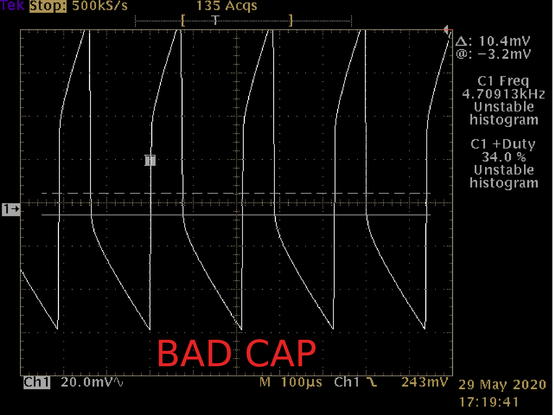
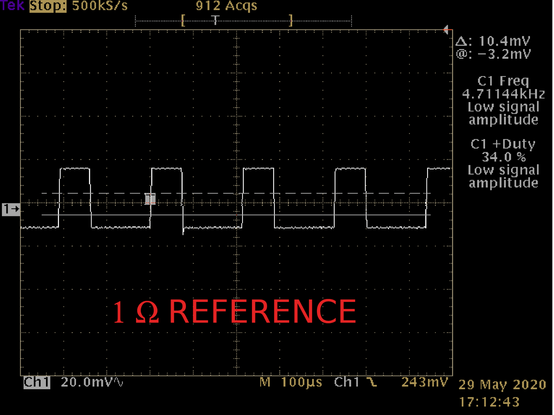
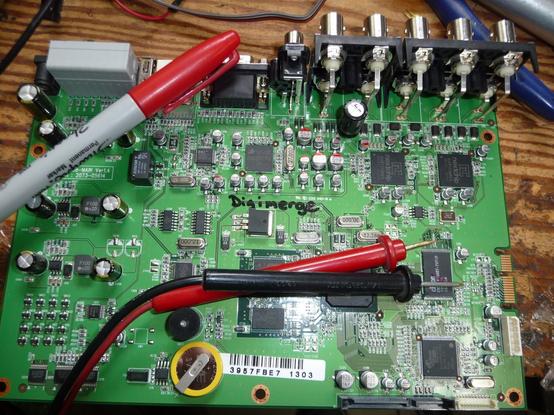
Do you life activities include diagnosing bad capacitors on circuit boards? Take the time to build an in-circuit capacitor tester and stop needlessly replacing caps that are fine! It takes just seconds to go thru a board and identify all the bad caps!

http://ruemohr.org/~ircjunk/circuits/captester.jpg

@RueNahcMohr here's my in circuit ESR checker.
https://webshed.org/projects/in-circuit-esr-meter/

Works quite nicely.

An in-circuit Equivalent Series Resistance meter

An Equivalent Series Resistance Meter Some time ago I was trying to repair a switched mode power supply (SMPS) in my oscilloscope. I’d been quoted £800 for a new PSU, so trying to fix it first was well worth my while. It’s pretty common for electrolytic capacitors to develop faults in an SMPS; specifically they develop an higher than normal internal resistance. So while the capacitor may hold a charge and measure as the correct capacitance, it will not behave correctly in a filter or PSU circuit. The ESR of a large high voltage, high capacity electrolytic capacitor should be fractions of an Ohm, smaller capacitors have ESRs of a few Ohms typically. As the capacitor degrades in use the ESR can easily climb to several hundred times the normal value, while exhibiting no changes to voltage and capacitance ratings Suspecting the capacitors, and not having a way to measure their series resistance, I set out to design and build an ESR meter.

@dtl @RueNahcMohr Oh, I like this, I wonder if you could delete the diodes, alter the amplfier to noninvering, add CMOS switch controlled by the oscillator and get synch demodulation to drive the meter with a passive RC filter to smooth dc. Might need a buffer. Using the switching "rectifier" would probably help linearise the meter scale at the lower end. Might be better still to switch to something that could deal with the "zero" signal and subtract it. Or not. I've not had enough tea so I could be spouting even more nonsense than usual

@synx508 @RueNahcMohr I did come up with a way to linearise the low end, and promptly forgot it. It's useful for a quick check rather than being a proper measurement device, there's always room to improve it.
@dtl @RueNahcMohr with a rail to rail op-amp could likely do linearising with a "precision rectifier" circuit, only one more op-amp and I tend to buy twin packages anyway. I might give that a go with a mcp6002. Now I'm thinking it would be nice to have multiple frequencies and some of what Rue's circuit offers. This is why I never end up building a capacitor tester…
@dtl @RueNahcMohr Well, I will start with the exact thing, except the 10μF coupling capacitor which I have inserted with what I reckon is the correct polarity.

@synx508 @dtl

I still like to be able to see the waveform so I can distinguish RC slope from the ESR shift... Aside from a DSP I'v not figured that one out.

@RueNahcMohr @dtl Yes, I can see it could tell you a little more than a scalar measurement. I like the idea of a small dedicated tester, though. I spent much of the day trying to find my box of panel meters and it still hasn't appeared, more updates when I find them.
@RueNahcMohr @dtl Found the largest and least appropriate meter first. Not far off 10 minus 1 division per 0.5Ω from 0 to 3Ω