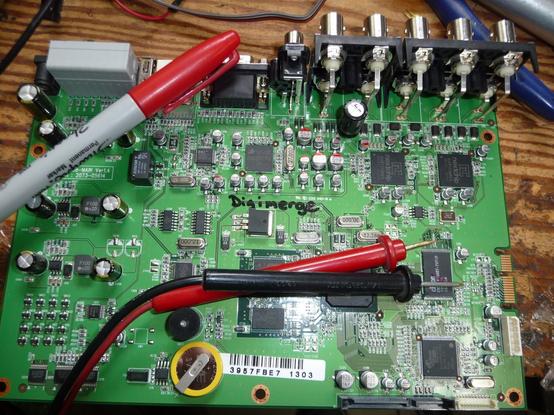
Do you life activities include diagnosing bad capacitors on circuit boards? Take the time to build an in-circuit capacitor tester and stop needlessly replacing caps that are fine! It takes just seconds to go thru a board and identify all the bad caps!
http://ruemohr.org/~ircjunk/circuits/captester.jpg

@RueNahcMohr do you have a theory of operation statement? It is not apparent to me how this can identify a bad cap in parallel with a bunch of good caps. Or is that not what "in circuit" means? Or am I missing something?
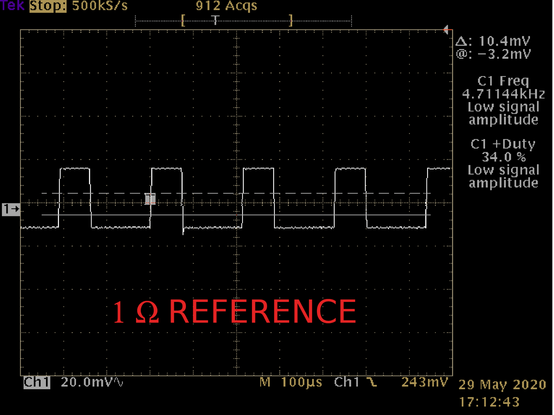
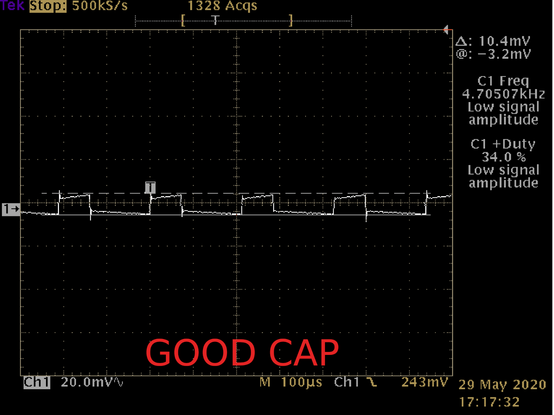
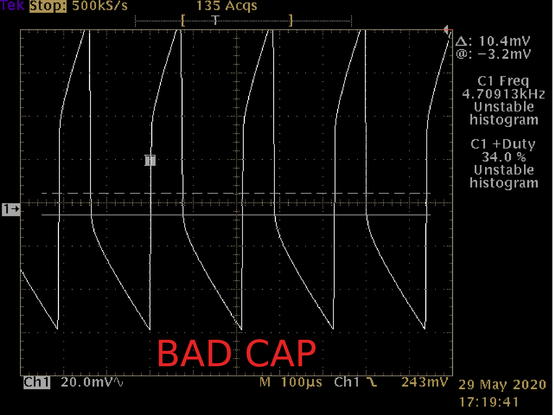
@poleguy The primary parasitic in a capacitor is plate resistance. As a capacitor gets worse, the resistance (ESR) gets MUCH worse. By applying a square wave current to the capacitor, you can see an instantaneous change in voltage thats proportionate to the ESR. The slope is irrelevant, look at the amount of instantaneous shift.

@RueNahcMohr Thank you for elaborating. I think I understand the expected waveform with good/bad ESR if we are looking at a _single_ capacitor.

However, if there are two capacitors in parallel and only one is bad, I would expect to see the same waveform irrespective of which capacitor I probed, right? So then I would still have to pull one out of the circuit to know which of the two was bad? Or am I still missing something?

@poleguy yes, it doesn't work well for large clusters of paralleled caps. but in that situation, you usually already know their bad.
Its that little 4.7uF 50V in the corner that the bootstrap supply relies on that you need to know about.