
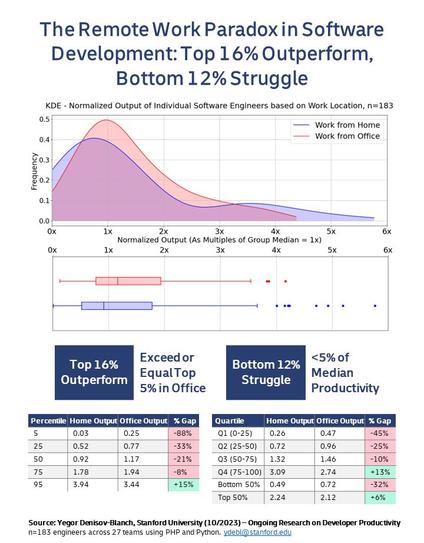
The datapoint that the top 16% of remote workers outperform the top 5% in-office while the bottom 12% of remote workers underperform the bottom 5% in-office seems intuitive.

If you’re a top performer then gaining 1-2 hours a day from not commuting makes you more productive. If you’re the kind of person who needs help to get the basics done, then being on Slack versus in the office is worse.

RTO is penalizes top performers due to underperformers not being able to handle the freedom.
@carnage4life I wonder how best to handle the underperformers. Do they need more support, more training, better mentorship? Or should they be let go so they can find more suitable jobs? A caring society would have a government department empowered to help them. #Caringism

@dan613 @carnage4life It’s slightly more complicated than that. Managing remote teams, and especially remote workers still learning the ropes, requires a certain skill set (and to a lesser extent appropriate policy and procedures). Some managers work on these skills and use them effectively, others don’t.

So certain workers may perform better while remote if they have managers who can actually handle remote teams.

1/2

@dan613 @carnage4life Workers need the appropriate skill set to be productive while working remote too!

This isn’t to say that some people aren’t just better at managing themselves than others. Some people really need to be in the office for at least a couple days a week.

2/2

@carnage4life

Leaving aside the question of how performance is measured, which is a weird concept with many flaws: I'm intrigued by the very low performers, who again do better from home than in the office.

@passenger @carnage4life There are a number of possible explanations for this, like neurospicy people being less stressed and more focused when working at home.

@MisuseCase @carnage4life

That's a good point. My experience of working with neurospicy people is that they're usually high performing, but that may simply be because of my field.

@carnage4life I would suggest that the top performers don't necessarily gain extra work time by not commuting, they are more productive because they aren't being interrupted as much when they work from home.

on the other hand, some of those interruptions are from junior engineers (the under performers) asking for help, and the benefit to the team of that easy communication is a net positive.

@carnage4life I've been on both sides of this. My company started WFH when I was working in a role I was not comfortable in, and frankly, I felt lost and thankful that I was due to rotate to a different position. By the time I got up to speed on the new role, I was able to knock out more work than I ever could before now that I didn't have to spend time commuting or on random distractions.
@carnage4life n=183 is not a very convincing study size but yeah, not surprising.
@carnage4life Perhaps but also different people have different needs- I was a good developer but needed the social aspect to care. Completely agree for the need for in person support for less experienced or struggling workers
@carnage4life I would not be surprised if the DOGE mandated work-in-office-or-else produces a net LOSS of efficiency in the US economy. The restoration of cars and fuel spent by commuters will be appreciated by the sort of corporations that gave most to the Hump campaign.
@carnage4life we've all been underperformers at some point in our careers.