 Robert Naumann
 Mars Buttfield-Addison 🛰
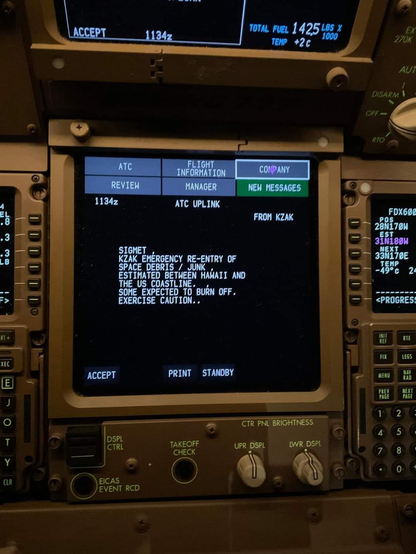
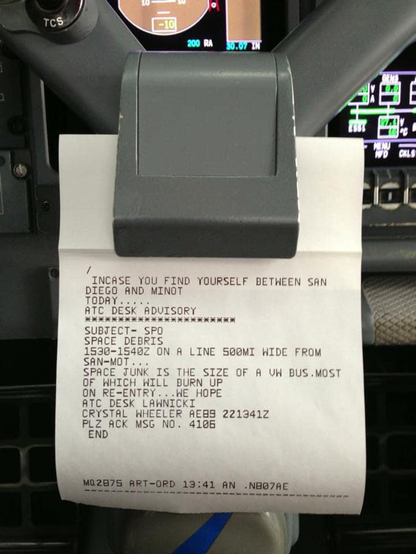
Pilots on Facebook are sharing stories + images of #SpaceJunk breakups and alerts they have seen. Surreal that this is seemingly a regular occurrence in #Aviation now.
@StarkRG @RedstoneLP2 @admin @TheMartianLife
☠️ The brutal reality:
IF something from Space X burning up in the atmosphere was to take out a plane, a big plane with over 200 souls on -board, people would freak out, Elon would do literally nothing (except maybe tweet), WE would all do nothing, then it would go back to business as usual.
Right?
@clintruin
Not to defend Musk, but the chances of that happening are so miniscule that i don't think it would justify any action. You're in way more danger crossing a suburban street.
SpaceX is only the launch provider for most large satellites at this point, starlink sats are super tiny and very likely to burn up. Second stages can hit the ground but mostly have predictable ground tracks. Those are the most likely to cause problems, not satellites.
@StarkRG @RedstoneLP2 @admin @TheMartianLife
@rbos @StarkRG @RedstoneLP2 @admin @TheMartianLife
My point had NOTHING to do with the "chances of that happening".
My point had everything to do with the reaction --not just of Musk -- but also the general public...
No matter how "miniscule" the possibility of an actual occurrence.
Hence my giant IF at the beginning of the post.
@TheMartianLife well, but the risk of getting hit while in the air is similar to getting hit while on the ground
so… not that high
only they move a relatively large thing that maybe COULD be agile enough to evade
IDK… this probably would be the last thing I'd worry about if flying?
@drazraeltod I’d not worry about it, no. The odds of an incident are so minor.
That said, I would imagine their odds of being hit are slightly higher than the ground. To get hit on the ground, something has to have de-orbited over land, made it to the ground, and hit specifically you. To get hit in the sky you could be over the ocean (where we deorbit things), hit anywhere on the aircraft (which has a large footprint), and up high (where more pieces could be intact).
Also a passenger airline will absolutely not be logistically able to manoeuvre so fast, even if the frame where capable and they had warning. These memos are less a warning to do something about and more an “if you suddenly explode or depressurise, this was why”.
@xaphania @TheMartianLife you might be surprised at how sporting an airliner can be when push comes to shove
but you can't dodge a hypersonic blob of molten metal
"Exercise caution. The junk is speeding at you from above so I'll be fucked if I know what exercising caution would even look like but yeah, exercise caution"
@TheMartianLife oh wow! I'm also in the field of space traffic and #spacedebris and this is so cool (as a proof). I've never seen it before.
Big ass problem what we're getting up there
@caeruleus657 “dark and quiet skies” are more the domain of the astrophysicists and space weather people I work with. My actual job is to operationalise atypical systems to collect SSA data for Australia, because there aren’t enough dedicated sensors in the southern hemisphere to keep as good a track of things as we’d like.
I worked a bit with dedicated and passive arrays when interning and contracting, and I’ve done some dedicated real-time backend stuff for some of our telescopes down here that do launch and mission support for NASA/ESA, now I’m mostly working on very high-frequency astro telescopes looking at feasible ways to design and performance test “commensal” SSA systems that other VLBI instruments can just follow to collect SSA data for free without changing their busy observation schedules.
We know these telescopes catch satellites incidentally all the time, so I’m looking at the performance trade-offs of the approach where you pick satellites out of data collected for other reasons. So the transmission or reflection might be coming from outside the primary beam, or caught by some antenna and not others, or way below the noise floor before integration but correlation will scrub it entirely. The goal is to figure out in a comparable way how much worse all that is versus the benefit of being able to collect data all the time.
@TheMartianLife “exercise caution”
That’s as helpful as a roadsign “possible rock slides” 🙄
Have you seen this? But trigger warning. It might make you want to yell.
@TheMartianLife polluting earth was not enought.
Space is now full of junk.
You want to put a staellite up there, you need to fire a rocket first to make some space.
 Marc
Marc RedstoneLP2
 Seris
Seris 

 StarkRG
 Kid Mania
 Rob Bos
 Cegorach
 Riku Mattila
 Keith 🇦🇺
 kæt
kæt nicki xaphania mouse 🐁
 Slyence
 AlisonW ♿🏳️🌈♾️
 🔶Mark Nicoll 3.5%🏴🇬🇧🇪🇺🇺🇳
 Tim Ward ⭐🇪🇺🔶 #FBPE
 Nonya Bidniss 🥥🌴
 Jaap Zeldenrust
 Methylzero
 vxo
vxo Kevin Karhan
 Bill Freedman
 Les capsules du prof Lutz
 Jay 🇺🇦
 Tobias Klausmann
 chris overcash
 Pepijn Schmitz
 bitzero
 Jim Luther
 Daniel
 🌲🧿 "Max"t💽d🏵️n 🔎🍄
 DoomsdaysCW
 Dr. Alissa, Turbo-Nerd
 Possumantha
 Eva Chanda
 Farce Majeure
 Covidiocracy
 Ismael Olea
 Vincent 🌻🇪🇺 en 🌹☘️
 T_X
T_X Ian K Tindale
 Andreas Brunthaler
 Dr. Jürgen Knödlseder
 pjɛʁ-səlim
 Alexander Janßen
 Ben Zucker 🍰
 Carly Sagan