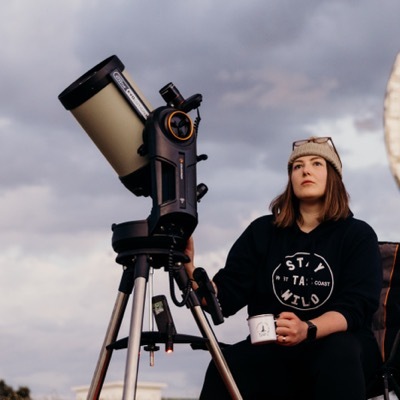
 Mars Buttfield-Addison 🛰
Pilots on Facebook are sharing stories + images of #SpaceJunk breakups and alerts they have seen. Surreal that this is seemingly a regular occurrence in #Aviation now.
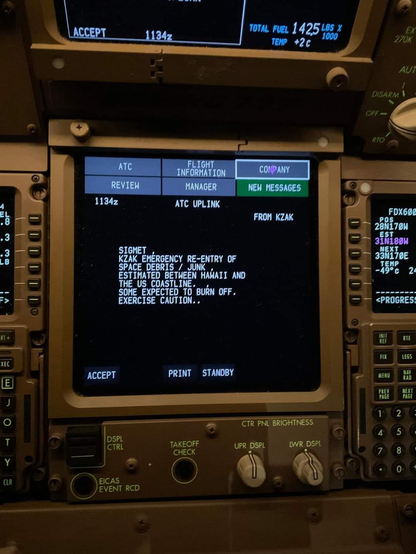
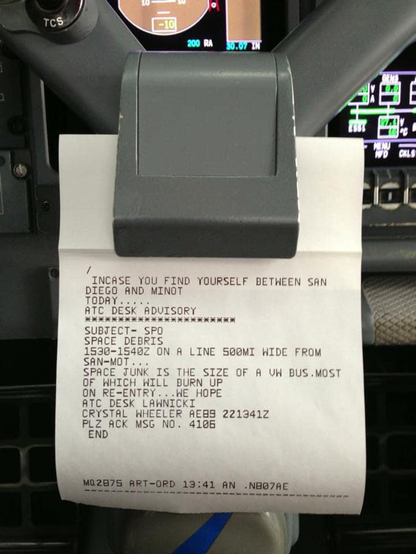
@TheMartianLife oh wow! I'm also in the field of space traffic and #spacedebris and this is so cool (as a proof). I've never seen it before.
Big ass problem what we're getting up there
@caeruleus657 “dark and quiet skies” are more the domain of the astrophysicists and space weather people I work with. My actual job is to operationalise atypical systems to collect SSA data for Australia, because there aren’t enough dedicated sensors in the southern hemisphere to keep as good a track of things as we’d like.
I worked a bit with dedicated and passive arrays when interning and contracting, and I’ve done some dedicated real-time backend stuff for some of our telescopes down here that do launch and mission support for NASA/ESA, now I’m mostly working on very high-frequency astro telescopes looking at feasible ways to design and performance test “commensal” SSA systems that other VLBI instruments can just follow to collect SSA data for free without changing their busy observation schedules.
We know these telescopes catch satellites incidentally all the time, so I’m looking at the performance trade-offs of the approach where you pick satellites out of data collected for other reasons. So the transmission or reflection might be coming from outside the primary beam, or caught by some antenna and not others, or way below the noise floor before integration but correlation will scrub it entirely. The goal is to figure out in a comparable way how much worse all that is versus the benefit of being able to collect data all the time.
 Daniel