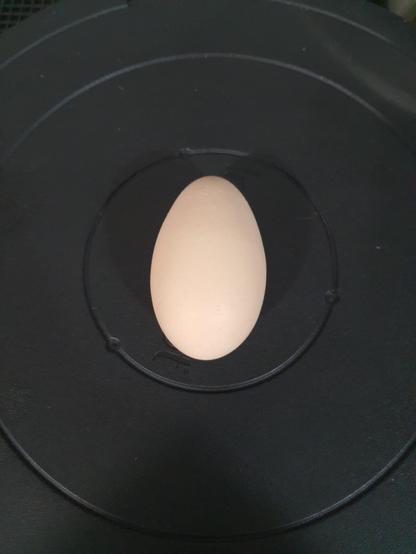
It may be an insidious, centrist plot to downplay the tension between Big-Endians and Little--Endians.

I think they're:
(1) cutting eggs in half
(2) glueing round ends together to make new double-round eggs.
This implies that somewhere there's a population of double pointy ends...
Where's the investigative journalism when you need it?
@retrosponge @riggbeck @helenczerski
That's right
@burtyb @helenczerski Count me in!
Perhaps this is because the eggs sold tend to get bigger?
highly recommend shining strong light through it to find the air bubble , LED-Flashlight/torch or the light form your smartphone works best I find
@jkanev @Kultanaamio @_maleficentgirl @helenczerski
Even better I cook hard boiled eggs by covering them with cold water in a pan. Bring it to a boil. Turn it off and let it sit for a half hour.
@jkanev @Kultanaamio @_maleficentgirl @helenczerski
If you want to boil them, you need water. So just dip them in cold water. The side with the bubble tends to get up. The older the egg the more. If it swims it's spoiled.
@helenczerski @helenczerski My armchair "research" suggests that shape apparently [1] varies between species/breeds and, presumably irrelevantly here, the sex of the embryo [2]. As rounder eggs seem to be more robust, there may be a commercial advantage to selecting for them [3]. The weirdness of that is presumably a matter of conscience.
[1] https://www.sciencedirect.com/science/article/abs/pii/S0260877407004633
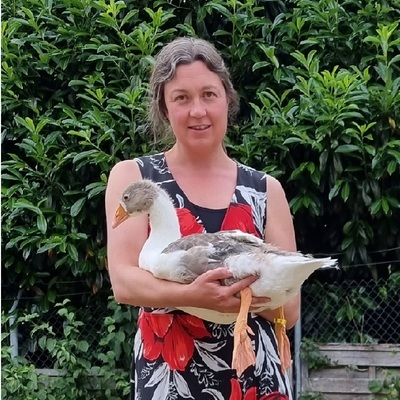
@wibble @helenczerski FWIW I would seriously question reference [2] here. Sex determination of birds pre-incubation is a strong interest of mine due to breeding pet geese, and I've never heard of the "egg shape index". If it was that well established, commercial hatcheries would certainly be using it, and they are not.
I know it's in Nature and all, but this is at most very early-stage science.
However, all my individual geese lay recognisably different-shaped eggs.
@solar_chase @helenczerski The length-breadth index of eggs has been cropping up academically (grading's more subjective) since 1914, apparently thanks to Maynie Rose Curtis. It's been called the Egg Shape Index since the 1940s, though it's also been called eccentricity, ovality etc., which doesn't help.
The chick-sex relationship (also in ducks, but not afaik geese) seems to exist, but no more reliably than anything else [4] so I'd not expect rapid adoption.
Numerous researchers and institutions have been developing in ovo sexing technologies to improve animal welfare by identifying male embryos in an early embryonic stage and disposing of them before pain perception. This review gives a complete overview of the technological approaches reported in papers and patents by performing a thorough search using Web of Science and Patstat/Espacenet databases for papers and patents, respectively. Based on a total of 49 papers and 115 patent families reported until May 2023 worldwide, 11 technology categories were defined: 6 non-optical and 5 optical techniques. Every category was described for its characteristics while assessing its potential for application. Next, the dynamics of the publications of in ovo sexing techniques in both paper and patent fields were described through growth curves, and the interest or actual status was visualized using the number of paper citations and the actual legal status of the patents. When comparing the reported technologies in papers to those in patents, scientific gaps were observed, as some of the patented technologies were not reported in the scientific literature, e.g., ion mobility and mass spectrometry approaches. Generally, more diverse approaches in all categories were found in patents, although they do require more scientific evidence through papers or industrial adoption to prove their robustness. Moreover, although there is a recent trend for non-invasive techniques, invasive methods like analyzing DNA through PCR or hormones through immunosensing are still being reported (and might continue to be) in papers and patents. It was also observed that none of the technologies complies with all the industry requirements, although 5 companies already entered the market. On the one hand, more research and harmony between consumers, industry, and governments is necessary. On the other hand, close monitoring of the market performance of the currently available techniques will offer valuable insights into the potential and expectations of in ovo sexing techniques in the poultry industry.
You're holding that egg upside down
Silly!
Everybody know those are free range eggs. Unsedentary (is that a word?) chickens don't allow their eggs to settle.
You'll find the most round eggs come from those health nut chickens who are joggers.
@helenczerski Eggs, have they changed or have I? 🤔
(apologies to Richard Herring)
@helenczerski It's Bill Gates and Big Poultry at their shennanigans again!!
All I have noticed is that at Tescos, a box of medium free-range now seems to contain what I'd previously call "small" eggs.... But you know, Every little excess profit helps!
@helenczerski Oops. I double checked with a real egg in a jug and It’s the rounded end that has the air sac.
If nothing else I have demonstrated the value of practical science.
🤭
@helenczerski The poor chickens!
Problem of breeding for battery hens? I only buy free-range local eggs and they are still big-endian/little-endian.
Swift would be shocked.
@helenczerski I'm not a farmer or anything like it. But I know eggs are soft when they, um, come out? So pointed eggs would imply that the chickens had to, how can I put this? Squeeze.
Perhaps this is just better healthcare in battery farms. Or bigger chickens (but the same size eggs)?
@helenczerski I don't want to eggsacerbate the situation, but this is taking things to the eggtreme.
We all need to stand firm and declare an oeuf is an oeuf,