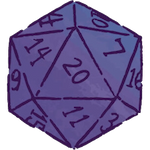
I've been meaning to make an updated version of this for a while so here it is, every numerically-balanced d20 layout!

Feel free to share, especially with any dice makers you think may be interested!

There is a more detailed explanation video by @henryseg for The Dice Lab (which use layout C, if you're curious!) https://youtu.be/Nh2H_4g6evc

#dice #ttrpg #DnD

- YouTube

Enjoy the videos and music you love, upload original content, and share it all with friends, family, and the world on YouTube.

Some additional notes if anyone is curious:

I've also seen layout C on Role 4 Initiative dice (I fully recommend their sets with larger numbers and the 'arch d4's)

I know these are all the numerically balanced layouts because I ran an exhaustive computer search a few years ago. If your d20 doesn't match a layout above, it's not fully numerically balanced.

A die without this kind of layout isn't necessarily unfair! A perfectly formed d20 would be fair whichever faces the 1 to 20 numbers are on

And a key point I think is very important (and you're welcome to relay it to your DM if they get mad at you for dice that aren't numerically balanced or are even spindown/counter dice):

Dice don't usually need to be so fair! In most cases it is fine so long as they are fair *enough*.

Especially with RPGs, the point isn't perfectly balanced competition, the point is to have fun and come up with a good story. Almost any die is good for that!

additional (absurdly nerdy and pedantic) point:

These layouts keep biased dice more fair by having their average rolls be as close to the expected value as possible.

A fair d20 rolls 10.5 on average, a biased d20 with these layouts rolls 10.5 on average (unless the bias is HUGE)

But that doesn't mean the biased die is now equally likely to get any number from 1-20, it still lands on some faces more often, those faces are just less likely to be always a help or a hinderance.

And depending on the game system you are using, the biased die may still be more likely to give positive or negative results, especially if it has many re-rolls, discarded values, or non-numerical meanings that aren't balanced (eg, four crit successes with only one crit fail - the system itself is skewed but a biased die could skew it more/less for an individual player)

Before I forget, reflected layouts are the same but mirrored in 3D (you can't just flip the 2D net!).

So layout R(C) is what you would see if looking at layout C in a mirror, which I have a photo of!

(the reflection has R(C) layout, but obviously the labels also appear flipped, because, mirror)

hmmm, maybe you *can* just flip the 2D net now that I think about it. It wouldn't look the same as above but it would make a rotation of the reflected layout... I think?

tbh I'm starting to get tired and don't want to share misinfo so I'll stop adding to this thread here. Everything but this point I'm super confident about though. 👍 

okay, awake Sophie is thinking clearly, you CAN just flip the net to get a reflected layout.

I've made a new image to be clearer about this (the original is still not wrong, it's just that the reflected nets shown are also rotated - which makes no difference to the layout but is an unnecessary complication for understanding)

@Sophie Flipping is the same as mirroring.

@Sophie I've stared at this long enough and rotated enough shapes in my head to convince myself that:

any mirroring of C produces R(C). It's 'upside-down' but the 1-5-14-18-15 corner is preserved

whether that rolls fairly is going to come down to number etching divot depth

@Sophie Video game where you use dice. All the dice have specific biases you can figure out over time. You can buy and trade dice to optimize your build.

@Sophie recently saw a clip about the usefulness of "emphasis dice" - you replace 18 and 19 with 20s, but also replace 2 and 3 with 1s. They were saying that more frequent critical successes and fails can be a fun way to add tension to extra impactful moments.

Unfortunately I only listen to TTRPG content and don't have a group (yet) so I'm curious what you think of that!

@fletchmakesstuff I think that is cool tbh! It might make some things a little less "crunchy" which might disappoint some players, but if the group is happy with it then it's a great tool to have in the pocket. (Though I am also a person who doesn't play often these days, so, grain of salt!)
@Sophie @henryseg show us an evil unbalanced dice

@Stellar tbh I don't think I have any less balanced d20s that don't use the standard (apart from some gamescience ones, and I don't have the energy to check the math on them rn)

But, how about a gamescience d12 with one half as unbalanced as numerically possible?

@Stellar (technically, a d12 layout can't be balanced in all the ways a d20 can, but this one for sure is almost as bad as it could be without adding extra '1's.)
@Sophie @henryseg very cool! does the adjacent-faces make up for any discrepancies in weight from removing material to make the digits?

i've long wondered if e.g. "18" removing more weight than "1" had any effect

@tomasekeli honestly it's not something I thought about when working on the problem. I think the discrepencies are almost always negligable and if it truly matteredwe would be doing what casino dice do; filling the pips/numbers with a material of the same density as the rest of the die.

That said, any shift to the center of mass made by void space of the numbers shouldn't change the die's overall average roll if using this layout.

@Sophie @henryseg @3psboyd are you using one of these layouts?
@fencepost my dice app uses layout A by default for icosahedral dice.
@Sophie I pinged Matt Boyd because he's started making and selling dice, many of which have things in them.
@Sophie @henryseg This paper https://www2.oberlin.edu/math/faculty/bosch/nbd.pdf
claims that one particular arrangement– the one you labeled "c"– is the single most perfect possible. Are they wrong or did they add in an extra requirement that narrows it from 6 to 1?
@60sRefugee @henryseg it’s pretty late for me rn, I don’t think I’ve overlooked anything, but I’ll check tomorrow and let you know :)
@60sRefugee okay so I checked and the six layouts I list share the same properties for numerical balancing that the paper describes (six vertex sums each of 52 and 53, ten face sums each of 31 and 32). As Henry said, their solution wasn’t assumed to be unique, my guess is they just had the search stop once a solution was found, while I went looking for all solutions from the start (after they had proven there was at least one to find, so I already knew I wasn’t wasting my time :) )
@60sRefugee @Sophie I don't think we ever claim that the solution we found is unique, just that it is a solution.
@henryseg @60sRefugee I know I’ve definitely claimed to have found all the working solutions, but I can’t remember where I put the code so it’d take me a while to prove it lol.