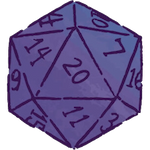
I've been meaning to make an updated version of this for a while so here it is, every numerically-balanced d20 layout!

Feel free to share, especially with any dice makers you think may be interested!

There is a more detailed explanation video by @henryseg for The Dice Lab (which use layout C, if you're curious!) https://youtu.be/Nh2H_4g6evc

#dice #ttrpg #DnD

- YouTube

Enjoy the videos and music you love, upload original content, and share it all with friends, family, and the world on YouTube.

Some additional notes if anyone is curious:

I've also seen layout C on Role 4 Initiative dice (I fully recommend their sets with larger numbers and the 'arch d4's)

I know these are all the numerically balanced layouts because I ran an exhaustive computer search a few years ago. If your d20 doesn't match a layout above, it's not fully numerically balanced.

A die without this kind of layout isn't necessarily unfair! A perfectly formed d20 would be fair whichever faces the 1 to 20 numbers are on

And a key point I think is very important (and you're welcome to relay it to your DM if they get mad at you for dice that aren't numerically balanced or are even spindown/counter dice):

Dice don't usually need to be so fair! In most cases it is fine so long as they are fair *enough*.

Especially with RPGs, the point isn't perfectly balanced competition, the point is to have fun and come up with a good story. Almost any die is good for that!

additional (absurdly nerdy and pedantic) point:

These layouts keep biased dice more fair by having their average rolls be as close to the expected value as possible.

A fair d20 rolls 10.5 on average, a biased d20 with these layouts rolls 10.5 on average (unless the bias is HUGE)

But that doesn't mean the biased die is now equally likely to get any number from 1-20, it still lands on some faces more often, those faces are just less likely to be always a help or a hinderance.

And depending on the game system you are using, the biased die may still be more likely to give positive or negative results, especially if it has many re-rolls, discarded values, or non-numerical meanings that aren't balanced (eg, four crit successes with only one crit fail - the system itself is skewed but a biased die could skew it more/less for an individual player)

Before I forget, reflected layouts are the same but mirrored in 3D (you can't just flip the 2D net!).

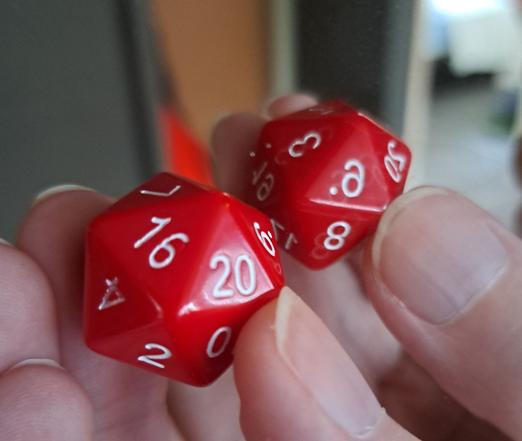
So layout R(C) is what you would see if looking at layout C in a mirror, which I have a photo of!

(the reflection has R(C) layout, but obviously the labels also appear flipped, because, mirror)

hmmm, maybe you *can* just flip the 2D net now that I think about it. It wouldn't look the same as above but it would make a rotation of the reflected layout... I think?

tbh I'm starting to get tired and don't want to share misinfo so I'll stop adding to this thread here. Everything but this point I'm super confident about though. 👍 

@Sophie I've stared at this long enough and rotated enough shapes in my head to convince myself that:

any mirroring of C produces R(C). It's 'upside-down' but the 1-5-14-18-15 corner is preserved

whether that rolls fairly is going to come down to number etching divot depth