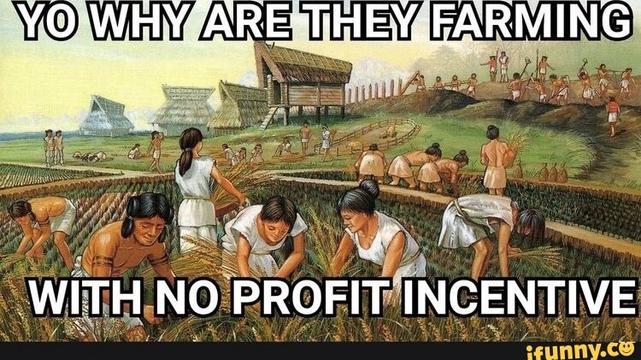
Thread: the spread of agriculture and the rise of the state.

You have probably heard some variation of this argument:

“Humans are bad in some way—violent, rapacious, hierarchical, etc—because bad social structures outcompete good social structures.”

Violent societies outfight and conquer peaceful societies. Agricultural societies outbreed and swamp non-agricultural societies. Hierarchical societies mobilize more labor and resources and bludgeon egalitarian societies. It’s a sort of folk-Game Theory argument that’s quite popular in certain misanthropic circles, especially among people who enjoy feeling holier-than-thou without explicitly resorting to racist myths or social Darwinism.

1/12

Consider in particular Jared Diamond’s argument that agriculture was “the worst mistake in the history of the human race.”

“As population densities of hunter-gatherers slowly rose at the end of the ice ages, bands had to choose between feeding more mouths by taking the first steps toward agriculture, or else finding ways to limit growth. Some bands chose the former solution, unable to anticipate the evils of farming, and seduced by the transient abundance they enjoyed until population growth caught up with increased food production. Such bands outbred and then drove off or killed the bands that chose to remain hunter-gatherers, because a hundred malnourished farmers can still outfight one healthy hunter. It's not that hunter-gatherers abandoned their lifestyle, but that those sensible enough not to abandon it were forced out of all areas except the ones farmers didn't want.”

A variation on this is Stephen Hawkings’ warning about meeting alien species: “If aliens ever visit us, I think the outcome would be much as when Christopher Columbus first landed in America, which didn’t turn out very well for the Native Americans.”

https://www.discovermagazine.com/planet-earth/the-worst-mistake-in-the-history-of-the-human-race

2/12

The Worst Mistake in the History of the Human Race

The advent of agriculture was a watershed moment for the human race. It may also have been our greatest blunder.

Discover Magazine

In response to this claim, let’s take a look back to the spread of agriculture into Europe starting about 9,000 years ago. Most of Western Europe was, at that time, populated by a community that geneticists have creatively dubbed “Western Hunter Gatherers.” These people—dark skinned and light-eyed—hunted and fished and foraged, preferring woodlands and the edges of wetlands and bodies of water.

Archeologists wondered for a long time if agriculture spread by adoption—if these foragers took up farming. But, thanks to genetic studies, we now know that agriculture spread into Europe mostly by migration as early farmers from Anatolia migrated first into what is now Greece and then into the rest of the continent.

These Neolithic farmers brought with them cereal crops, like wheat, and domesticated animals, like cattle, that had originated in the ancient Near East. They resembled modern Sardinians, the modern community with the highest percentage of these Neolithic farmers among their ancestors.

(Basically, if you have ancestors from Europe, your ancestors almost certainly included people from both of these foragers and these farmers.)

These two communities, rather than clashing, co-existed with each other throughout Europe for thousands of years. They sometimes interbred, but for the most part they left each other alone, each preferring very different environments.

https://www.nationalgeographic.com/history/article/ancient-face-cheddar-man-reconstructed-dna-spd

3/12

Britain's Dark-Skinned, Blue-Eyed Ancestor Explained

Thanks to technological advances, scientists can see ancient DNA in new detail.

At the Blätterhöhle cave in what is now Germany, researchers found the remains of three different ancient communities.

The first were hunter-gatherers, based on both their genomes and the stable isotopes in their teeth and bones, which revealed a diet of wild game. The second group also belonged to the same genetic population as the first, but ate a diet heavy in freshwater fish. And the third were agriculturalists, descended primarily from those Anatolian farmers but with some hunter-gatherer ancestors as well. This last group ate a diet heavy in domesticated animals.

So three very different communities, with different but overlapping ancestries and very different ways of life, lived side-by-side, sometimes intermarrying, and using the same cave to bury their dead. And, based on radiocarbon dating, they continued to do so for 2,000 years after the arrival of agriculture.

It’s hard to square 2,000 years of co-existence with Diamond’s Just So story about the inexorable and mechanical expansion of farming at the expense of hunter-gatherers.

https://www.researchgate.net/publication/257648697_2000_Years_of_Parallel_Societies_in_Stone_Age_Central_Europe

4/12

In Britain, agriculture arrived about 6,000 years ago with those Neolithic farmers. As at Blätterhöhle, they intermarried with the local hunter-gatherers, eventually absorbing that community.

But, several centuries after agriculture arrived, the evidence for farming starts to drop off in the archeological record and doesn’t reappear for almost another thousand years. Chris Stevens and Dorian Fuller argued in the journal Antiquity in 2012 (sorry, no full text link) that “cereal cultivation was abandoned throughout many parts of the British Isles in favour of increased reliance on pastoralism and wild resources during the Middle to Late Neolithic.”

People seem to have abandoned the growing of crops like wheat in favor of gathering wild hazelnuts, the shells of which show up in large quantities at sites throughout this period, and herding domesticated animals. Stevens and Fuller note that this period also coincides with population decline, which they suggest was driven by a worsening climate but which I wonder might not have been a product of the plague (genetic evidence for which shows up all across Europe around this time).

But the authors also note that this is the period during which monumental stone architecture, like Stonehenge, was constructed. So clearly the people of Britain were still able to coordinate and mobilize for massively complex undertakings, even if they had abandoned agriculture for a long while. It’s hard to square a thousand-year abandonment of agriculture by a sophisticated and energetic society with a teleological story about agriculture’s inevitable advance and structural advantages over foraging.

https://www.cambridge.org/core/journals/antiquity/article/abs/did-neolithic-farming-fail-the-case-for-a-bronze-age-agricultural-revolution-in-the-british-isles/DDC019088534FB8D35AF356D346842E1

5/12

Did Neolithic farming fail? The case for a Bronze Age agricultural revolution in the British Isles | Antiquity | Cambridge Core

Did Neolithic farming fail? The case for a Bronze Age agricultural revolution in the British Isles - Volume 86 Issue 333

Cambridge Core

Stevens and Fuller note a host of other examples in which societies abandoned agriculture but still mobilized labor and resources for monumental projects:

“…the shift away from settled agriculture towards mobile pastoralism, characterising much of peninsular India from the end of the Chalcolithic (1200–900 BC)…”

“In the Gansu region of north-west China, the Dadiwan Neolithic pursued low-level millet cultivation for five centuries or more during the sixth millennium BC, before apparently fading away, with a hiatus of more than five centuries prior to the influx of more permanent millet-pig agriculture associated with the immigrant Yangshao tradition.”

“A further case is seen in the shift from sedentary agriculturalists to nomadic-pastoralism in Late Bronze Age Mongolia, associated both with the appearance of stone monuments and possible climatic change.”

In other words, this was a phenomenon that happened not just in Britain but all over the world. People sometimes adopted agriculture, and then their descendants abandoned it, only for their descendants to pick it back up again. Some farmers lived alongside foragers for *thousands of years* without swamping the foragers.

6/12

Something ELSE really interesting happened in Britain after the abandonment of farming. About 4,500 years ago, a new community began migrating into ancient Britain, bringing with them the Bell Beaker Phenomenon.

The Bell Beaker Phenomenon was a sort of archeological package—distinct artifacts, like the bell-shaped cups that give this phenomenon its name, as well as new burial practices. Stevens and Fuller also note that the time period of their arrival also coincides with the re-emergence of agriculture in Britain.

Archeologists debated for years as to whether this represented a population movement from continental Europe or merely the adoption of a new material culture by Britain’s Neolithic population. We now know from genetic studies that there was indeed a migration into Britain, and that it resulted in a near-total population turnover—some 90% of the subsequent ancestry in Britain derived from these Bronze Age newcomers, rather than the indigenous Neolithic community.

https://www.cambridge.org/core/journals/cambridge-archaeological-journal/article/neolithization-and-population-replacement-in-britain-an-alternative-view/128FA814D030CAFCDE3D2F8AE6CC45A7

7/12

Neolithization and Population Replacement in Britain: An Alternative View | Cambridge Archaeological Journal | Cambridge Core

Neolithization and Population Replacement in Britain: An Alternative View - Volume 32 Issue 3

Cambridge Core

Ah-ha! Perhaps here is our evidence for Diamond’s thesis! Newcomers (re)introducing agriculture and overwhelming the non-farmers with their vastly and implacably larger numbers.

Except that, strangely, there’s no evidence for a violent take-over. No mass graves, no battle sites. The skeletal remains found during this period show no increase in injuries that would indicate interpersonal violence. The newcomers intermarried with the indigenous population. The newcomers began using and maintaining the same sacred sites as the indigenous community, including Stonehenge.

Whatever happened during this period, it seems like it was a lot more complicated than Diamond’s conquest story.

https://www.cambridge.org/core/journals/antiquity/article/return-of-the-beaker-folk-rethinking-migration-and-population-change-in-british-prehistory/ABF13307796A0476353FA8D2DA38A21A

8/12

The return of the Beaker folk? Rethinking migration and population change in British prehistory | Antiquity | Cambridge Core

The return of the Beaker folk? Rethinking migration and population change in British prehistory - Volume 95 Issue 384

Cambridge Core

These historical and archeological examples point to a much more flexible, dynamic process than Diamond claimed. There was no one-way process of expansion and conquest. They were not trapped; they did not inevitably conflict with each other because of structural imperatives. People could and did make choices.

So why do we live in a world now in which virtually everyone is fed by agriculture, descended from a global society in which virtually everyone was a farmer?

If we reject Diamond’s teleological argument—that this world of ours was *inevitable*—then I would point a theme from the works of recently-deceased James Scott as a tentative alternative: the state’s obsession with order, predictability, and legibility.

From the earliest states to the present, states have tried to settle foragers and convert them to agriculturalists. Foragers tend to move around, resist authority, and create diverse surpluses. They are, in short, hard to rule, hard to count, hard to conscript, and hard to tax.

But farmers are the opposite: they tend to stay in one spot, close to their crops. They can be associated with fixed locations and discrete units of territory. And they tend to produce—or can be coerced into—regular and uniform surpluses.

https://theanarchistlibrary.org/library/james-c-scott-against-the-grain

9/12

Against the Grain

James C. Scott Against the Grain A Deep History of the Earliest States 2017

The Anarchist Library

In particular, Scott blamed cereal grain agriculture for the rise of states, because cereal grains are uniquely suited for taxation: “visible, divisible, assessable, storable, transportable, and 'rationable.'”

“The fact that cereal grains grow above ground and ripen at roughly the same time makes the job of any would-be taxman that much easier. If the army or the tax officials arrive at the right time, they can cut, thresh, and confiscate the entire harvest in one operation. For a hostile army, cereal grains make a scorched-earth policy that much simpler; they can burn the harvest-ready grain fields and reduce the cultivators to flight or starvation. Better yet, a tax collector or enemy can simply wait until the crop has been threshed and stored and confiscate the entire contents of the granary…”

“The 'aboveground' simultaneous ripening of cereal grains has the inestimable advantage of being legible and assessable by the state tax collectors. These characteristics are what make wheat, barley, rice, millet, and maize the premier political crops. A tax assessor typically classifies fields in terms of soil quality and, knowing the average yield of a particular grain from such soil, is able to estimate a tax. If a year-to-year adjustment is required, fields can be surveyed and crop cuttings taken from a representative patch just before harvest to arrive at an estimated yield for that particular crop year. As we shall see, state officials tried to raise crop yields and taxes in kind by mandating techniques of cultivation…The point is that with cereal grains and soil preparation, the planting, the condition of the crop, and the ultimate yield were more visible and assessable.”

Not only are the products of cereal agriculture suited for taxation, but the farming itself is too. A farmer who works the same plot year year has a fixed “address.” The state knows where they live, what their name is, how much their land should produce each year, and how much it can extract as taxes.

10/12

So I would conclude by proposing this: that the spread and ultimate dominance of agriculture was not some function of agriculture itself, but rather of intentional state violence. Coercing people into being settled, taxable, conscriptable, and *controllable* farmers would also have produced the added benefit of creating a population entirely dependent on a single, easily controlled food supply, rendering us even more docile.

This would explain the transition from agriculture as a flexible option that people sometimes adopted, abandoned, or lived alongside without transforming themselves, into what we live with today—industrial agriculture as the sole source of food for the vast majority of people alive.

This is just a hunch, but one that feels intuitively true. From the Assyrian and Incan Empires to the indigenous reserves of the modern US and Australia, states have always and everywhere been obsessed with settling nomads and transforming foragers into farmers.

11/

@HeavenlyPossum I think this assessment takes a too-dark view of governance. Yes, there are states who use such things to abuse their people, but it's a mistake to reference the worst examples and act as if they are representative. Permanent residence, governance, & taxes can also have benefits such as common defense, infrastructure development & educational advancement. It's not always an evil scheme, and evils are not always limited to agrarian-based power structures anyway. Humans are humans.

@corbin_lambeth

*Governance* is not a synonym for the state, and we’re perfectly capable of doing all those things without state coercion. The state is, always and everywhere, aggression.

@HeavenlyPossum If you're insisting on using "state" with a narrow definition that can only & ever mean coercion & oppression then okay, but that's not the common understanding.

It also seems that you are presupposing your conclusion with such a definition. We don't need any discussion at all about agrarian vs hunter-gatherer structures if we declare that "the state" is oppressive & coercive at the outset. It's making the same mistake (but in the opposite direction) as your interlocutor.🤷🏼‍♂️

@corbin_lambeth

I’m using the term “state” in a specific political science sense. I realize this is not how people tend to colloquially think about the state, but that’s to their own detriment.

I do not declare states oppressive and coercive at the outset, but rather by surveying the history of states, which readily reveals that all of them are always oppressive and coercive. 🤷‍♂️

@HeavenlyPossum You continue making the same mistake of pretending the worst examples are representative. Doubling down on the same doesn't strengthen your argument. If you're not comfortable w/ criticisms of your flawed thesis, then what else can I say? I would nevertheless encourage you to do some reflecting on your own just-so narrative. Because I think you can do better. You see the problem with your opposition. Now turn that rubric to *your* thesis 👍

https://www.britannica.com/topic/state-sovereign-political-entity

State | Definition, History, Figures, & Facts

State, political organization of society, or the body politic, or, more narrowly, the institutions of government. It is a form of human association distinguished from other social groups by its purpose, the creation of order and security; its methods, the laws and their enforcement; its territory; and its sovereignty.

Encyclopedia Britannica

@corbin_lambeth

> “You continue making the same mistake of pretending the worst examples are representative.”

I don’t know how you could infer that I am relying on “the worst examples” when I just referred to surveying the history of all states.

> “Doubling down on the same doesn't strengthen your argument.”

I didn’t “double down” on anything, I explained to you my methodology.

> “If you're not comfortable w/ criticisms of your flawed thesis, then what else can I say?”

Chief, you keep replying to me in response to a thread that I wrote. You do whatever you want but don’t pretend that I’m forcing you to say anything.

> “I would nevertheless encourage you to do some reflecting on your own just-so narrative. Because I think you can do better.”

Thanks for your confidence in me!

“You see the problem with your opposition.”

I don’t, because the entirety of your argument seems to be “not all states are bad” when I know factually that’s not true. 👍

@HeavenlyPossum I guess you *can't* do better. My mistake. 🤦🏼

@corbin_lambeth

Thanks for stopping by to be a condescending asshole

@corbin_lambeth @HeavenlyPossum Give 1 example of a state that doesn't oppress people
@HeavenlyPossum @corbin_lambeth It has been my observation that it is the anarchist reading of the term, and that states tend to prefer their subjects not to know that association.
@corbin_lambeth @HeavenlyPossum I love this weird idea that somehow intentionally harming others and trying to control them in some way like this is not always evil and unacceptable.
@Li
That would be really weird indeed.
@corbin_lambeth that's what governments do though <3
@Li Rolls eyes. Governments also accomplish a lot of good like occasionally protecting vulnerable people and communities or imposing restrictions on pollution. As I've discovered in multiple threads today, anarchists don't have any viable solutions, just bitching about crap we all hate. Must be loads of fun. #muted

@corbin_lambeth sometimes terrible system meant to harm people do good thing omg clearly this makes it okay and excuses everything yes i am very smart

Question how is everything you just said accomplished exactly?

The problem that too many anarchists insist on is their own just-so story that any and all states are evil regimes bent on controlling others. This is simply not the case.

@corbin_lambeth

Which states do not assert control over people?

@corbin_lambeth
well, i currently live in an evil regime bent on controlling others, established a few centuries ago as a genocidal colony by another evil regime bent on controlling others, both of which claim to be the intellectual descendants of a far more ancient evil regime bent on controlling others (which went through like 4 different forms of government while maintaining its own evil-regime-ness)

so that's quite a lot of ambient evil regime particles

@saddestrobots Do you have a viable solution?

@corbin_lambeth @saddestrobots

Professional posters call this “moving the goal post”

@corbin_lambeth
do i have a "viable solution" to what?

the historic observation that i live in an evil regime?

@saddestrobots Do you have a viable alternative to "the state" as you define it?

@corbin_lambeth
i'm just a guy. i can name the stuff that needs to die — and the stuff that is dying already whether we like it or not, the cracks that are already showing which evil regimes will just fill up with fascism in order to try to sustain a failing system — but any better world we build isn't going to be the monolithic product of just my own imagination.

if you want a clear gradual step, we should be moving towards para-states without hard borders or exclusionary citizenship.

@corbin_lambeth
but, here's the thing, too: if you actually want to build a democratic society of any kind, even one that's just a bunch of less-evil states, the anarchist critique is helpful and harmless

at worst it's just a bunch of "you're choosing to do this, you know" — which is exactly what we all should be thinking if we're serious about all this democracy and consent shit

people mostly get mad at anarchists because they really wanna feel that their "evil regime" is necessary and good

@saddestrobots
Sure. That makes a lot of sense. I just don't understand the anarchist hang-up on their just-so definition of "the state." ANY state or system of governance/organization/structure/hierarchy/ or community-ism will still be vulnerable to the same evils within the human heart. Yes, every city or nation state as we have known them fails on some level, but what alternative is there that won't be subject to the same human pettiness & frailties?

@corbin_lambeth
You're pointing it out right now.

>Any state system iof governance/organization/structure/hierarchy

Yeah, you're talking to an-archists. The word comes from no hierarchy. An archy.

It means no governance. Only voluntary actions. It may come in many forms - from markets, through polycentric voluntary federations to full-blown local communes. All of those can be achieved without coercion.

As for how, is by empowering the individuals to the point where they are truly ungovernable. It involves building tools for micro manufacturing like 3d printers and small CNC machines, decentralizing power grid, making people independent through community building - mutual aid, guerilla gardening, arming the vulnerable (read queers with guns) and digital sovereignty - denationalizing money with #cyphercash , strong encryption for everyone, fediverse, anonymization like Tor, open source software and hardware. Also defensive scifi tech that doesn't exist yet, like force fields - changing how the violence scales with numbers of people. If one person can survive an attack of fully armed 100s, the states just collapse.

This is a very short "how". It's not something one person or organization is doing. Anarchists independently push in these directions. If just those listed things are widely spread, the status quo will look much different.

@saddestrobots

@licho @saddestrobots Okay. You guys keep pushing in your little directions and get back to me when it starts working out.
I do like the idealism behind it. I really do. I'm on my own quixotic mission to repeal the second amendment. It's never going to happen, but I keep pushing. So I get it, at least a little bit with anarchists.

@corbin_lambeth
It's a multigenerational project. It's an eternal power struggle, a flow within the system. The results of this work will very likely not be an anarchy but a less fascist status quo. You will however notice our failure and you will notice it very painfully.

@saddestrobots

@saddestrobots Ok. Maybe you can tell me how a para-state evades the trouble you see in a regular state? Can we define problems out of existence? But more importantly, tell me, given the insane rhetoric in our country right now over immigration and "open borders," do you think trying to nudge us towards this evolution you see as a "next step" is workable? Don't get me wrong; I love idealism of a certain stripe, but is it viable?

@corbin_lambeth
it's either that or fascist climate-wars genocide hell — the forces causing people to move around aren't gonna let up, if our evil regime just cleaves to the status quo it's gonna become a lot more evil; and that's just one example

it's not "idealism" to think about more than just what's gonna be in the tv sound bytes next week

what you're advocating is just yelling "a better world isn't possible!" until we get the worst possible world by default

@saddestrobots No, that's not what I'm advocating at all. In fact, I'm not sure I've advocated anything. I'm asking questions, namely, is what *you* are advocating workable? Is it anything more than a pollyanish idealism of "Tear it all down, Man!"? Because most of the time that's what it seems like with anarchists.

@corbin_lambeth
in this thread: people actually enjoyed many of the benefits of agricultural economies long before they were managed by the state, while flexibly mitigating many of the downsides

you: anarchists just want to tear it all down

@saddestrobots Bleh. This fails to connect with anything you and I have been discussing. 🤷🏼‍♂️
@corbin_lambeth Chains can be kinky. That doesn't mean chains aren't chains.

@corbin_lambeth @HeavenlyPossum There are other ways to achieve common defense, infrastructure development and educational. Intersecting and overlapping voluntary democratic associations can supply that.

States are inherently coercive, and due to their massive force it isn't clear how someone could consent to them in the first place