103/ seems to me from reading this and some of the references that the disagreement seems to be “technical”. Krugman seems to agree that the fear of deficits is overblown, but seems to argue that interest rates are another tool to manage possible inflation. Tbh I haven’t gotten the opposite impression yet from the book, but maybe I missed it.

One thing I do wonder about is that if the deficit is in the form of bonds, won’t higher interest rates affect the cost of the accumulated deficit? Wouldn’t the public side now also have to pay more for the accumulated deficit? How does that work?

Maybe I don’t know how any of this works

104/ Also why reach immediately for interest rates? Is it because tax hikes are politically harder to pass? Interest rates seem to bring with them unintended consequences like increased profits for private sector banks and things like rent increases. In an inflationary economy I would think that the poor aren’t those “heating” things up.

105/ she is describing a model for interest rate that I think she is going to argue against. In it there seems to be a mechanism where one imagines that the private sector and public sector compete for loans in the same fixed sized market. And so the public sector deficits are in this model financed by loans in this market. And therefore the increased deficit would then be a significant increase in demand on a finite supply of money. And therefore drive the interest rate up.

But… that’s not how it works? In the real world? The banks increased their interest rates when the central bank did. So this model doesn’t make sense at all to me.

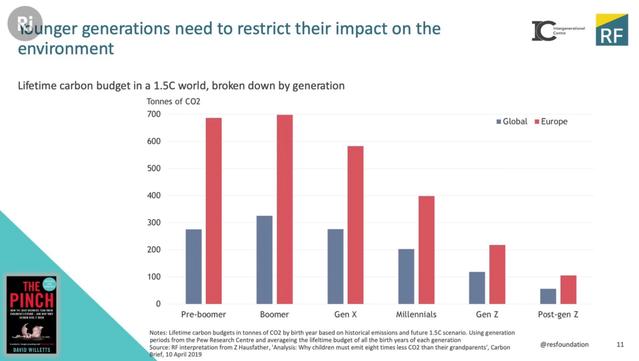
106/ Halfway through this but tbh this is a much more convincing argument for this phenomena than the pretentious colonial-envy drivel by Piketty. Young people are struggling because they are poorer than previous generations.
https://youtu.be/ZuXzvjBYW8A?si=g_1Z9XfgsTpioq2G
(h/t @Di4na)
Have the Boomers Pinched Their Children’s Futures? - with Lord David Willetts

YouTube
107/ I wonder if the distribution he is presenting is the same in other countries. Because according to him, boomers are consuming more than young people right now. And they are doing that from inside of their unmortgaged homes. Meanwhile young people get berated for being poor and are required to reduce their carbon footprint to a fraction (1/7?) of the boomers. Jeez.
108/ omg these numbers are mind blowing. Boomers are absolutely killing it. And young people are so screwed.
109/ Related/unrelated : Piketty pisses me off even more now. Because instead of just presenting the facts, I had to accompany him on his colonialist reminiscence tour. For data that is absolutely meaningless. Interspersed with the only woman he knows the name of, Jane Austen.
110/ if y’all are new here, you can experience my spiraling rage at Piketty’s Capital in that books thread (also linked to in my pinned thread of book threads)
https://social.vivaldi.net/@Patricia/112704863073553929
Patricia Aas (@[email protected])

4/ “Capital in the Twenty-First Century” by Thomas Piketty https://social.vivaldi.net/@Patricia/112681938811222913

Vivaldi Social
111/ oh my, I had forgotten how complete the Piketty-roasting Past Patricia did was 🧨🔥 good for her.
112/ Getting towards the end of chapter 4 (which I skipped earlier) and she’s talking about the crisis with Greece. And I have a question for EU folks: From a lot of these books I have gotten the impression, though maybe they haven’t gone out and said it, that Germany and perhaps France has an outsized influence/control over the Euro monetary policy. Is that accurate?
113/ This speech is very interesting and recent. Only a couple of weeks old. And also here the speaker, Philip R. Lane, member of the Executive Board of the ECB, seems to say that the relationship between growth of the money supply and inflation is not as clear as one used to think. This is very interesting… I think I need to read it more carefully.
https://www.ecb.europa.eu/press/key/date/2024/html/ecb.sp240626~0cdeaedbb1.en.html
Modern monetary analysis

The European Central Bank (ECB) is the central bank of the European Union countries which have adopted the euro. Our main task is to maintain price stability in the euro area and so preserve the purchasing power of the single currency.

European Central Bank

114/ And here from the Congressional Research Service

Deficit Financing, the Debt,
and “Modern Monetary Theory”
https://sgp.fas.org/crs/misc/R45976.pdf

115/ I have read a lot from the aftermath of the financial crisis. And a lot of mainstream economists are all “Listen, inflation is too low, interest rates are also low and employment is high… and according to our models that isn’t possible.” And then they stop there. Can you imagine an actual scientific field that again and again had actual proof their models are wrong yet absolutely zero impulse to go: “ok, looks like this is all bullshit, maybe we should try to figure out how the system/economy actually works”

116/ But one thing I haven’t read much about is this inflation they’re currently fighting with interest rates globally. What do they think caused that? The EU guy didn’t seem to think it had anything to do with the financial measures during the pandemic, but rather fallout from the supply chain breakdown? I really need to read that speech more closely.

For Norway imo imported inflation of 2-3 percent doesn’t really matter when exchange rates mean that imports are 25(?) % higher than a couple of years ago. And I’ve realized that people aren’t distinguishing the two much in the media. But the interest rate hike that they are apparently doing to fight the insignificant inflation is killing households who are struggling with food prices due to the weak NOK.

For real. I don’t get the interest rate hike at all, it seems purely destructive for no reason. It clearly has zero effect on the value of the NOK.

117/ For real, how does this make any sense? Companies costs are increasing because the NOK is historically weak and interest rates shot up, so costs are way up and demand is way down. So their answer is to continue to beat Norwegian households into “submission” because they are already lying on the ground?

“There is uncertainty about the further development of the Norwegian economy. If companies' costs continue to rise rapidly or the krone becomes weaker than forecast, price inflation may remain high for longer than we currently envision. Then the committee is prepared to raise the interest rate again.” (Google translation)
https://www.norges-bank.no/kort-forklart/inflasjon/

Inflasjon

118/ This, however, makes more sense to me.
https://youtu.be/fjoDjv1R3to?si=0jJNF-sEFAdFC8rR
Sellers Inflation [Isabella Weber]

YouTube
119/ Ok, I’m not alone with this feeling. One could’ve taxed corporations that are apparently creating this inflation, but instead we’re going make regular people poorer and/or unemployed. The same people who are struggling with the inflation in the first place. Sounds very Friedman’esque
https://youtu.be/RyIeC21XeLs?si=O7YOGfZd_ETpc8vR
Jon Stewart Forces Economist To Admit Capitalism Screws Us All

YouTube
120/ Chapter 7. “The Deficits That Matter” Is pretty damning tbh, it seems to be mostly about how the US has fallen desperately behind other comparable countries. On all types of metrics, from child mortality to life expectancy.

121/ Finished chapter 7 and 8 and it is pretty clear to me that this is mainly aimed at the US, and seems to be intended as an economic lever to shift the US in a more social democratic direction.

This is her summary of MMT

122/ and tbh I think such a move would be positive thing not only for the US population, but also for the whole planet.

123/ I have been trying to find someone saying what is causing this inflation. And it's weird how little there is to find on this. But I found a page on the national statistical institute of Norway (SSB) talking about inflation in 2023. And it is really funny how they even point out the same feedback loops I've talked about in this thread (plus some more):
- rents are up (increased interest rates are probably a factor)
- imported goods are up (weak NOK is probably a factor)
Other things they brought up was that energy prices had been very high and that those losses were probably also being priced in.

The thing is... That means that we are turning up interest rates partially because we turned up interest rates and partially because our currency is weak and that energy prices were high a year ago. And turning up interest rates is not made to fix any of that.

It is made to cool down an overheated (too much money, too much spending) economy.

But that isn't what the economy looks like. But since they have reduced the entire state of the economy into one number (plus some including this, excluding that numbers), all context is gone and they pull out the same hammer that is part of the reason we got in this mess.
https://www.ssb.no/priser-og-prisindekser/konsumpriser/statistikk/konsumprisindeksen/artikler/kraftig-prisvekst-i-2023

Kraftig prisvekst i 2023

Året vi har lagt bak oss var nok et spesielt år når det gjelder prisvekst. I et historisk perspektiv steg prisene uvanlig mye. I motsetning til året før, da prisveksten økte kraftig for de fleste varer og tjenester som husholdningene kjøper, var bildet litt mer sammensatt i 2023.

SSB

124/ Their whole model is based on the assumption that when prices go up it is because demand is up. But sometimes prices go up because costs are up. And... that is not fucking supported.

I don't know what to say.

125/ Ok, this is fascinating. Norway has one of the largest sovereign wealth funds in the world, right? We’re loaded as a country. But I just read that Norway has debt, which… what? Why? So I had to look it up and unfortunately this Wikipedia page is only in Norwegian. But to me it describes parts of what MMT talks about. That state “debt” isn’t really debt, but largely a technical mechanism to control the money supply. It makes bonds available to buy and buys them back depending on if it wants to grow or shrink the money supply. Am I off base here?
https://no.wikipedia.org/wiki/Norges_statsgjeld
Norges statsgjeld – Wikipedia

126/ Jon Stewart on MMT with Stephanie Kelton
https://youtu.be/0G6obeUKWmw?si=-rW1dPklrdytZCMz
How Do We Fix The Economy? Modern Monetary Theory, Explained | The Problem With Jon Stewart Podcast

YouTube
127/ so back to my radiator system mental model. Question that seems partially answered by the above (which completely breaks with Friedmans model btw) is that the massive accumulation of wealth, on the part of the already wealthy, doesn’t cause inflation precisely because they don’t spend it. So that would, in the radiator system metaphor, mean that you keep on filling water into the system but some of the occupants in the building are tapping out water to fill their indoor swimming pools, or something. The system doesn’t come under massive pressure because of the excess water/money because it is being siphoned out continuously.
128/ I think maybe I should read the book Money by Jacob Goldstein again, because I might read it differently now. Is inflation inevitable when one has money, because I’m not currently convinced that that is true. And I’m very much not convinced that interest rates help. Tbh it seems to me that taxes should remove more money and allow a much more targeted removal. If removing money is actually the underlying problem. It seems to me that there are at least half a dozen very different things that fall into the “inflation” bucket.

129/ Ok, I had an epiphany.

And it’s about all the money that goes to the rich/banks. Where does it go? Because we don’t see it much in the real “normal” economy. (Or at least I thought so)

So what if, when we double or triple the money supply, but only/mostly give it to the rich/banks, we actually see inflation, but we didn’t recognize it as inflation?

What if the goods that got hit with inflation were “Capital” - that is real estate and stocks etc.

What if what we think of as capital gains is actually inflation on rich people stuff?

And maybe when rich people got a lot of money they spent it, but they spent it on rich people stuff?

Like apartment buildings.

And back to Harvey/Marx’ definition of “use value” vs “exchange value” - their money 💰 inflated the “exchange value” of real estate. Which is why nobody can afford a home anymore.

So basically the rich have their own economy, which shares its currency with us. But the stuff they can buy, at the scale they are at, are different things. We would perhaps get a nicer couch or more food if we got a lump sum in our scale (2000$ for example). They buy real estate and stocks at their scale (2.000.000$).

So you don’t see the inflation on groceries, but real estate values go up (or don’t go down).

130/ Which reminds me of a story a guy told me. So his building only had one electricity meter (I’m assuming it’s old), and so they had a practice of splitting the bill evenly between the units. But suddenly they had gotten a massive bill, 10-20x what they usually got. Turns out one of the units had started up a pot farm and apparently this was pulling a lot of energy for heating lamps or something (look I don’t know anything about growing pot). But since they only had one meter they had to split it anyway.

Or in my radiator system metaphor, what if one of the units had connected a pipe to the system and was siphoning off the water into the system next door? It’s a separate system. So our system would have this “weird quirk” where we filled and filled with water/money, but it never became over-pressurized. But if we filled a bit too much on a part of the system that bypassed this guys unit, then we actually saw over-pressurizing on occasion.

However, next door, they had to remove water regularly because it was constantly becoming over-pressurized from the continuous stream of water.

My brain is visual 🤷🏻‍♀️

131/ this theory should be testable, basically go over the cases where they tried to link increased money supply to inflation and instead try to link it to unusually increased capital gains, like increased real estate values and/or stock market increases. Or… a missing drop in capital gains when there should’ve been one.
132/ A lot of what he presents as data supports my theory. Increased money supply leads to almost instantaneous increase in real estate and stocks prices.
https://youtu.be/m4MahOuEdVw?si=gisQblyM__PZGdTC
How Can We Fix Inflation? With Economist Steve Hanke | The Problem With Jon Stewart Podcast

YouTube

133/ Lol, I’m still stuck on inflation. Remember way in the beginning of this thread when I said I’d be done with it soon? Well, here we are, way after the end of the book and I’m still stuck on inflation.

The problem is that inflation is like colic. If you ask people what colic is they’ll say something about stomach issues. But when you look up the actual diagnostic criteria it’s (for Norway): baby cries more than 3 hours a day, more than 3 days a week for more than 3 weeks.

So would it surprise you when I tell you about a study on kids that were diagnosed with migraines as children, one of the findings was that every single one had been diagnosed with colic as babies?

You have one single metric: baby cries.

IT COULD BE LITERALLY ANYTHING

(I’m clearly not annoyed by this)

So back to inflation. They have basically a shopping cart of stuff. And if it costs more then they say INFLATION. But why does it cost more?

Friedman (their hero) literally says that inflation happens (partially?) because people think it will happen.

I just can’t. This “field” is driving me nuts. It’s a wandering self fulfilling prophecy.

134/ Maybe some went up because their costs were up when rebooting their supply chains after the pandemic, maybe some went up because costs went up because of war (wheat in Ukraine), maybe some went up because of weaker currencies, maybe some went up because THEY RAISED THE INTEREST RATE, maybe some went up because… Everybody Else Did It And If We Do It Too Maybe We Can Make Some More Money???

But hey. We have one variable in our high school math equation. So fuck all of you.

😬🥳

135/ You know, one of the upsides of having more diversity in your field is new (and better 😇) metaphors, my gift to you:

Inflation is like colic

You don’t know why the baby/economy is crying

136/ I give up. Norwegian inflation went down more than projected, so now Norwegian economists are predicting interest rate hikes 🤯Wait what? Reason: the NOK got even weaker. Wat? Well, you see, since the Norwegian economy looks like it’s going better than expected, people think we’ll lower the interest rate so then NOK isn’t that interesting anymore so… 🤪

This is such a bullshit field, no other field would get away with this crap. They just gaslight you constantly.
https://e24.no/norsk-oekonomi/i/MnnAxK/kronen-svekker-seg-videre-reell-fare-for-renteheving

Kronen svekker seg videre: – Reell fare for renteheving

Etter de overraskende norske inflasjonstallene forrige uke fortsetter kronefallet.

137/ This is a joke. They’re just doing the economics equivalent of techno-babble. “Well, actually, the NOK is weak because inflation is low”
Fuck you, Mr Economist, y’all said the opposite a month ago.

Just say it like it is: WE DON’T KNOW, BECAUSE WE DON’T KNOW HOW THE ECONOMY WORKS, WE’RE JUST FAKING IT

Economics is not only a pseudoscience, economists are rude and condescending
https://borsen.dagbladet.no/nyheter/svakeste-pa-24-ar/81685750

Kronekurs Svakeste på 24 år

Krona dundrer ned til et historisk bunnpunkt mot britiske pund.

borsen.no

138/ Why is it my problem that they created a completely unsuited academic discipline to deal with a complex adaptive system? Why is it my problem that they don’t even realize that they are dealing with a complex adaptive system? This is like the Middle Ages. It’s all weird superstition and using retrospective correlations to “show” they were right. Just say every single thing and then cherry pick your statements after the fact.

This is how con artists and carnival psychic’s work.

DO ACTUAL SCIENCE.
This is embarrassing for all of us.

139/ Ref post 129: I’m watching the documentary “97% owned” about the British monetary system and there they say this explicitly: increased money supply inflates housing prices.

But they also talk about why this is true (they are speaking about the British system, I don’t know if this is the case for other countries):

Most of the increase in the money supply is done by banks “printing money” where they lend out money they don’t actually have, even fractional backing for.

And since the only way they can “print money” is through new loans and since mortgages are much less risky in comparison to business loans, they “print money” by granting mortgages thereby causing inflation in a very limited part of the economy: the housing market
https://youtu.be/XcGh1Dex4Yo

- YouTube

Enjoy the videos and music you love, upload original content, and share it all with friends, family, and the world on YouTube.

140/ Something I didn’t know: the author of The Deficit Myth, Stephanie Kelton, was on an 8 person advisory economics working group for Biden and had a lot of influence on the economic policies to get the US out of the pandemic recession.

https://youtu.be/LGlqnHTBP3I

- YouTube

Enjoy the videos and music you love, upload original content, and share it all with friends, family, and the world on YouTube.

141/ Picking up the inflation thread for the current justification for interest rate hikes. This presentation by Joseph Stiglitz (professor at Columbia University) is quite interesting. It’s his analysis of what caused the inflation.
https://youtu.be/4BAsZIHp9HI
- YouTube

Enjoy the videos and music you love, upload original content, and share it all with friends, family, and the world on YouTube.

142/ So I’ve been thinking, if it is the case that increases in the money supply has led to inflation in housing prices (among other things). And if that increase in the money supply is driven through and/or created by private banks. What would be a solution for Norway? (Possibly other countries, but that’s harder for me to say)

The primary goal would have to be to remove real estate (mortgages) from the menu of financial instruments available for the banks.

Back to the use value vs exchange value: the use value of a house is its value as a home for people. The exchange value should not be available for speculation.

So how could this be done?

I don’t see another way than to take mortgages away from private banks.

In Norway student loans are public, run through an institution called “Lånekassen” (the loan box?), and we also have another “public bank” called “Husbanken” (literally The house bank). Today it handles a quite small part of the market, but imagine that it becomes dominant, offering the lowest rates, humane policies like loan freezes etc that the student loan bank offers today.

The state would in effect take over the mortgage market.

Private banks would have to lend out money to for example businesses. Which might perhaps make VCs less interesting.

143/ This interview with Warren Mosler is interesting, because he’s saying a few things I haven’t seen in context:
1) when you raise interest rates, you are increasing how much you are paying out in interest on your bonds. And if you have a lot of bonds this payout can itself cause inflation, but the payout is also unevenly distributed, it goes to the folks who own bonds.
2) raising interest rates will cause price increases in all products that are directly or downstream affected by inflation. (This has become clear to me ref the rent discussion up this thread)
3) when inflation goes up you have to increase the money supply by the same percentage or you are effectively shrinking the economy: if something cost x before and it’s now 2x that means you need twice the money for the same thing.
4) Tariffs are inflationary (which seems obvious but is not always discussed)
- not mentioned by him, but I’ve talked about: a weak currency is also inflationary
https://youtu.be/e-VC5Dfd4_A
- YouTube

Enjoy the videos and music you love, upload original content, and share it all with friends, family, and the world on YouTube.

144/ If 1 is true and if more money to the rich/banks inflate real estate prices, then the contraction of real estate prices should be much lower than expected, because the people with money can still buy. Maybe you’d see a disproportionate increase (or smaller decrease) in prices of properties more likely to sold to the wealthy?
@Patricia I think the reasons for buying are also important though. Rich people / Investment Firms / Banks don't buy real estate just because they can, they do it because the value of it appreciates so much more and much more predictably than stocks or bonds. You'd have to make real estate unattractive to speculation and other predatory practices.
I know something several people propose is having a large amount of public housing since the government isn't setup to do speculative investments. Vienna is the famous example of a city with a very large supply of public housing. The flip side is that you're kind of trusting that a right wing party doesn't come into power and sells off that housing because of x or y reason.

145/ Oh this is interesting:

“The European Central Bank (ECB) published a study showing that QE in the Eurozone primarily contributed to an increase in the wealth of the richest 20% of the population. Additionally, a report by the UK Parliament’s House of Lords Library stated that QE is likely to have exacerbated wealth inequalities in the UK. However, it noted Bank of England analysis concluding the effect was relatively small. Research published in the Oxford Bulletin of Economics and Statistics found that expansionary QE via asset prices led to net wealth inequality increases on some (but not all) metrics for most countries under review.”
(h/t @_dm) https://adepteconomics.com.au/does-quantitative-easing-primarily-benefit-the-wealthy/

Does Quantitative Easing primarily benefit the wealthy? - Adept Economics | Decision Defining Insights

With aggressive fiscal and monetary policy responses to the 2008 financial crisis and the COVID-19 pandemic, new evidence has emerged of the unintended consequences of activist macroeconomic policies. This article considers the impact of Quantitative Easing (QE) on wealth inequality.   QE is an unconventional monetary policy used by central banks such as the US Federal … Continue reading Does Quantitative Easing primarily benefit the wealthy?

Adept Economics | Decision Defining Insights

146/ It seems to me that things created for rich people to save are the root of most evil here. I don’t really care if rich people are rich, but if their piggy banks are killing the rest of us that’s a problem.

Scenario: you are loaded. Where to put all of this money?

1) bank account: low interest
2) government bonds: low interest
3) stocks, a synthetically created instrument: we have split up the ownership of companies into tiny NFTs that can be traded, used for control and might give some payouts
4) real estate, both homes and financial instruments: the use of it as a financial instrument inflates the price of them as homes

Number 3 is basically the center of the book The Unaccountability Machine: “optimizing for shareholder value” (Friedman, of course) causes companies to behave in ways that are contrary to long term sustainability, both for the company and the planet.

147/ I increasingly feel a need to understand how loans from private banks work in Norway, do they also “print money”?
@Patricia they probably borrow from a central bank?
@janl apparently it seems, at least from other countries, that they don’t. They only have to have a fractional backing, so it seems to be normal that they “make up” the money. The documentary 97% owned (on Netflix and YouTube) goes into this process for Britain.
@Patricia ooooo_OOOOO
@janl it’s really interesting, the YouTube link is in this post
https://social.vivaldi.net/@Patricia/112837112508276909
Patricia Aas (@[email protected])

139/ Ref post 129: I’m watching the documentary “97% owned” about the British monetary system and there they say this explicitly: increased money supply inflates housing prices. But they also talk about why this is true (they are speaking about the British system, I don’t know if this is the case for other countries): Most of the increase in the money supply is done by banks “printing money” where they lend out money they don’t actually have, even fractional backing for. And since the only way they can “print money” is through new loans and since mortgages are much less risky in comparison to business loans, they “print money” by granting mortgages thereby causing inflation in a very limited part of the economy: the housing market https://youtu.be/XcGh1Dex4Yo

Vivaldi Social
@Patricia @janl there's no reserve requirement in the UK, and hasn't been since 1980 (when it was 1.5%). the money isn't so much made up as completely imaginary, but that doesn't matter as long as it stays within the banking system. thankfully most people are not in the habit of buying a house with a suitcase full of cash or there would be trouble.
@Patricia @janl in fact this has lately been making me wonder about the drive towards a completely cashless society.
@mrsbeanbag @Patricia @janl I think it's easy to overthink that one, tbh I believe it's no more than:
1. Cash is expensive to produce, the government wants to reduce that cost; therefore they encourage cashless
2. Cash is expensive to handle, banks don't like the hassle and pass cost on to retailers, who prioritise cashless to reduce costs
3. Governments like to be able to surveil what people do with money, electronic payments permit that, cash doesn't; therefore they encourage cashless more
@mrsbeanbag @Patricia @janl not that there aren't people who would encourage the change for their own ends, just saying it would be happening anyway without rich people being bastards

@mrsbeanbag @Patricia @janl UK banks are subject to Capital Requirements these days rather than Reserve Requirements which achieves much the same objective but with measures and accounting that much more reflects the modern ways of controlling lending & risk

"Capital requirements govern the ratio of equity to debt, recorded on the liabilities and equity side of a firm's balance sheet. They should not be confused with reserve requirements, which govern the assets side of a bank's balance sheet"

@Patricia As far as I know no major country bans rehypothecation. Individual banks can offer accounts that do not permit rehypothecation of your assets; this is typically a premium service offered to hedge funds who want to eliminate some counterparty risk when holding cash (caveat: this is all just my limited experience of the financial system through my job)
@Foritus do you have some talks, articles, books or something that goes into how this works?

@Patricia
The norges bank has an explainer on their website. Its much the same as elsewhere, with Norwegian details.

You can look at figure 2.4. The purple block is deposits in banks. Customers consider that as 'money'. The light grey on the asset side is claims on the CB. That's 'base' money 'printed' by the CB.

The rest of the purple is backed by assets that are valuable but not money. Thats the maturity transformation, where the banks 'turn' not-money into money

https://www.norges-bank.no/en/news-events/news-publications/Reports/norways-financial-system/2023-nfs/web-report-2023-nfs/

Web report 2023 NFS

@Zamfr @Patricia iirc the big thing that got the US banks into trouble in 2007 is that people defaulted on mortgages during a house price crash, which left banks repossessing properties that were now worth less than the mortgages secured on them. which is apparently something that happens automatically over there if you miss a single payment? but yeah not-money turned into even-notter-money in that case

@mrsbeanbag @Zamfr @Patricia you don’t get repo’d for a single payment miss lol. I don’t know exactly what the line is, Google suggests 120 days.

Lenders don’t like foreclosing on stuff, it’s bad for business.

@malwareminigun @Zamfr @Patricia ok i might have misunderstood something. not gonna lie it did sound absurd to me. although the subprime mortgages did/do have stricter terms than normal mortgages but can't immediately find exactly how that relates to foreclosure.
@mrsbeanbag @Zamfr @Patricia to be clear I’m not saying this is some kind of mercy or justice for the debtor. It’s just that people that loan money to buy houses are in the business of loaning money not in the business of selling houses. It’s kind of expensive, involves a bunch of legalities, and makes you look bad. So they only want to do that if they truly think they will see no recovery.
@malwareminigun @Zamfr @Patricia oh yeah of course, but that whole episode seemed to take everyone by surprise
@mrsbeanbag @Zamfr @Patricia Iirc in Denmark it takes four months from no longer paying your mortgage to being out on the street. Rates are good tho (but that doesn't matter until you've owned your house for a while).
But obviously the bank will call you and probably look at refinancing if you suddenly stop paying your mortgage. When you look at the properties that are sold by the mortgage lenders it is obvious that there was other stuff going on with these owners.

@mrsbeanbag @Zamfr @Patricia So the banks just stopped repossessing homes and the we had zombie mortgages sometimes for years.

Some folks got back on their feet and were ok, I don't know what the numbers panned out like in the end though.

This is a pretty crazy story though: https://www.npr.org/2024/05/10/1197959049/zombie-second-mortgages-homeowners-foreclosure

@shafik @mrsbeanbag @Zamfr oh wow, I’d love to learn more about these
@Patricia @mrsbeanbag @Zamfr the story is pretty well done, so listen to it when you get a chance.
@shafik @mrsbeanbag @Zamfr I did, I just wanted to know more
@mrsbeanbag @Patricia @Zamfr Also as I understand it, the banks were giving out mortgage loans to people for amounts way over what they could really afford. I had friends purchasing houses way over what they should have, counting on salary increases over the ensuing years to make up for it.
148/ This is a quite good explanation of MMT by one of the people who developed it, professor William Mitchell
https://youtu.be/MLKrBsTQntA
- YouTube

Enjoy the videos and music you love, upload original content, and share it all with friends, family, and the world on YouTube.

@Patricia i heard it put this way, "when the value of the currency goes down, the nation takes a pay cut"